
Ferrari Amalfi Spider: a test drive of the elegant 640 cv sports car
Its refined dynamics and comfort-focused features make Maranello’s new roadster a grand tourer that combines performance, excitement and versatility.

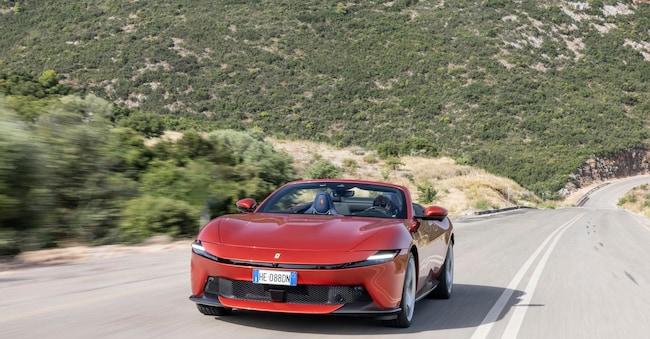
After testing the berlinetta version, we got behind the wheel of the Ferrari Amalfi Spider, the open-top variant of the Maranello grand tourer that aims to strike a balance between performance, comfort and driving pleasure. It is not an extreme car, designed solely to push the limits, but a sports car capable of engaging the driver whilst retaining a pleasant character even in everyday use. The first deliveries are scheduled for early 2027, with a list price starting at 270,000 euros.
Canvas hood and maximum soundproofing
The multi-layered fabric soft top helps to transform the driving experience: the system allows the roof to be opened and closed in 13.5 seconds, even whilst driving, at speeds of up to 60 km/h. This solution allows you to switch quickly from a more enclosed environment to open-air driving without compromising on comfort, thanks to the five-layer structure that ensures acoustic and thermal insulation. The wind deflector integrated into the rear section also reduces turbulence in the cabin.
The twin-turbo V8 delivers character and smooth acceleration
At the heart of the Ferrari Amalfi Spider lies the 3.855-litre twin-turbo V8 from the F154 family, capable of producing 640 cv and 760 Nm of torque. This engine offers a responsive throttle and progressive power delivery, allowing the car’s performance to be fully utilised without making it difficult to drive on a day-to-day basis.
The engine retains the distinctive sound characteristic of Ferraris thanks to an updated exhaust system, developed to comply with the latest regulations without compromising the auditory excitement that comes with sporty driving.
The eight-speed dual-clutch automatic gearbox complements the V8’s performance. In more relaxed driving conditions, it prioritises smoothness and comfort, whilst as the pace increases, it makes gear changes quicker and more engaging, adapting to a sportier driving style and enhancing the car’s responsiveness.

