
Ferrari Luce electric, everything we know while waiting for the debut
Over 1,000 horsepower, unprecedented styling and performance to match the coat of arms
Key points
The debut of the first electric Ferrari is approaching. While waiting to find out what the most divisive car in the Modenese company's history will be like, with the world reveal scheduled for 25 May, Luce has already unveiled a series of details starting with the 800 Volt architecture, four motors, two in pairs at the front and another two in the rear e-axle, for a total of a thousand horsepower powered by a 122 kWh battery that ensures, according to the company, 530 km of autonomy. Performance is that of a true Ferrari: 0 to 100 km/h in 2.5 seconds and 310 km/h top speed.
New Ferrari Electric Light
The Ferrari Luce was born in collaboration with LoveFrom, a creative collective founded in San Francisco by Jony Ive (Apple's historic designer) and Marc Newson, who was involved in the project from the earliest stages. Later, in the development phase, LoveFrom worked with the Centro Stile Ferrari led by Flavio Manzoni, ensuring that every solution was designed to respect the architectural constraints and homologation requirements of a mass-produced road sports car.
Ferrari Luce Interior 2027
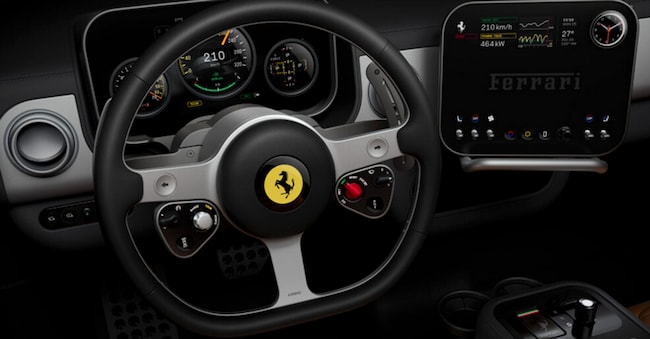
Less touch and more buttons, despite a few too many references to the Apple world. This could be summed up as the interior of the Ferrari Luce, where there has been no lack of criticism for the various similarities with details seen on past iPhones and iPads designed by Jony Ive himself. In detail, the display system revolves around the instrumentation christened Binnacle, mounted on the steering column and synchronised with the movements of the steering wheel. The solution, unprecedented for a production Ferrari, integrates two superimposed Oled screens developed with Samsung Display. The visual effect, enhanced by aluminium rings and glass lenses, creates a three-dimensional depth that recalls the aesthetics of historic analogue instruments. The central control panel, which can be swivelled towards the driver or passenger, houses the Multigraph, a mechanical-digital element with three independent hands and four operating modes, from the stopwatch to the Launch Control function. The 100 per cent recycled aluminium is machined from billet and anodised to achieve durable surfaces. Corning Fusion5 glass, used for the key, display and gear selector, offers scratch and impact resistance.
Ferrari Chassis Light
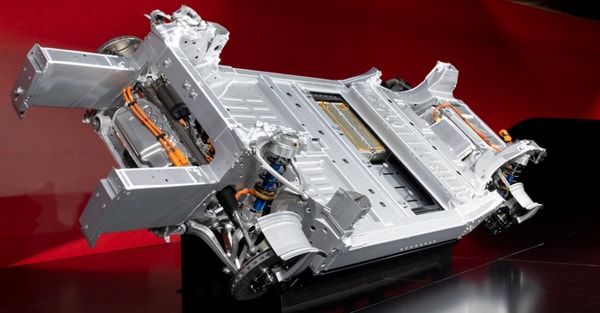
The chassis of the Ferrari Luce was designed from the ground up. The wheelbase is compact and the driving position forward, inspired by mid-engined berlinettas. The architecture, designed to accommodate the battery pack in the floorpan, uses lightweight alloys and shock-absorbing towers to manage the weight of the electric powertrain without penalising rigidity. A patented battery mounting system contributes to the overall solidity, while the new rear subframe, the largest cast element ever made in Maranello, isolates vibrations and reduces noise without sacrificing driving precision. Elastic bushings filter out rolling noise and surface roughness, while the active suspension inverters are integrated into the structure to limit mass and bulk. The result is a balance of comfort and responsiveness, with minimal weight gain compared to a thermal sedan.
Ferrari Light Power
The Ferrari Luce is powered by a system of four permanent magnet synchronous motors, two on each axle, the direct result of experience in Formula 1 and the XX Programme. The front and rear motors reach 30,000 and 25,500 rpm respectively, record values for a production car. Total power reaches 310 kW at the front and over 620 kW at the rear in Performance Launch mode, with a power density of almost 3.2 kW/kg. Halbach's magnet arrangement technology optimises the magnetic flux, improving torque and reducing rotor weight. The result is a faster delivery and 93% efficiency. Each motor is integrated with its own inverter and drive system, creating a compact and completely self-contained module. Dynamically, the front motors reach maximum speed in less than a second, with an angular acceleration of 45,000 rpm per second. Carbon-fibre rings, just 1.6 mm thick, hold the magnets in place even at maximum centrifugal stress, a solution derived from motorsport and now industrialised.

