
Ferrari Hypersail, the high-tech sailing yacht aiming to break the round-the-world record
An innovative vessel featuring advanced materials and autonomous energy systems, designed to glide across the water and complete a round-the-world voyage in less than 40 days

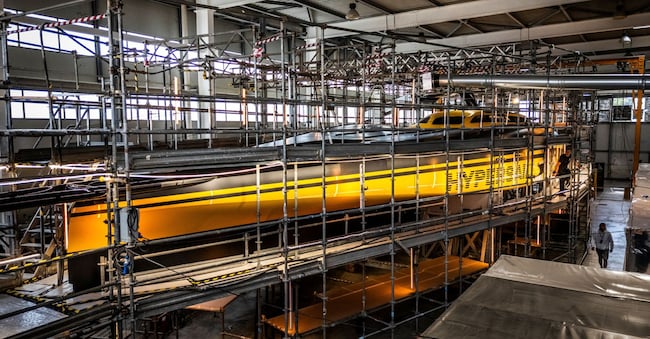
It’s hard to say what the new “boat” Ferrari Hypersail looks like. It’s black, or almost black, like many racing yachts, where carbon fibre dominates. It has some yellow on it, like so many Ferrari cars. It’s large enough to be one of those vessels that seem to fly over the water rather than sit in it. The team has finally unveiled it and taken photographs. It’s still inside the shipyard in Pisa where it was built, but the hull and deck are complete and sealed. And walking round it, you can imagine what it will be like to see it out at sea, with the crew enclosed behind the solid watertight doors whilst the water flows past. And then there’s the double-skin mainsail – meaning it’s made from two sails joined together rather than a single layer – which creates a wing-like profile.
In the world of sailing boats, nothing on this scale had ever been attempted before. The boat will be completed in the coming months and is expected to be launched at the end of March. To finish it, all the electrical and electronic systems for power generation and navigation control need to be installed, and above all the foils – the parts that will enable it to fly above the water. Compared to the America’s Cup boats, which stem from designer Guillaume Verdier’s ‘Hypersail’ concept, this design features an additional central fin with a ballast bulb, which helps the boat regain its correct position on the open sea. The system is fascinating in terms of its construction; the side wings are in fact built from a carbon and titanium sandwich, with an outer titanium layer (just over half a millimetre thick) designed to protect the fin from friction with the water at high speed. At full speed, it will be at a height of approximately 5 metres. The ultimate goal is the Jules Verne round-the-world record, to be completed in under 40 days – half the time the writer had already deemed impossible. First, there will be extensive testing in the Atlantic to ensure it is reliable and safe. One of the first tasks, following the launch scheduled for late March and the opening of the base in Livorno within the Azimut Benetti shipyards, will be towing trials without sails to test the structures and the response of the control systems. A modified motorboat will act as the tug, if one can call it that for a vessel that is expected to reach 40–45 knots (around 80 km/h). Considerable power is required.
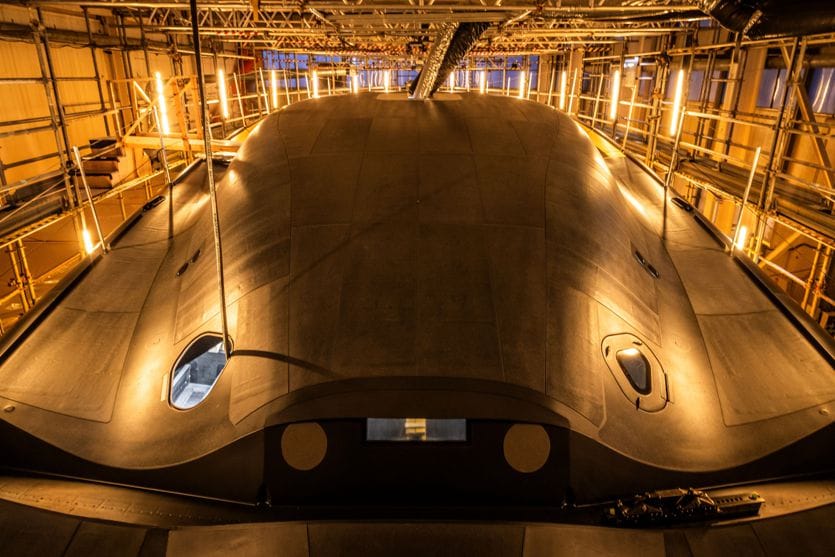
But the Ferrari Hypersail is not just a vessel designed to break records. Its dimensions and requirements are so different from those of other boats that even the design method is new. Even the mere fact that it was proudly unveiled – albeit to a select group of journalists – marks a departure from the closed-door approach typically adopted for regattas. It is fair to say that the design process will leave a lasting legacy for the nautical world and the boat-building industry. But let’s return to the aesthetics: there is a certain resemblance to road-going Ferraris, stemming from aerodynamic requirements. In short: it is also the wind that dictates the shape, and this represents a fascinating cross-pollination with the world of cars. But there is also a reverse influence: cars learn from boats, which serve as a testing ground. It is no coincidence that, at the outset of carbon fibre construction for Formula One cars, engineers specialising in boats were consulted, as this technology was already being used successfully in that field. In terms of the boat’s construction, the development work on the Hypersail has led to the registration of over 20 patents, including the Winch by-Wire, a system that generates energy using the crew’s strength – a ‘coffee grinder’ coupled to a generator rather than directly to the sheets. This system provided inspiration for the manual gearbox in new road cars, which gives the driver the feel of the old gear lever, complete with the characteristic ‘grating’ sound.
One of the boat’s key requirements is energy self-sufficiency. Out in the middle of the ocean, there are no mains-powered chargers…
The study of energy requirements is in-depth, involving calculations of consumption and solar insolation for the solar panels, as well as the output of the wind generators. The crew aspect of the boat is managed by Enrico Voltolini, who recently brought Giulia Conti – a former Women’s America’s Cup winner and renowned sailor – on board. Others will be joining them. Marco Ribigini is the Technical Team Leader and Matteo Lanzavecchia the Chief Technology Officer. Men who have made the leap from the motor racing world to sailing, so to speak. But Flavio Manzoni, Ferrari’s Chief Design Officer, has been personally involved in this project, contributing design insights: “What has guided us is the Ferrari approach to design, which is unique in the sense that the union of form and function is of fundamental importance. Aerodynamics is a perfect example of the similarity between boats and cars because, ultimately, we are talking about a dynamic sculpture, which is precisely the principle from which we start when designing. There is no Ferrari car design that does not begin with an analysis of aerodynamics, which becomes the very source of inspiration.”


