
Ferrari: simply ordering drivers not to overtake isn’t enough: Leclerc makes a mistake and Vasseur must explain
Hamilton spun, two Ferraris failed to make it through to Q3, and second place in the constructors’ championship is still up for grabs. The instructions issued by the pit wall did not prevent the collision, whilst Elkann must also address the responsibilities of the team principal

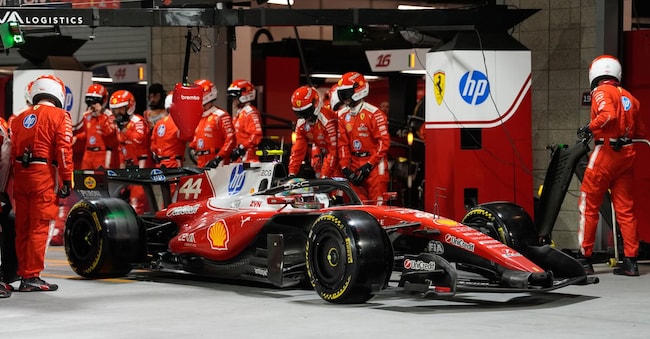
Ferrari leaves Las Vegas in second place in the Constructors’ Championship, with 517 points compared to Red Bull’s 440: a 77-point gap, with 86 points still up for grabs at the Qatar and Abu Dhabi Grands Prix. The reigning champions Mercedes, however, are 149 points adrift, and the story of the weekend tells a different tale from their position in the standings: no Ferrari cars made it through to Q3, two ten-second penalties and just seven points scored in the race. Hamilton, who finished seventh, has moved up to third place in the drivers’ standings – thanks to others’ misfortunes – with 267 points, compared to 264 for Russell and Norris.
On lap 38, Leclerc attempted to take the inside line at Turn 7 but started his move too far out and collided with Hamilton, causing him to spin. The stewards noted that, at the apex of the corner, the front axle of car number 16 did not even reach the wing mirror of car number 44: Charles had not, according to the regulations, secured the necessary space to claim that line, so he was found fully at fault and given a ten-second penalty, which saw him drop from sixth place at the finish line to tenth in the official results, losing seven points from his tally. Leclerc admitted he felt embarrassed towards the team, whilst Hamilton was also handed a ten-second penalty, but for a different infringement, having retained an advantage after going off the track during his duel with Norris (though he is no novice: there were nearly 90 such incidents recorded throughout the weekend). Lewis nevertheless expressed relief at having a better race pace than in qualifying, and Sainz’s final overtake on Russell allowed him to retain three points, rather than one, in the battle for fourth place in the world championship.
The issue that Vasseur needs to clarify is not just about a misjudged braking manoeuvre: the team principal claims to have instructed Leclerc not to overtake Hamilton, partly because on the Strip – with slipstream and energy management to consider – two cars getting in each other’s way are more likely to end up within reach of their rivals; after the collision, he described the manoeuvre as ‘completely unacceptable’ and summoned Charles to explain himself. However, to determine whether this was an order that was ignored or a communication that arrived too late, one needs to know the full radio transcript; in any case, it remains unusual to see Ferrari lay bare its internal disagreements so openly: the atmosphere is far too tense, and few are willing to take full responsibility. Back at Monza, Hamilton had already asked for more precise rules of engagement – preferably in writing – whilst Vasseur believed the existing ones were clear; following the disputes in Mexico and Brazil, finding two Ferraris colliding over sixth place makes it difficult to brush the whole thing aside with a mere telling-off.
This is where the matter also comes to John Elkann – not because he needs to intervene personally on the encrypted UHF radio, but because, at the end of September, he reaffirmed his confidence in Vasseur and must therefore assess how that confidence is being repaid. In the Exor letter published in March 2026, referring to the 2025 results, he had alluded to Enzo Ferrari’s ‘museum of mistakes’ , where broken parts were kept so that their causes could be studied, drawing a comparison between a winning endurance car and a Formula 1 car falling short of its ambitions. Unfortunately, by 2026, even amongst hypercars, the Prancing Horse no longer reigns supreme. That line of reasoning can now be applied to the management of the drivers, starting with a concrete question: why did the team order issued from the pit wall fail to have the desired effect, and how can we explain that, despite further clarifications, tensions have resurfaced on the track?
On the other hand, the crash is merely the most striking part of a weekend that got off to a bad start in qualifying, with Leclerc eleventh and Hamilton twelfth, both eliminated in Q2. Charles estimated a loss of one second on the long straight of the Strip, a figure which, on its own, is not enough to condemn the power of the Ferrari engine: before reaching the braking point, what counts is the speed out of the previous corner, aerodynamic drag and, above all, how much electrical energy remains to be used and for how long. Hamilton complained of a damaged underbody, which he blamed for losing three to four tenths, and insufficient power delivery on his final attempt, which he reckoned cost him another six tenths. Leclerc, too, squandered his last chance. The car had its limitations, but its drivers failed to make the most of what was possible.


