
Ferrari unveils Hypersail, 33-metre carbon monohull with solar panels
Maranello engineers worked with naval designers on the sailboat that will challenge the ocean

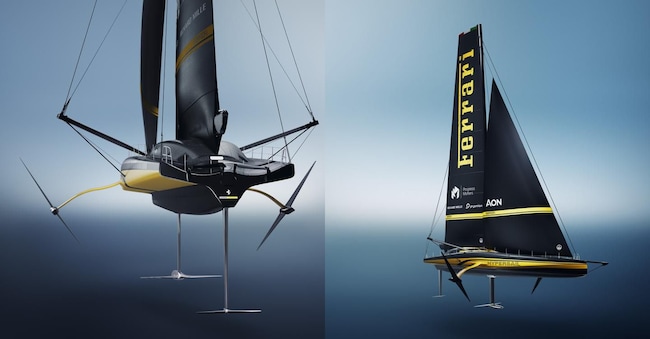
The similarities between the Formula One circuit and the America's Cup, the ultimate expression of sailing competition, have often been evoked, first and foremost for the almost alchemic mix of technology and the human factor, between innovation and the unpredictability of race conditions, ranging from the weather to driver or skipper error. The oldest sporting trophy in the world has been defined as the Formula One of the sea, but since yesterday the scenario has changed, at least a little: Ferrari presented the Hypersail project in Milan, on the day on which the world's largest furniture-design fair opened in Rho (see the article opposite) and the city came alive with the many events of the Fuorisalone. The America's Cup (for the moment) has nothing to do with it, but the 100-foot (about 33 metres) "flying" oceanic monohull unveiled in the Ferrari flagship store a stone's throw from the Duomo makes thoughts and emotions race to the boats ready for the next America's Cup, in terms of futuristic (almost science fiction) silhouettes and equally technologically advanced materials.
Osmosi between high-tech fields
"For the Ferrari Design Studio Hypersail was an unexpected opportunity and a challenging objective, due to its complexity, which allowed us to extend our creative research to a different context from the usual one," explained Flavio Manzoni, Ferrari's chief design officer. "We are actually not new to operations of this kind: in the past, the experience gained in projects for racing cars, to cite a sector with a very high technological content, favoured the exploration of a more complex sphere, in which to measure ourselves and broaden our skills. Manzoni worked in symbiosis with naval designer Guillaume Verdier and the Ferrari engineering team to translate aerodynamic, hydrodynamic and structural constraints into aesthetic opportunities (the presentation during Design Week is no coincidence). The tapered silhouette evokes the proportions of the Ferrari Monza SP1/SP2, while the exterior of the coachroof (the raised part of the deck) recalls the architecture of the Le Mans-winning Hypercar 499P. Integrated into the deck and the coachroofs are several solar panels, the position of which was determined by an advanced study of the sun exposure that the hull will have while sailing. "Matteo Lanzavecchia, Ferrari's head of vehicle engineering and chief technology officer of Hypersail, emphasises: "Hypersail is a unique boat in terms of size and technology, developed to guarantee maximum performance in such an unpredictable environment as the ocean. The 'flight' over the water is made possible by a sophisticated control system, the result of the know-how developed on our cars, powered by energy recovered from renewable sources such as wind, sun and movement.
Structure and colour
Hypersail's main material is carbon and the livery deserves a special mention: alongside the special 'Hypersail grey', yellow, Ferrari's second soul, has been used. In developing the yacht, the Ferrari Design Studio wanted to create a link between the Hypersail's future-oriented silhouette and the history of the brand's aesthetics: the new Fly yellow carries with it a valuable narrative heritage. In fact, it was the brainchild of Fiamma Breschi, widow of pilot Luigi Musso - famous for his distinctive yellow helmet - and friend of Enzo Ferrari.
A chance for everyone
On the occasion of Design Week, until Sunday 26 April, the Hypersail project is narrated in an exhibition itinerary inside the Ferrari flagship store and with the Hypersail lighthouse-installation on the main terrace of Highline Milano, overlooking Piazza del Duomo.


