Icons

Fiat Panda, the benchmark in small cars for more than 40 years

Small on the outside and big on the inside, essential but very functional and with a nice line: the characteristics of the first series that became an icon also permeate the current one, which consolidates a consistently successful career

by Massimo Mambretti

5' min read

5' min read

Original, practical, small but with a spacious interior littered with original solutions, the only or second family car and economical. These were the characteristics of the small car that Fiat identified internally in the mid Seventies as the 141, to be immediately what became the Panda. Characteristics that would inspire all its descendants.

Although higher, the number is destined first to stand between the 126 of the smaller Fiat and the 127 of the compact car of the time, and later to replace them. The citycar had the task of blocking the way for the spartan Citroën Dyane and Renault 4. This is why the 141 was initially to be called the Rustica, a name later given in 1979 to a cross-country-style version of the 127 produced in Brazil.

Loading...

Consult our price list

Fiat Panda, the name conveys its mission

.

The name Panda was an ingenious intuition but, undoubtedly, also misunderstood because even today many people think it refers to the friendly big bear. In 1980, this was also thought by the WWF, which, being an environmental protection organisation, considered the combination of the large mammal that also features in its logo and a car inappropriate. A diplomatic incident with Fiat ensued, which, however, was quickly closed thanks to a substantial donation from the Turin-based company. In fact, Fiat chose Panda inspired by the Roman goddess Empanda, protector of roads and travellers, who is also often said to be called Panda tout court. A name that today we can say is very apt and rational, because in almost forty-five years of life the more than three million Panda's produced have travelled many roads and with many people on board.

Fiat Panda, le foto della storia della mitica citycar

Photogallery20 foto

Fiat Panda, in 1980 innovates the concept of the hatchback

Considered, along with the 500, the Italian small car par excellence, the Panda was designed in record time by Giorgetto Giugiaro to whom Fiat submitted a specification that had to agree on many factors. The Panda had to be small on the outside, large and multifunctional inside, light and inexpensive. Giugiaro conceived a front-wheel-drive hatchback saloon with two doors and a hatchback, 3.38 metres long with a squared-off, sympathetic line in which functional solutions such as drip pans were integrated into the design to avoid costly additional work. The interior is ingeniously innovative at a stroke. In fact, it can be configured in many ways thanks to the upholstery inspired by the canvas suspension of deckchairs. So, for example, it can form a large storage compartment at the rear or a hammock for babies by moving the support tubes into special slots, but also a makeshift bed by sliding the front seats forward and lowering their backrests together with the rear one. Canvas 'technology' also inspires the pouch that replaces the dashboard by moving instrumentation, switches and air vents to a panel behind the steering wheel.
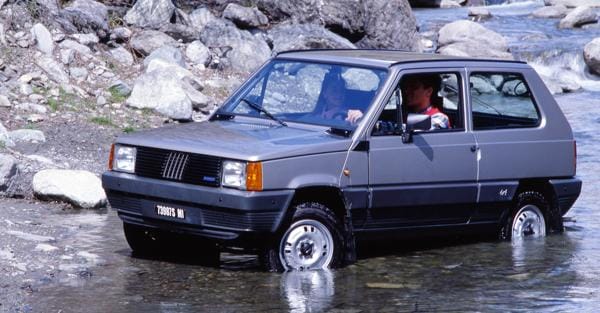
The mother of all Panda's debuted at the 1980 Geneva motor show in the 30 version with the air-cooled twin-cylinder engine with 30 bhp from the 126 reserved for Italy, and the 45, which mounted the water-cooled four-cylinder engine with 45 bhp from the 903 cc 127. Aesthetically, the two versions differ only in the asymmetrical position of the small grille on the front: on the 30 it is on the right side to direct air to the twin-cylinder's fan, while on the 45 it is on the left to channel it towards the water radiator.

Produced until 2003, the first Panda evolved continuously. In particular, with the iconic and unstoppable 4x4 made from Steyr Puch equipped with insertable four-wheel drive, the variants with double canvas sunroofs, the substantial 1986 restyling with which it was officially christened the Panda Supernova (although no one ever called it that) with which it adopted four-cylinder Fire engines and upholstered seats, as well as the Omega rear axle instead of the rigid rear axle on the front-wheel drive versions to improve comfort. Previously, not great. With this update also comes van versions and special series.

In twenty-three years, the first Panda also offered many new fittings, was the first among the small cars to be fitted with a diesel engine, and with the Selecta version offered an automatic, continuously variable gearbox. Furthermore, between 1990 and 1998 it was ahead of its time with the Elettra and Elettra 2, clearly two electric versions.

Fiat Panda, in 2003 changes format but not eclectic personality

The second series of Fiat's versatile citycar is fortunately still called Panda. In fact, it had risked being called Gingo as it was presented at the 2003 Geneva show to underline the fact that it was a car from a new project. Instead, it has continued to be called Panda, thanks to the controversy raised by Renault over the similarity between the names Gingo and Twingo, which prompted Fiat to use the well-known name.

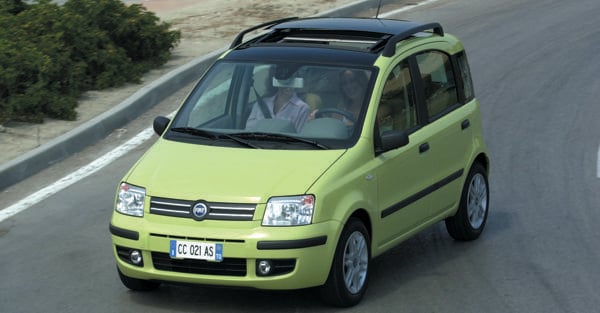
The second series of the Panda is related to the first only by the taut features of the body, which, however, is five-door and 3.54 metres long. The Panda 2.0, which looks like a scaled-down MPV promising with its appearance (the result of a collaboration between the Fiat Style Centre and Bertone) a good dose of functionality is based on a platform that will also be taken up by the 2008 500, has a conventionally furnished interior with a classic dashboard supported by a central console that is even raised to put the gear lever within easy reach. It also offers the most advanced electronic safety systems of the period. The engine range consists of the four-cylinder 1-litre and 1.2-litre petrol and the 1.3-litre turbodiesel. In 2004, it was voted Car of the Year and expanded the range with the long-awaited 4x4 version with an electronically controlled permanent traction system, from which the Climbing and Cross with an outdoor-style outfit would also be derived. In 2006 came the peppery 100 hp version and the LPG and CNG bifuel versions. After undergoing a single very slight restyling in 2009, it was retired in 2012.

Fiat Panda, in 2012 evolves in style, then becomes hybrid and also Pandina

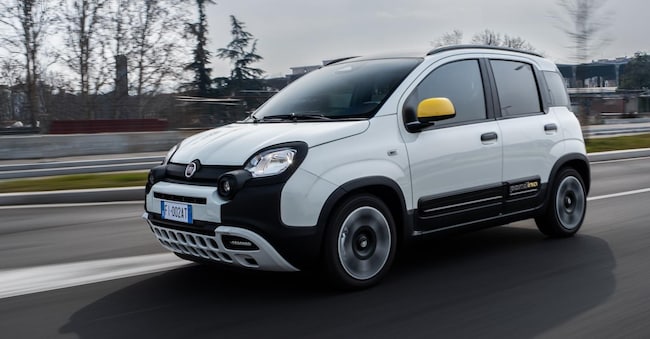
Replacing it is the Panda 3 designed by the Fiat Style Centre, which reaches 3.65 metres in length as the bodywork is stylistically a rounded evolution of its predecessor, also inspired by the need to increase crash safety parameters. This series brings the production of the citycar back to Italy in Pomigliano d'Arco (the progenitor was born in Tichy in Poland) where it is and will still be produced for a few years in the update in which it is marketed at this time, which brings it into line with the new regulations on safety devices. What's more, it also comes in the fancy Pandina variant. In other words, the nickname by which the Panda has always been called by everyone.

This generation, which is based on an evolution of the previous Panda's architecture, in particular to meet the upgraded safety requirements, has an interior that takes some cues from the 500 but, among other things, incorporates a shelf in the dashboard inspired by that of the 1980 Panda. From 2020 it offers infotainment with a 7-inch display supporting Apple Car Play and Android Auto, which is joined in the recent Pandina by a 7-inch digital cluster. Like those of its progenitors, the Panda family has offered many fittings, many special versions, as well as the must-have 4x4 and Cross versions and vans.

On debut, the 1.2-litre petrol, 1.3-litre turbodiesel and LPG and CNG bifuel engines, evolutions of those of the previous series, will be joined by the 900 cc TwinAir petrol twin-cylinder, offered in aspirated and turbocharged versions, later also offered in a CNG-fuelled variant. In 2020 comes the Hybrid version with 12 V technology, powered by a one-litre three-cylinder engine.

Copyright reserved ©
Loading...

Brand connect

Loading...

Newsletter

Notizie e approfondimenti sugli avvenimenti politici, economici e finanziari.

Iscriviti