
Fibra, Fibercop and Nokia are testing infrastructure that acts as a sensor
Memorandum of Understanding signed to trial fibre sensing: optical fibre not only transmits data, but can also detect landslides, faults, vibrations, floods and anomalies in real time

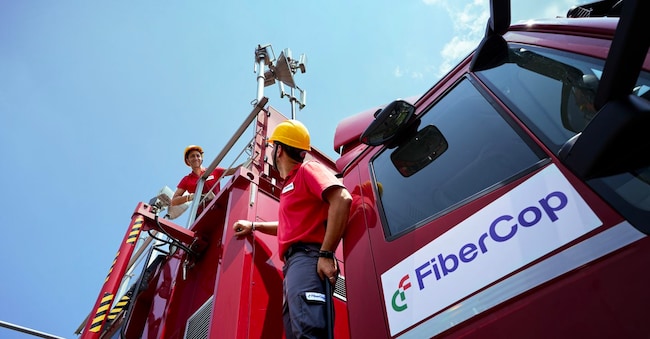
Fibre optics are no longer just a ‘data motorway’, but a vast network of sensors stretching beneath cities, roads and regions. This is the new frontier opened up by the agreement between Fibercop and Nokia, who have signed a Memorandum of Understanding to trial technologies capable of transforming the fibre access network into a smart monitoring platform.
The idea is simple, at least in its ambition: to use the infrastructure that is already in place not only to transmit information, but also to understand what is happening around the network. Landslides, fallen trees, roadworks, vandalism, vibrations, temperature fluctuations, seismic activity, flooding, leaks or traffic: fibre sensing aims to detect and locate physical events by analysing the light signal travelling through the fibre. Artificial intelligence is then used to interpret these signals, identifying anomalies, mechanical stress or environmental changes.
For Fibercop, the network operator controlled by a consortium led by KKR, which holds a 37.8 per cent stake and in which the Ministry of Economy and Finance (MEF) also holds a 16 per cent stake, the focus is industrial rather than technological: increasing the reliability of the infrastructure, reducing the need for on-site interventions, anticipating faults and launching new monitoring services. “This collaboration represents an important step in the evolution of fibre infrastructure, which can become increasingly intelligent and capable of providing new information useful for its management,” said Stefano Paggi, Chief Technology & Operations Officer at Fibercop. “The aim is to explore solutions that help strengthen the network’s reliability and open up new application possibilities to support the economy.”
The trial will focus on two areas: on the one hand, advanced monitoring and predictive maintenance, to detect performance degradation and potential disruptions before they lead to service disruptions; on the other hand, the detection of external events and environmental conditions along the infrastructure.
The tests will be carried out in controlled environments, in Fibercop’s laboratories and on isolated sections of fibre, to assess accuracy, performance and potential use cases. For Nokia, the project forms part of the evolution of networks towards systems capable not only of carrying data, but also of interpreting it. “AI is radically changing what networks are expected to do. Networks are no longer limited to simply carrying data; they also help operators understand what is happening in real time,” said John Harrington, Executive Vice President and Head of Europe at Nokia. “By combining the innovation of Nokia Bell Labs with our AI-enabled fibre sensing, we can help Fibercop transform its fibre network into an intelligent monitoring platform that delivers reliable infrastructure capable of sensing, understanding and acting in real time. By working together, we can support faster detection of network issues, enable new ‘monitoring as a service’ applications and create a more resilient network.”


