2026 World Cup

FIFA is distributing $1.2 billion amongst national teams and the club sector

Record figures for prize money for national teams (871 million) and the Club Benefits Programme for the clubs to which the players belong (355 million)
by Marco Bellinazzo

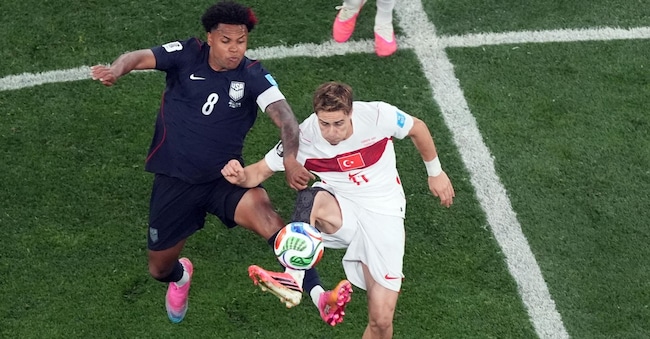
 L'americano Weston McKennie (a sinistra) lotta per il pallone contro il turco Kenan Yildiz durante il secondo tempo della partita della fase a gironi della Coppa del Mondo FIFA 2026 a Los Angeles, Stati Uniti.  EPA/SCOTT STRAZZANTE

3' min read

Translated by AI
Versione italiana

3' min read

Translated by AI
Versione italiana

The 48-team World Cup does not merely change the sporting format; it fundamentally reshapes the economic structure of global football. The 2026 World Cup, to be hosted by the United States, Canada and Mexico, marks an unprecedented leap in scale: FIFA will distribute a total of around $871 million to the national associations, almost double the $440 million allocated for Qatar 2022.

This confirms a trend that has now become structural: the World Cup remains the main platform for generating and redistributing revenue in international football. But the most interesting figure concerns how this wealth is allocated.

Loading...

The rewards pyramid

The structure of the 2026 prize fund combines two approaches: one based on ‘solidarity’ and one closely linked to on-pitch results.

Each qualifying national team receives at least 12.5 million dollars in guaranteed prize money, divided as follows: 10 million as a qualification bonus and 2.5 million as a preparation grant.

In addition to these are performance-related prize funds, distributed on a non-cumulative basis: group stage (33rd–48th): 9 million; round of 32 (new): 11 million; round of 16: 15 million; quarter-finals: 19 million; 4th place: 27 million; 3rd place: 29 million; 2nd place: 33 million; Winner: 50 million.

The most significant figure, in symbolic terms, is the final one: the 50 million awarded to the champions represents the highest payout ever, an increase of 8 million compared with the 42 received by Argentina in 2022.

A World Cup worth almost a billion (and more)

If we look beyond the prize money awarded directly to the federations, another key figure emerges: the 2026 World Cup will see total redistribution exceed one billion dollars.

Alongside the 871 million earmarked for national teams, FIFA has in fact established a further financial pillar: the Club Benefits Programme, which provides a further 355 million dollars for clubs.

It is the formal recognition of an economic reality: human capital – the players – is developed and remunerated by the clubs, whilst the sporting and commercial value of the World Cup is derived from the national teams.

The ‘Global Dividend’ for clubs

The compensation mechanism for clubs is therefore one of the most significant elements of FIFA’s new structure. For the 2023–2026 cycle, a total fund of 355 million dollars is earmarked (up 70 per cent on the 209 million dollars allocated in 2022). In fact, $250 million is earmarked for the tournament’s final phase, whilst $100 million has already been distributed for the qualifying rounds.

The real innovation lies precisely in the extension to the qualifying matches: for the first time, FIFA is remunerating the club ecosystem throughout the entire World Cup cycle, not just during the final phase.

In practical terms, payment is made on a daily basis per player selected and throughout the entire tournament period (from approximately 10 days before the tournament until the team is eliminated).

Estimates suggest: at least $5,000 per day per player, with peaks estimated at around $10,000–11,000 per day. In total terms, this works out at around $160,000–250,000 for a player eliminated in the group stages and up to $500,000–700,000 for those who reach the final.

For Europe’s top clubs, with 10–15 players called up, this represents revenue running into millions. For small and medium-sized clubs, however, it can be a significant item in the balance sheet, capable of funding sporting and infrastructure activities.

The integrated supply chain

A comparison with the past therefore reveals a clear transformation: in 2022, FIFA distributed 209 million to clubs, with an average payment of around 10,950 dollars per player per day.

Today, the system is broader and more inclusive: more teams (48), more matches (104), more clubs involved and more levels of remuneration

In short, it is the shift from a ‘vertical’ redistribution – with federations at the centre – to a more horizontal approach that involves the entire football value chain. In a system increasingly characterised by tension between national team football and club football, FIFA is thus attempting to redistribute support and wealth.

The result is an ecosystem in which the World Cup is no longer merely the most prestigious tournament on the planet, but increasingly a global economic platform that generates revenue, redistributes it and – above all – uses it as a lever for governance.

Copyright reserved ©
Loading...

Brand connect

Loading...

Newsletter

Notizie e approfondimenti sugli avvenimenti politici, economici e finanziari.

Iscriviti

Tutto mercato WEB