Football and business

FIFA: the new commercial company proposed by Infantino sparks protests across Europe

FIFA is proposing the formation of a company to attract external investors and raise funds for the global development of football, but UEFA and Europe are firmly opposed to the idea

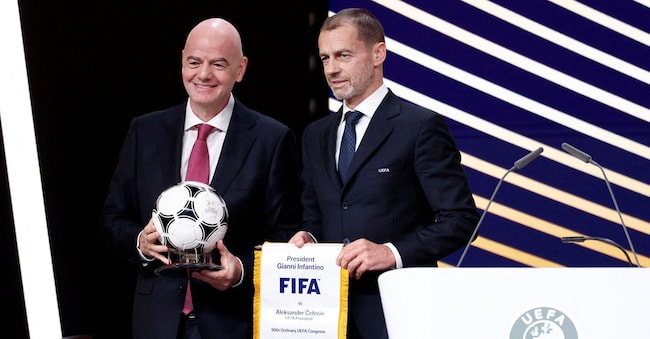
Il presidente della FIFA Gianni Infantino  REUTERS

4' min read

Translated by AI
Versione italiana

4' min read

Translated by AI
Versione italiana

The ‘commercial’ management of FIFA under Gianni Infantino adds a new chapter to its history and is sparking an ever-growing wave of opposition within the world of football and amongst fans, particularly in Europe.

The latest move by the International Football Federation, fresh from the 48-team World Cup, the biggest ever, has publicly announced its intention to set up a new commercial company to manage its major events, in which external investors will be able to acquire a minority stake.

Loading...

The new company, named FIFA Forward Enterprise (FFE), will be responsible for consolidating the International Federation’s commercial and organisational activities, including the World Cup and the Club World Cup, whilst FIFA will remain the global governing body of football and retain a majority stake in FFE.

The proposal will soon be put before the 211 member associations and the 37-member FIFA Council, who will be the only ones to make the final decision, a FIFA spokesperson said.

The International Federation maintains that this initiative forms part of a plan aimed at tripling the funds allocated to the development of its member associations, providing access to up to 20 million dollars of capital to be invested in infrastructure improvements, coach education, national teams, competitions, grassroots football and women’s football.

Gianni Infantino, who is standing for re-election as president of world football’s governing body, has given assurances that every national association will have access to a fair share of the available funding, with the aim of «democratise football worldwide".

Specifically, the proposal drawn up by Infantino would allow FIFA to invite external investors to acquire minority, non-controlling stakes in the FFE, whilst retaining control and exclusive authority over the governance of football, competitions, the fixture list and all regulatory and sporting decisions. “External investors will only hold a minority stake in the FFE and will play no operational role,” said a FIFA spokesperson. “Similarly, they are investing in a company controlled by FIFA, not in FIFA itself. For FIFA, nothing changes.”

According to various sources, the International Football Federation is reportedly working with bankers at JPMorgan to attract these sought-after external investors with a view to raising up to 4.2 billion dollars. The investor group is reportedly led by Joshua Kushner, brother of the ever-present Jared Kushner, son-in-law of US President Donald Trump, who has long had a rock-solid alliance with Infantino.

UEFA's criticism

The proposal has drawn fierce criticism from UEFA, the body representing European football associations: ‘The spirit and governance of football are not commodities to be traded, especially in the absence of transparency regarding who stands to profit financially from them. None of us owns football. It is not up to FIFA to sell it,’ stated a spokesperson for the organisation. Relations between UEFA and FIFA have deteriorated in recent years, and UEFA President Aleksander Ceferin even refused to attend the World Cup final following a series of disagreements over disciplinary procedures, refereeing logistics and match management.

Even the new British Prime Minister Andy Burnham wrote on X that ‘the World Cup is not a product. It is the world’s biggest sporting competition and has never been owned by anyone. You can present the deal however you like. Once you’ve sold a part of it, you’ve sold the whole thing.”

Loading...

According to reports by the BBC and ESPN, UEFA is considering the possibility of convening an emergency meeting this week with its 55 member associations to discuss FIFA’s proposal.

The standoff with Europe

There is no doubt that FIFA’s push to open up to the world of private equity represents an attempt to reshape the commercial landscape of global football, whilst at the same time opening up a new front in the long-running battle with Europe for power and control over the enormous wealth generated by the sport.

FIFA already generates billions of dollars in revenue from television rights, sponsorship and other commercial agreements, and is expected to exceed its target of 13 billion dollars for the four-year cycle that concluded with the recent World Cup and which included last year’s Club World Cup.

Yet these figures pale in comparison with the wealth generated by European football. UEFA reported in February that its elite club competitions generated €4.4 billion ($5 billion) in the 2024/25 season alone.

Football competitions across the continent generated over 40 billion euros during the same period, with the ‘Big Five’ (the Premier League, the Bundesliga, LaLiga, Serie A and Ligue 1) accounting for just over half of that figure, according to Deloitte’s annual analysis of football finances.

FIFA has long been striving to shift the financial centre of gravity of football away from Europe – which once dominated the composition of the governing body and held control over its flagship event, the World Cup – towards Asia, Africa and the Americas.

Last week, Infantino stated that a 64-team World Cup is an idea under discussion, after CONMEBOL, the governing body of South American football, pushed for an expansion ahead of the centenary tournament in 2030.

In the past, the president of the International Federation had already attempted to commercialise FIFA’s assets by attracting external investment. A proposal for an expanded Club World Cup, put forward by a consortium led by SoftBank in 2018, never got off the ground precisely because of strong opposition from UEFA.

But it is certain that Infantino will rely on the support of the majority of the 211 federations affiliated to FIFA, rather than on Europe, to push ahead with his private equity programme. And, for the time being, none of the major continental football blocs has joined UEFA in voicing its opposition.

Copyright reserved ©
Loading...

Brand connect

Loading...

Newsletter

Notizie e approfondimenti sugli avvenimenti politici, economici e finanziari.

Iscriviti

Tutto mercato WEB