The anniversary

Fifteen years ago the L'Aquila earthquake. Where does the reconstruction stand? Superbonus capped at 70 million

On 6 April 2009, an earthquake devastated the Abruzzo region, killing 309 people and causing 10 billion in damage. Fifteen years later, private reconstruction is well underway, public reconstruction is going more slowly

by Flavia Landolfi

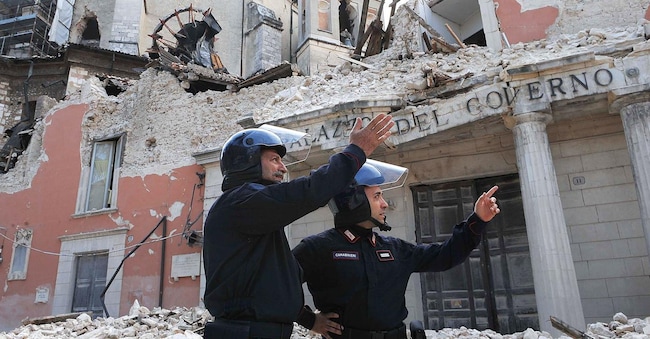
9 aprile 2009  - L' Aquila- Terremoto: Protezione civile, il punto sugli interventi- Due carabinieri davanti al palazzo della prefettura dell'Aquila distrutto dal terremoto . (ANSA / Carlo Ferraro /JI)

5' min read

5' min read

On 6 April 2009, fifteen years ago, the hands in L'Aquila stopped at 3.32 a.m., when a 6.3 magnitude tremor gutted the earth, engulfing houses, buildings and churches and causing the death of 309 people, more than 1,600 injured and more than EUR 10 billion in damage. Much water has passed under the bridge since then, but the memory of that wound is etched like an indelible mark on the life of Abruzzo's capital city.

In L'Aquila, the watchword today more than ever is reconstruction. Not only material but also social: giving life back to a territory, making it breathe and expand again. "The full reconstruction of the city and the villages is a duty and a commitment to be continued. For every social component, first and foremost for the institutions," said President of the Republic Sergio Mattarella on the anniversary. And Prime Minister Giorgia Meloni stressed that "L'Aquila is a model, for the response that the State has given right from the management of the emergency, through the reconstruction to the regeneration of recent years, the first effects of which are now being seen".

Loading...

"Today we can say that our rebirth is like a novel - of ideas, of projects, of achievements - that has been able to translate the scratches of the soul into works of art, the collective feeling into a beautiful urban rhythm, the city into a place of permanent culture," said Mayor Pieluigi Biondi. The 309 victims are our perpetual memorandum, they are the keystone of our destinies, they are the inspirers of the successes that L'Aquila has achieved in recent years, not least the designation as Italian Capital of Culture 2026. An achievement of great prospective value, thinking of our young people, so that they never have to know nihilism or resignation'.

The Reconstruction

According to the Struttura di missione s2009 earthquake led by Mario Fiorentino operating within Minister Musumeci's Civil Protection Department, almost 10 billion euro have been allocated for private reconstruction between 2009 and 2023, of which 8.6 billion have already been transferred for a total of 87% of the works completed. The public reconstruction machine is slower and in difficulty: out of 3.4 billion in the same period, 72% has been used, equal to 2.4 billion and 1730 interventions. According to the Municipality of L'Aquila, as of February 2024, 98% of the dossiers submitted for private reconstruction had been instructed, while for public reconstruction (figure updated to 31 August 2023), 65% of the public works had been financed..

And so while private reconstruction is well ahead, public reconstruction is slowing down. Bureaucracy is to blame, says the mission structure. Blame the chronic inability of public bodies to spend the available resources. An atavistic evil that does not spare the earthquake-stricken areas. ''The dynamic reconstruction model experimented following the tragic event that struck L'Aquila in 2009,'' Fiorentino explains, ''aims not only to restore and rebuild the places hit by the earthquake, but also to act as a garrison for the recovery and socioeconomic and cultural development of the regional capital and territories. Fiorentino added that the 'need is all the more pressing because the city of L'Aquila is the regional capital and its villages and territories constitute historical and cultural centres of the highest importance on the national scene'.

The resources
From 2009 to date 13 billion have gone to reconstruction, but that is not all. Another 417 million went to the development plan for the earthquake-affected areas. It is called Restart and counts from 2016 to 2023 already two editions, the last, the second, to be activated with 110 million. The first could count on 580 million euro and was based on six pillars: entrepreneurship, tourism, environment, research and technological innovation, culture and higher education.

With a financial endowment of 317 million euro, it has already committed 88.2 per cent of the allocated resources and allocated 93.2 per cent of them, explains the Mission Structure. Lastly, the NPC, which on a mandate from the Draghi government has poured almost 1.8 billion euro into the 2009 and 2016 seismic crater areas, "involving," explains the structure, "the productive fabric and economic and social activities with a view to an integrated re-launch between reconstruction and development for the areas hit by seismic events, putting in place actions to counter the phenomenon of depopulation of these areas.

Capital of Culture
The city now looks ahead. On 14 March, it was proclaimed Italy's Capital of Culture for 2026, beating out nine other finalist cities: Agnone, Alba, Gaeta, Latina, Lucera, Maratea, Rimini, Treviso, and Unione dei Comuni Valdichiana Senese. Investment in culture in L'Aquila from 2017 to date has amounted to some EUR 25 million. Around EUR 8 million will be committed to the Capital Project in 2026, one of which will be made available by the ministry.

"For L'Aquila, culture has represented the driving force behind social and physical reconstruction," explain the municipality. "It was the winning intuition of the last administration, born from a very precise vision based on the revival of the city through the creative reinterpretation of memory, the exaltation of identity and religious values as forms of civil progress and tourist attraction, the redefinition of the concept of a plural and inclusive community, the opening up to knowledge and research, and the possibility of using and experiencing time differently.

Geologists
But going back to the earthquake, the wounds have not healed and experts keep a beacon burning to ensure that the past does not repeat itself. "100% of the municipalities in Abruzzo are at seismic risk," says Nicola Labbrozzi, president of the Abruzzo geologists' association. "To date, the First Level seismic microzonation studies, which have identified zones of homogeneous seismic behaviour, have covered the entire territory of Abruzzo. For Level II and III seismic microzonation, therefore with more detailed characteristics at a local level, studies have been concluded for 9% of Abruzzo municipalities and started for 30%'.

The superbonus
The novelty is contained in the latest in a long series of decrees that are progressively more and more restrictive: measure 39/2024 published in the Official Gazette on 29 March, in closing the superbonus spigots, has maintained the facility for the 2009 earthquake, though setting a ceiling of 70 million euro. It will be up to Parliament to press the MEF to try to save the other earthquake areas cut off: Ischia, Emilia Romagna, Molise and Sicily. The big ones excluded from the mother of all building bonuses.

Copyright reserved ©
Loading...

Brand connect

Loading...

Newsletter

Notizie e approfondimenti sugli avvenimenti politici, economici e finanziari.

Iscriviti