
Fifty-six entries for the model manager

3' min read
3' min read
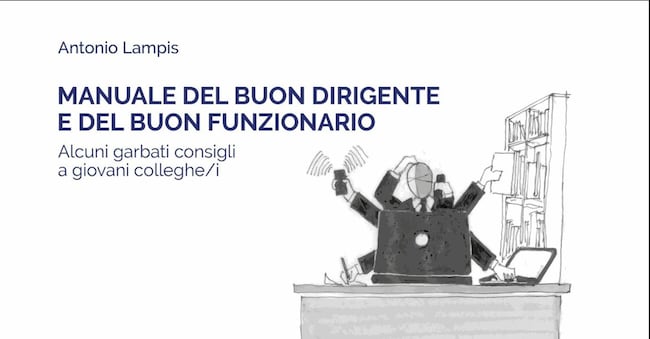
'Only speak in public about things that you have really contributed to developing and that really come out of your head': this is the second of the pieces of advice found in the book Manual of the good manager and the good civil servant by Antonio Lampis, under the heading Authenticity. And it well represents the philosophy of this publication and of its author, whose long experience in public administration led him from the Autonomous Province of Bolzano to the position of Director General of Museums for the Ministry of Culture (2017-2020) and then again to the direction of the Department of Italian Culture in the South Tyrolean city, where he is also Vice-President of the Free University.
In order to condense years of expertise, practice and management vision, Lampis has chosen a peculiar path in terms of format and style: an agile lexicon of 56 words for as many concepts, presented in alphabetical order and flanked by Luca Dal Pozzolo's illustrations.
The selection of terms flows between the first entry Recruitment (how a manager should welcome a new person and introduce him or her to the staff) and the last entry Zeal, which recommends - on the basis of authoritative sources - to make moderate use of it. The shortest entry is dedicated to the Bar, the longest to the Palace: drawing on an editorial Lampis himself had published in the past, this entry presents a lucid analysis of the roles of assemblies, governments, offices and citizens themselves and is accompanied by a sharp typological gallery of Politicians and Executives, from the 'pure politician' to the 'official politician', from the 'super-specialist executive' to 'the new public manager'. Each figure a node in the complex web linking politics and administration.
The alphabetical order inexorably shuffles the hierarchy between words, so that the treatment of Cross-cultural communication (a useful vademecum of international etiquette) comes immediately after the advice on Tie. The item Meetings (the advice: 'always keep them short') is followed by the word Shoes, understood as footwear to be chosen judiciously, but also as a warning not to 'shoe-horn' colleagues, because impropriety leaves traces throughout one's career.
There is no shortage of universal items, the validity of which transcends administrative offices and management positions: thinking carefully about who to involve in/for Knowledge in communications; drafting concise memos (maximum eight lines) of what you do; knowing how to say Thank you.

