
'The Beast', an extraordinary audiovisual experience
Bertrand Bonello's powerful feature film starring Léa Seydoux arrives in cinemas

3' min read
Key points
3' min read
A beast to narrate contemporaneity: 'The Beast' arrives in our cinemas, one of the most important titles of the year to reflect on the world around us, the virtual universe and human relationships in today's society.
It is no coincidence that behind the camera is Bertrand Bonello, French director and author of some of the most interesting films of recent years among those that have attempted to narrate our present through a series of stimulating symbolism. Just think of the extremely powerful 'Nocturama', a film in which aesthetics merge with content, or the experimental 'Coma', one of the most profound and touching audiovisual reasonings on the subject of Covid and the pandemic.
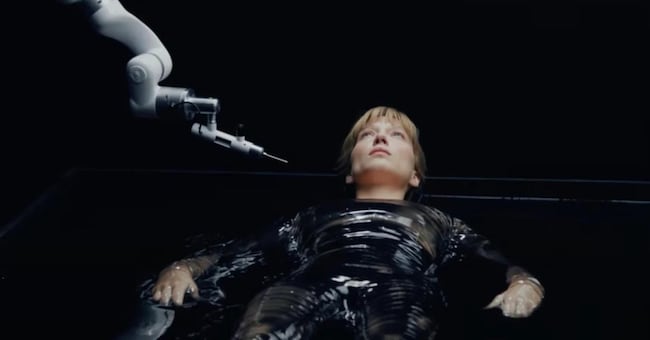
Set in a near future where artificial intelligence reigns supreme, 'The Beast' tells of a world where human emotions are now considered a threat. To get rid of them, Gabrielle must purify her DNA: she therefore immerses herself in previous lives, where she meets Louis, her great love, again.
This (great) film opens with a sequence set in a set surrounded by a gigantic green screen, where the protagonist has to act while imagining objects and characters that will later be added in post-production. Thus, from the very first minutes, 'The Beast' also proves to be a film about cinema and the gaze, so much so that it represents one of the most fascinating viewing experiences of recent times.
Past and present mingle, fictitious images merge with real ones, through a mise-en-scene where the analogue and digital worlds dance without barriers of any kind and in which we spectators also lose ourselves along with the protagonist.

