Weekend films

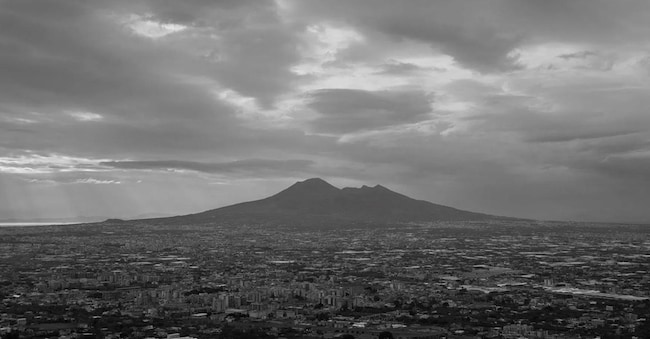
'Under the Clouds', life on the slopes of Vesuvius according to Gianfranco Rosi

At the weekend, Italian cinema is the star with the new film by the famous documentary filmmaker and 'Duse' by Pietro Marcello

by Andrea Chimento

3' min read

3' min read

"I filmed and lived for three years on the horizon of Vesuvius, looking for the traces of history, the excavation of time, what remains of everyday life. I collect stories in the voices of those who speak, I observe the clouds, the fumes of the Campi Flegrei': this is how Gianfranco Rosi presented his latest documentary, 'Under the Clouds', at this year's Venice Film Festival, with which he lifted the Special Jury Prize.

It is an important recognition, which enriches the already precious trophy cabinet of the director born in 1963 in Asmara, Eritrea, where his father worked: Rosi had already won the Golden Lion at the Venice Film Festival in 2013 for 'Sacro GRA' and then the Golden Bear at the Berlin Film Festival for 'Fuocoammare' in 2016, a film with which he had also reached the Oscar nomination.

Loading...

Curiously enough, however, his most incisive works - 'Below Sea Level' and 'El Sicario - Room 164' - predated these triumphs, whereas 'Nocturno' (2020) and 'In viaggio' (2022) were much more disappointing in recent years.

With 'Sotto le nuvole', Rosi regains a certain polish, creating an overview of what is happening on the slopes of Vesuvius in a work similar to the one he did with 'Grande Raccordo Anulare' for his film twelve years ago.

In 'Sotto le nuvole' Rosi frames an area criss-crossed by inhabitants, devotees, tourists, archaeologists digging up the past, a street teacher devoting his time to after-school activities for children and teenagers, fire fighters overcoming the small and big fears of the inhabitants, the police chasing tomb raiders, while, in Torre Annunziata, Syrian ships unload Ukrainian grain.

“Sotto le nuvole” e gli altri film della settimana

Photogallery4 foto

A trip down memory lane that half works

.

Rosi moves in the footsteps of history, of the memories of the underground, also touching on the history of cinema and constantly reflecting on the past and the present.

It is no coincidence that the director opted for black and white photography, undoubtedly elegant but also excessively lacquered.

The overview of people described by the camera is effective and interesting, but Rosi falls a little too much in love with the images and the formal focus often exceeds that of the content, which is too repetitive.

The audio-visual experience has charm, but the prolixity of the narrative affects the film, which thus ends up working half-heartedly.

Duse

Among the weekend's new releases in theatres is 'Duse', the fourth fiction feature film by Pietro Marcello, a director who began his career by signing interesting documentaries such as 'Il passaggio della linea' and 'La bocca del lupo'.

Three years after 'The Scarlet Sails', presented at the Directors' Fortnight at the Cannes Film Festival, Marcello is back behind the camera to narrate the Divina, one of the most famous actresses in theatre history.

The film focuses on the last years of the life of Eleonora Duse who, in the times between the Great War and the rise of fascism, feels a call stronger than any resignation and returns to where her life began: on the stage.

It is not just the desire to act that drives her, but a deep-seated urgency: the need to reassert herself in a world that is inexorably changing and threatens to take everything away from her, even the independence she has won through her life's work.

In a film centred entirely on such an 'unwieldy' character, it is only natural that one of the main aspects should be the performance of the actress called upon to play her: Valeria Bruni Tedeschi succeeds admirably in conveying the inner torments, frailties but also the exceptional talent of the Divina, once she has returned to the stage.

If the main merit of the film lies in the performance of its actress, an important mention goes to the theme of art as a form of salvation against the misfortunes of the world.

The historical references are marked by the use of archive images, a characteristic choice of Pietro Marcello's style, which in this case, however, is rather superfluous. Beyond these archive materials and some overly shouted passages, Marcello gives life to an elegant audiovisual symphony, well directed in its editing times and accompanied by a remarkable soundtrack. Must-see.

Copyright reserved ©
Loading...

Brand connect

Loading...

Newsletter

Notizie e approfondimenti sugli avvenimenti politici, economici e finanziari.

Iscriviti