Weekend films

'A Year at School', realistic portrait of adolescence

The second feature film by Laura Samani, a director who made a name for herself with 'Small Body', arrives in cinemas

by Andrea Chimento

3' min read

Translated by AI
Versione italiana

3' min read

Translated by AI
Versione italiana


Italia cinema is the star of the weekend in cinemas with 'Un anno di scuola' by Laura Samani and 'Vita mia' by Edoardo Winspeare.

Loading...

Let us start with the film by the director from Trieste, who became famous thanks to her very interesting first feature, 'Piccolo corpo', which led her to deservedly win a David di Donatello as best first-time director.

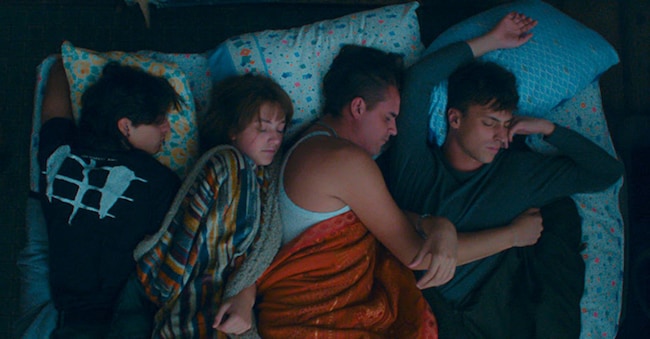
Set in Trieste in 2007, the film tells the story of Fred, a lively, non-conformist and energetic 18-year-old Swedish girl who arrives in the city to attend the last year of a Technical Institute, and soon finds herself in a very peculiar situation: she is the only girl in an all-male class.

His arrival does not go unnoticed. From day one, he catches the attention of his classmates, in particular three inseparable friends who have been close since childhood. The three form a tight-knit and seemingly indissoluble nucleus, but Fred's presence triggers something unexpected: the boys' friendship begins to crack, shaken by jealousies, unspoken desires and latent rivalries.

All three, in different ways, feel attracted to her, but what Fred really wants is just to be accepted by the group and to be part of it.

Laura Samani was inspired by a short story by Giani Stuparich, written almost a century ago and set in 1909 Trieste. Despite the temporal distance, the director found many insights from her adolescence in the text from which she drew and then added much of her personal experience.

It is no coincidence that in 2007 Laura Samani was eighteen years old and there is certainly a lot of her school life within the film.


A sincere but lacking in great flashes


After the good results of 'Small Body', Samani confirms his effective directorial vision with this sincere and extremely realistic film, capable of taking us inside the group dynamics at the centre of the narrative.

The limitations, however, lie in situations that have already been seen in the cinema countless times, so much so that they risk a certain manner, both in the writing and in the staging.

Nothing serious, certainly, but a few more flashes and a pinch of courage would have made this feature film more incisive and less predictable.

Nevertheless, it remains a product that is definitely worth seeing and capable of interestingly reasoning about language barriers as a form of invitation to communication and the effort to try to understand different cultures.

“Un anno di scuola” e gli altri film della settimana

Photogallery4 foto


My life


Also among the new releases in theatres is 'Vita mia' by Edoardo Winspeare, a film in which Dominique Sanda returns to star, four years after her performance in 'Il paradiso del pavone' by Laura Bispuri.

The French actress plays Didi, a woman raised in the noblest Hungarian aristocracy.

As a child, she witnessed first the Nazi occupation and then the rise of the communist regime. Forced into exile, she found refuge in France, where she worked as a seamstress at Maison Dior in order to survive. Her marriage to an Italian nobleman finally led her to Salento, a land where she would remain until the last days of her life. The film portrays her as an old woman, tried by illness but still proud and elegant. The weakening of her body forces her to ask for help from Vita, a young local woman, of working-class origins and with a family linked to the ideas of the class struggle. A relationship of respect and mutual discovery slowly develops between the two, in which the fascination and harsh reality of an impoverished aristocracy intertwine with the contradictions of the present.

Among the best films made by Edoardo Winspeare, 'Vita mia' is a product with a universal flavour, capable of effectively reasoning about Europe and its history.

With good sensitivity, the director who grew up in Salento deals with subjects that are not easy, while also managing to offer a valid female portrait in which the confrontation between the past and the present is only one of the main themes that are told.

There is a little too much didacticism and some dialogue is slightly forced, but the overall design holds up and Dominique Sanda's charm and skill do the rest.

Copyright reserved ©
Loading...

Brand connect

Loading...

Newsletter

Notizie e approfondimenti sugli avvenimenti politici, economici e finanziari.

Iscriviti