Defence

Military ships: Fincantieri in pole position for US Navy plans

Washington wants to build 100 more combat units over the next 30 years, but US production capacity is severely constrained and China's rapid growth requires acceleration. CEO Folgiero is ready to increase the effort to meet the challenge

by Celestina Dominelli

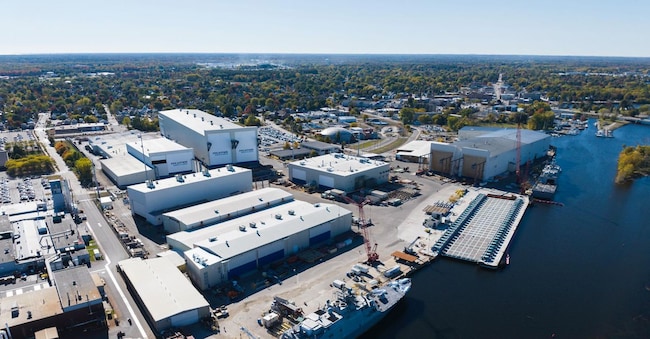
Il cantiere di Marinette negli Usa

4' min read

4' min read

Fincantieri is in pole position to exploit the opportunities that may arise from the shipbuilding expansion plans announced by US President Donald Trump.

Also because the group led by Pierroberto Folgiero can count on solid bases overseas where it operates through its subsidiary Fincantieri Marine Group (Fmg), which manages three shipyards: Fincantieri Marinette Marine, Fincantieri Bay Shipbuilding and Fincantieri Ace Marine, all in the Great Lakes region of Wisconsin.

Loading...

The executive order signed in April

.

It has to be said that, at the moment, the 'machine' for strengthening the US Navy is still at a standstill, but the US tycoon's intentions have been put down in black and white in the executive order signed last April with which the US administration aims to increase the number of combat ships to 381 within the next 30 years. Translated: 100 new units that will be added to the 296 currently in service between aircraft carriers (almost all nuclear-powered), destroyers and other ships, including 66 submarines.

Meloni: "L'economia del mare e' centrale, asset su cui puntiamo"

The limits of American shipbuilding

.

A not inconsiderable leap forward, therefore, which the US-made shipbuilding industry, however, is unable to sustain. The reasons? The production chain is tight and the main plants, which belong to the American big boys Huntington Ingalls Industries (HII) and General Dynamics, are saturated.

Not to mention a market marked by reduced competition and whose survival is mainly ensured by frequent injections of taxpayers' resources.

The latter have certainly favoured consistent technological development (America is at the forefront in electronics thanks to Lockeed Martin), but they have not allowed the stars and stripes industry to guarantee an adequate production capacity 'at home'. This seems even more necessary in the light of the changed geopolitical context, in which the theatres of conflict are multiplying, also due to the activism of the American president, and the sea offensive of other powers is growing, starting with China, whose strength clearly emerges from a document released in April by the US Congress, 'China Naval Modernisation: implications for US Navy Capabilities'.

The Chinese threat

.

From that analysis, it is clear that the Chinese Navy is now, by far, the largest among East Asian countries and, between 2015 and 2020, has surpassed the US Navy in the number of combat units. According to counts made by the US Department of Defence, Beijing currently boasts over 370 platforms, including main surface units, submarines, oceanic amphibious ships, but also mine warfare ships, aircraft carriers and auxiliary fleet units. A very varied set-up, therefore, to which more than 60 Houbei-class patrol vessels equipped with anti-ship missiles (Ascm) must be added. And the plans announced in recent months speak of reaching 395 ships by 2025 and 435 by 2030.

Concerns at the top of the US administration

.

It is not surprising, therefore, that at the top levels of the American administration, the speed with which China is expanding its fleet, together with the production capacity of its shipyards, represents an element of great concern, with respect to which, however, the US strategy risks having restricted margins of manoeuvre by virtue of the constraints just mentioned. Not to mention that, to further complicate the picture, there is the possibility that Beijing could also convert part of the civil ship production capacity it has consolidated over the past decade to the military sphere.

Fincantieri's landing in the USA in 2008

Hence the need for Washington to rebuild a solid national industrial base by exploiting the cards at its disposal. This includes Fincantieri, which today represents a key asset in American manufacturing capacity.

Proof of this is the great work carried out by the Italian group which, it is worth remembering, landed in the USA in 2008 by taking over Manitowoc Marine Group (MMG), then one of the leading American medium-sized shipbuilders, with a number of large government clients (including the US Navy and Coast Guard) and two shipyards in Wisconsin - Marinette Marine Corporation (in Marinette, focused on the construction of military ships) and Bay Shipbuilding Company (in Sturgeon Bay, for the construction of commercial ships and repairs) - as well as a repair facility in Cleveland (Ohio).

The group's investments in the States

.

So it was from that acquisition that Fincantieri's American campaign began. As Folgiero recently recalled, Fincantieri has invested $800 million overseas, $400 million of which was for the expansion of Marinette alone, the historic shipyard founded in 1942 to boost the US war effort in World War II and which has become the lynchpin of the Italian group's presence in the States.

At the facility at the mouth of the Menominee River in Wisconsin, which boasts the construction of 1.500 vessels for the United States, Fincantieri is building several classes of ships for the US Navy: from the Littoral Combat Ships of the Freedom class - units designed both for coastal surveillance and defence and for deep-water operations - to the new Constellation class frigates under the maxi contract worth about US$ 5.5 billion signed in 2020 and which the group managed to win, beating off competition from American giants such as Hii and General Dynamics. Proof of Fincantieri's ability to conquer more and more space in the US market.

Copyright reserved ©
Loading...

Brand connect

Loading...

Newsletter

Notizie e approfondimenti sugli avvenimenti politici, economici e finanziari.

Iscriviti