Fine Art Biennale Paris at the Grand Palais
In the capital, some 100 galleries at the Grand Palais presented works spanning 3,000 years. Good reception from collectors

4' min read
4' min read
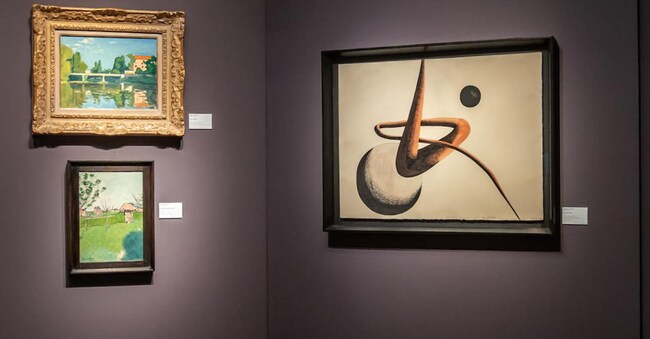
The growth of the art market in Paris does not only concern contemporary and 20th century art, the prerogative of the October fairs and auctions. Indeed, 21 November saw the opening of the third edition of FAB Paris, a play on words that reveals the decades-long tradition of the new fair, born from the merger of the younger Fine Art Paris and the doyen La Biennale des Antiquaires. This elegant fair has finally found its permanent home in the refurbished Grand Palais and the Parisian public flocked to the event in defiance of the snow and resulting cold.
From 22 to 27 November about one hundred galleries, one third non-French and one quarter present for the first time, presented thousands of objects across more than 3,000 years of history and all continents. The proposal is explicitly aimed at developing 'cross collecting': to stimulate buying in more than one of the twenty or so traditional 'categories' into which art is segmented by periods and cultures. In terms of prices, next to a few rare millionaire works the offer was concentrated in the sub-quarter million euro bracket. There were many works below the EUR 20,000 threshold, especially works on paper and objects, among which the hyper-specialised Galerie Montanari also deserves its place, offering only frames and mirrors from a few thousand euro up to EUR 32,000. The prices quoted are asking prices, normally not inclusive of tax and not actually realised values.
The Italian presence
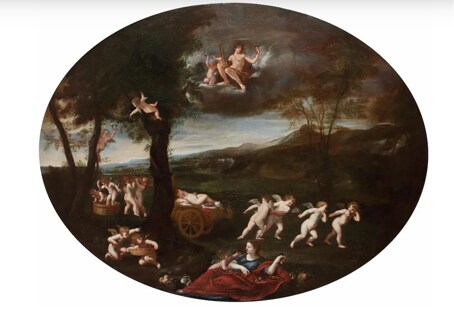
.The pre-eminently French-speaking character of the participating galleries saw the participation of a select group of Italian realities that are characterised by their presence abroad with permanent venues focusing on complementary periods. Prominent among them was the traditional art of the Roman/London-based Laocoon Gallery/W. Apolloni, which proposed one of the most relevant works of the fair from the point of view of history and visual impact: it is the monumental cycle painted by the Bolognese Francesco Albani, known as 'The Four Seasons Santacroce' of 1640-45, four oval oil canvases of more than two metres each, offered on the market at EUR 2 million, thanks also to the fact that they are in free circulation since they came from a French auction some decades ago.
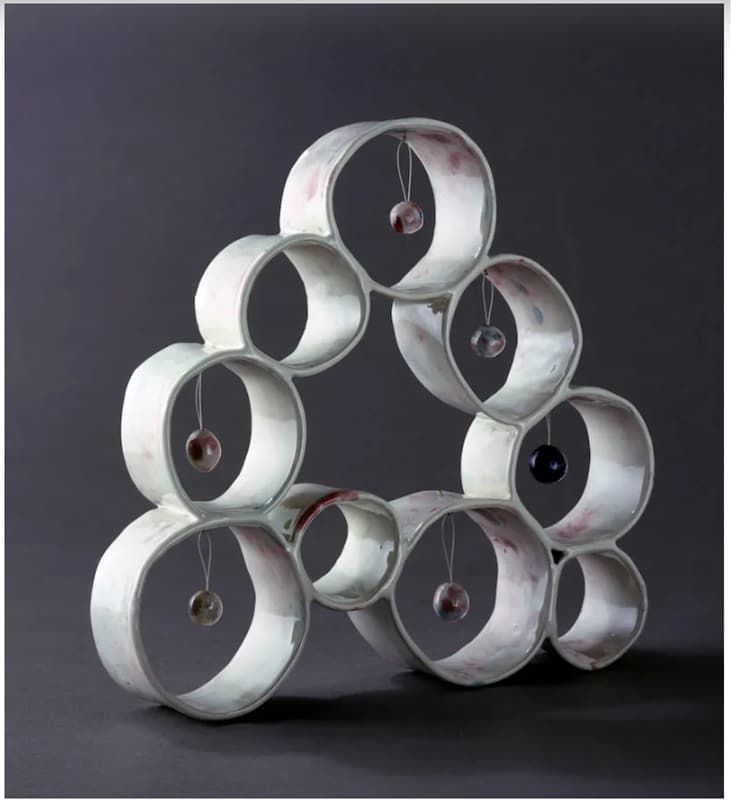
A proposal straddling the antique and the 20th century for the Roman Miriam di Penta, who already boasted a work sold out in the opening hours, a delightful still life of the Spanish school. Alongside her antique paintings are works from the Italian 20th century, such as a pleasing ceramic sculpture by Melotti and Venetian glass designed by Carlo Scarpa. Brun Fine Art's display is all about the relationship between luxury design accompanying works of art, an area in which the versatility of Lucio Fontana stands out, particularly with his ceramics. An edition of Fontana's two oval bronze 'natures' with holes and cuts, respectively, also stands on the stand of the queen of Italian design, the Milanese Robertaebasta.
Modern Art
.In a context of strong internationalisation of French art, it is not surprising that post-war Informal painting is strongly represented by a considerable number of mainly Paris-based galleries, although perhaps a greater variety would have been desirable. Among them was Applicat-Prazan with its usual offering of quality works by Poliakoff, De Stael, Helion, Soulages, but also a lively canvas by Magnelli that had already sold at the opening. Exhibiting for the first time at FAB is the important gallery of contemporary art Almine Rech, with a wide range of multi-coloured works by Poliakoff, to which the contemporary Ha Chong-Hyun responds with works of Korean minimalism.