Effis data.

Fires: 40 per cent on agricultural land – 37,000 hectares burnt in 2025

In Italia, a total of almost 100,000 hectares were lost: it is the third-largest European country in terms of area affected, equivalent to five times the area of the Municipality of Milan. In cultivated areas, 23 per cent of the fires affected evergreen shrubs and olive trees

Epa

3' min read

Translated by AI
Versione italiana

3' min read

Translated by AI
Versione italiana

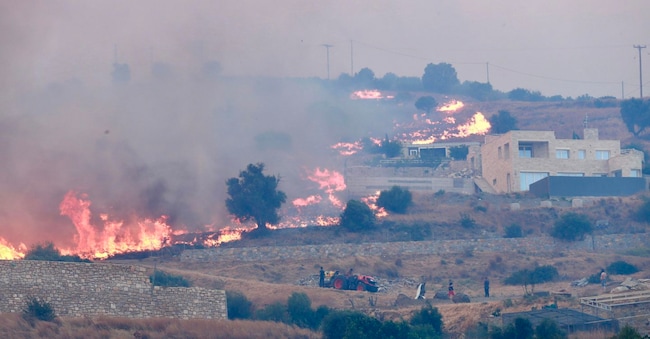
Whilst Europe continues to burn, with massive wildfires affecting Mediterranean countries such as Spain, France and Greece, a new investigation carried out by Miir as part of the European Data Journalism Network – of which *Il Sole 24 Ore* is also a member – traces the pattern of wildfires across Europe using data from the European Effis system.

The phenomenon

Loading...

The situation in Italia is not reassuring: in 2025, 94,456 hectares went up in flames, equivalent to five times the area of the municipality of Milan. In 2021, as many as 157,000 hectares went up in smoke. Last year, fires were more frequent but smaller in scale: each fire burned an average of 55 hectares, compared with a European average of 191.

As highlighted by Openpolis, which drew on data from Edjnet, more than a third of all fires in Europe (36 per cent) occur in our country, but the area burnt accounts for just 10 per cent of the total. It is the number of incidents that is rising; in 2025, it exceeded 1,700 cases in Italia for the first time. In 2024, there were 1,343. The risk of fire is increasing due to drought and heatwaves that push temperatures well above 40 degrees. When these two conditions combine with strong winds, the fires can burn for weeks. So-called ‘megafires’ – that is, fires covering more than 10,000 hectares – are becoming increasingly common: in 2025 alone, there were 18 such fires in Europe.

INCENDI, LE AREE AGRICOLE COINVOLTE

Loading...

Across the continent, the number of hectares affected by fires was close to one million, totalling 904,000. It is as if, in the space of a year, all 20 of the European Union’s largest capital cities had gone up in flames, from Rome (128,736 hectares) to Dublin (11,499 hectares). In a European comparison, Italia ranks third behind Spain and Portugal. The Iberian Peninsula tops the list, accounting for as much as 43 per cent of the land burnt across the whole of Europe.

The epicentre of the wildfires in Italia is by far the South, where 95 per cent of the national area affected by wildfires is concentrated; the remainder is recorded in Central Italy, with almost none in the North, where only 0.3 per cent of the hectares burnt are located. The provinces most severely affected in 2025 were Agrigento, Caltanissetta and Trapani, which together account for 40 per cent of the national total. This comes as no surprise, given that in recent years Sicily has almost always accounted for more than half of the country’s burnt areas.

The economic impact

Wildfires also pose an economic problem, particularly for the agricultural sector. In fact, agricultural land accounts for almost 40 per cent of the areas burnt in Italia, with 37,000 hectares affected. To put this into perspective, this is an area equivalent to that occupied by two of the largest wine-growing regions in the north-east: the Prosecco DOC and Valpolicella regions.

However, as already mentioned, this phenomenon rarely affects the North (although the trend is on the rise – see the interview on the right), and even less so when it comes to agricultural land: those most affected are farmers in the South, where 98 per cent of the agricultural land burnt nationwide is located. This figure, however, may also include authorised fires carried out for land and field management purposes.

In the fires that affected agricultural land, almost a quarter of the area burnt (23.4 per cent) consisted of sclerophyllous vegetation, which includes Mediterranean scrub, evergreen shrubs and olive trees. In Sicily, this figure rises to as much as one in three hectares (32.7 per cent).

Loading...

Just last week, in the province of Agrigento, a massive fire destroyed more than 50 olive trees and two vineyards. In mid-July, meanwhile, in the Pollino National Park in Calabria, one of the season’s largest fires burnt almost a thousand hectares of vegetation – mostly Mediterranean scrub – in the space of a week.

Indeed, the fires did not even spare protected areas and nature reserves: 28 per cent of the affected area fell within the Natura 2000 network, the European system of protected areas established to safeguard natural habitats and rare species. The area within the Natura 2000 network affected by the fires totalled 26,660 hectares.

The situation in 2025 is clearly dire, and it does not appear to be a phenomenon confined to the past: wildfires continue to plague the summer of 2026 as well, and with the arrival in recent days of the season’s fourth heatwave, the risk is growing ever higher.

Copyright reserved ©
Loading...

Brand connect

Loading...

Newsletter

Notizie e approfondimenti sugli avvenimenti politici, economici e finanziari.

Iscriviti