
"Factories first': the Friuli model 50 years after the earthquake
The 1976 earthquake affected 279 industrial companies, stopping 40% of Udine's production system - Paolo Fantoni's memory
by Barbara Ganz
 Aggiungi Il Sole 24 Ore
ai preferiti su Google
Paolo Fantoni was 18 years old: he remembers well the night of the earthquake, the sounds of collapsed houses, the destruction of the factory in Gemona: 'Only later did we learn that the factory in Osoppo, where 350 people worked, had also collapsed. The next day, my father and some workers were already at the company, rebuilding. On 8 May we gave notice that the month's salaries were available, as a sign of trust. Two caravans stood in for management and the personnel office respectively'.
The reconstruction
The Osoppo factory was replaced by a new one, already under construction at the time of the earthquake: the destroyed site completed its reconversion in the mid-1980s and today houses the production of panels for the group, which has grown to 1,100 employees, 700 of whom work in Osoppo. The fundamental choice "was to settle the population in tent camps to avoid mass emigration and keep people close to the factories," the entrepreneurs who symbolised the companies that recovered from the rubble remember today.
Fifty years later, Friuli remembers the earthquake, which struck the region on 6 May 1976, devastating an area of 5,700 square kilometres, affecting 137 municipalities and around 600 thousand inhabitants. In the epicentre area, some 17,000 homes collapsed or were irreparably damaged, causing 989 deaths, over 3,000 injured and 100,000 homeless. 279 industrial companies were affected, of which 166 were members of the Friuli Industrialists' Association, with over 10 thousand employees. Approximately 40 per cent of Udine's production system came to a halt.
First the factories
Large companies such as Snaidero in Majano and Pittini in Osoppo were among those affected. "Friuli demonstrated that, by putting economic and productive recovery first, one rebuilds not only the material fabric, but also the social one," emphasises Luigino Pozzo, president of Confindustria Udine. In the front row then was the Association of Industrialists of the Province of Udine - today Confindustria Udine - with a central role played by the entrepreneurial system in the rebirth of the territory, which "lost everything that night, but not its determination. The entrepreneurs did not give up: they reopened factories even in makeshift premises, kept jobs and laid the foundations for a reconstruction that became a national model. A reconstruction 'beyond the existing' borrowing a phrase from Andrea Pittini,' Pozzo recalls.
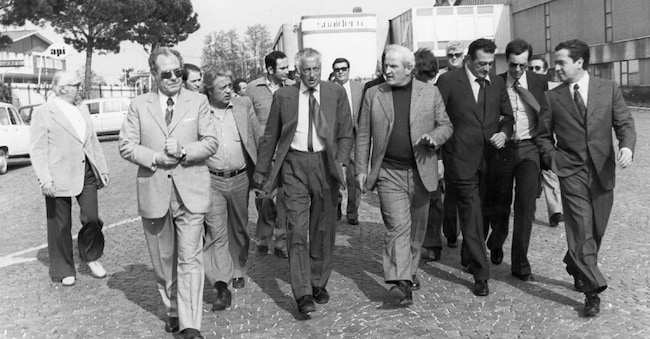
"It is around the factories that we have to rebuild, but first we have to make them survive by providing them with men and means,' was the guiding principle expressed at the time by association president Rinaldo Bertoli and which became the pillar of the 'Friuli Model'. With the successive presidencies of Rinaldo Bertoli, Gianni Cogolo and Andrea Pittini, the association played a strong role in supporting local businesses: three days after the quake, it opened a subscription that raised over 3.5 billion lire, earmarked for prefabricated buildings, housing for workers and emergency structures. He promoted concrete solutions such as temporary employment, contract work and agreements with banks and trade unions. Thanks to the commitment of the national Confindustria (Confederation of Italian Industry), with the visit of the then president, Gianni Agnelli, interest-free loans and rapid intervention were requested and obtained. The associated construction companies formed the Corif Consortium, which became the sole interlocutor for the construction of infrastructure.

