
First Republic: Farewell to Cencelli – how he devised the Christian Democrats’ handbook to power
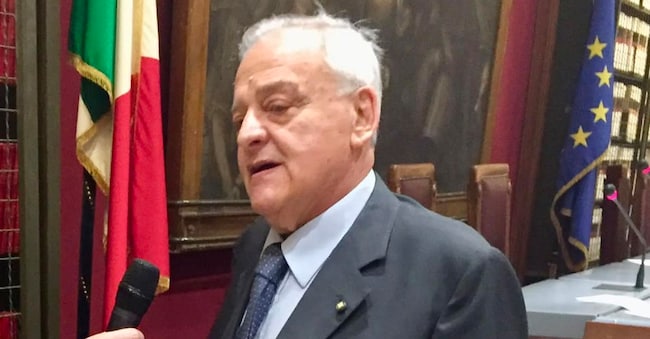
An official of the Christian Democrats. In 1967, as part of the ‘Pontieri’ faction, he devised a system for allocating party and government posts on the basis of political clout

Key points
Think of the First Republic and the association is almost immediate. That playbook for the almost precise distribution of power and positions has gone down in history. Massimiliano Cencelli died in Rome on the afternoon of Saturday 8 August: he was 90 years old. In the 1960s, he was an official of the Christian Democrats (DC), but his surname will forever be associated with a method for allocating political and government posts to representatives of various parties or factions in proportion to their political clout. The term ‘manual’ is journalistic in origin but has become part of everyday language. It also brings to mind the term ‘lottizzazione’ (the parcelling out of positions), of which the manual perhaps represents the most scientific application.
How the handbook came about
It was Cencelli himself who revealed how the handbook came about in an interview with the newspaper *Avvenire* in 2003: ‘In 1967, Sarti, together with Cossiga and Taviani, founded the “pontieri” faction at the Milan congress,’ he recalled, ‘so called because it was meant to act as a bridge between the majority and the left. We secured 12 per cent of the vote, and we had to decide on the posts within the executive committee. So I proposed: if we have 12 per cent, just as on a company’s board of directors posts are allocated according to the number of shares held, the same should apply to party and government posts based on membership cards. Sarti told me to work on it. In that way, Taviani retained the Interior portfolio, Gaspari became Under-Secretary for the Post Office, Cossiga took Defence, and Sarti was appointed to Tourism and Entertainment. The matter became public knowledge because, during government crises, Sarti – who loved to joke – would always reply to journalists seeking scoops: ‘Ask Cencelli.’
Rotondi: his handbook remains a political masterpiece
“More than the party leader, Cencelli has always remained in the news; he has never stepped out of the spotlight and never will. His masterpiece was a manual that was as celebrated as it was, paradoxically, never published: the ‘Cencelli Manual’,” comments Gianfranco Rotondi, former leader of the Christian Democrats and now an MP for FdI. ‘The Cencelli Manual,’ Rotondi continues, ‘associated every position of power (minister, undersecretary, committee chair) with a “power score”, making it possible to form governments with a fair distribution of posts amongst allied parties and their internal factions. In fact, it is still in use, in the sense that the practice of dividing up posts still exists. Massimiliano made it a scientific process, and that was his greatest achievement – though not his only one: he was honest and loyal, like all DC officials, a structure devised and selected by Fanfani when he decided that De Gasperi’s party-movement should become the party-state. The rest is Italian history.’
Mastella: his handbook should be reprinted
‘Farewell, Massimiliano. With your political acumen, you understood that it was necessary to give due weight to all political perspectives, and that an alliance was only truly such when based on mutual respect. Your handbook was a distillation of applied political grammar. It ought to be reprinted so that many in today’s centre-left might read it.’ These are the words of farewell from the mayor of Benevento and leader of NdC, Clemente Mastella. ‘The Christian Democrats,’ recalls the mayor of the Sannio capital, ‘were home to extraordinary minds such as Cencelli; in addition to the handbook, he was one of the founders, alongside Cossiga and Taviani, of the “Pontieri” faction, another key term worth reviving, symbolising a brilliant synthesis of the diversity that politics always embodies and a rejection of preconceived animosities. His legacy remains relevant today: my condolences to his family.”
Naples: through him, those in power learnt the importance of limits
‘For many years, Massimiliano Cencelli was – unjustly, as many of his own opponents acknowledge – the symbol of an insatiable and never-satisfied power, eager to perpetuate itself against all logic and the will of the electorate. It took the arrival of Berlusconi, and the emergence onto the scene of the apostles of bipolarism and the dealers of the ‘all-in’ game: whoever wins, wins it all and does as they please. Cencelli, with his famous ‘manual’, reminded the Christian Democrats – the party he had joined in 1954 – that the essence of power in a democracy lies in its limits and in respecting them. Better still: that power, bestowed by the electorate, is not a conquest nor the spoils of war; rather, it is a tool to be used sparingly to meet the country’s needs and to foster, alongside material well-being, new spaces for democracy and freedom.’ So says Osvaldo Napoli, of the national leadership of Azione.

