Astronomy

First images of the Sun's South Pole taken by European satellites

Images of the solar south pole taken by the Solar Orbiter probe of Esa, the European Space Agency, have been released

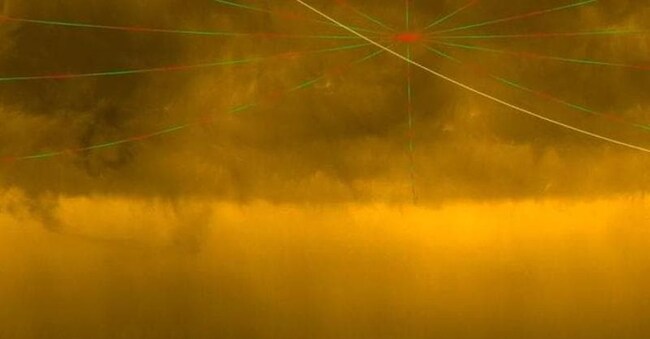
L’immagine scattata dalla sonda Solar Orbiter di Esa

3' min read

3' min read

Space Europe has had a lot of management and development problems for some time now, but it has to be said that the scientific satellites proposed by the research community on the old continent and realised by consortia of industries are always excellent and often outstanding, as are the service satellites for GPS or Earth observation

Beautiful images of the solar south pole taken by the Solar Orbiter probe of Esa, the European Space Agency, have been released a few hours ago,

Loading...

These are not only new and very significant images, but also the first of this part of the Sun and they reveal a very chaotic moving area, which was perhaps not expected. To take the images, the probe tilted its orbit 17 degrees, enough to see the South Pole. Those of the solar North Pole will arrive in October.

You can clearly see the atmosphere in constant motion with light zones where the temperature is estimated to be 7000 degrees and other, dark, zones that are much colder, although they are still 1000 degrees. As far as size is concerned, we are talking about tens and tens of thousands of kilometres for each zone. On the other hand, when we speak of a solar flare, we are dealing with 'flares' of incandescent gas of millions of kilometres, and let us remember that our earth is a sphere, to a first approximation, of 15,000 kilometres. Luckily, then, our mother star is among the few, percentage-wise, that is incredibly quiet: an alteration of a couple of percentage points in the Sun's energy output would do us no good at all.

The study is definitely very important, and for those who think it is research for its own sake, as astrophysicists are often mistakenly considered to be, it must be said that telecommunications companies are very interested in these studies, thinking that a greater and more detailed knowledge of the solar period, which is about 11 years, could improve the prevention of failures of telecommunications satellite constellations, Starlink in the lead since it currently has more than 8000 active satellites in low orbit.

We often forget this, but the Sun is the only star whose surface we can study in detail, since it is only 150 million kilometres away from us and has a diameter of 1.5 million. We observe it, study it, and even fear it. To our eyes, the sun appears as a super-bright little disc, so much so that it is really better not to observe it directly, but if you look at it with a solar telescope, either from the ground or from space, you notice a continuous activity, like a tingling of more or less hot clouds of gas, and therefore of different colours.

The sun's magnetic fields are nice and orderly when the Sun is quiet, but then, when the cycle continues, they become precisely chaotic and disordered, favouring the emission of particles, the solar wind, and energy, at levels that, in addition to creating the beautiful northern lights, can seriously interfere with technological systems in orbit or even on the ground: power grids.

Until now, however, no one, neither human nor robot, had been able to see the solar pole, which is "... a wonderful achievement". In the words of Carole Mundell, scientific director of the European Space Agency.

Without going into the intricacies of space mechanics, we can say that it is not easy to reach a suitable orbit for these shots, so the adventure has never been attempted, and this is already quite an achievement. If we then want to add a fundamental detail: we will probably never be able to go beyond the surface of the Sun with a satellite, because the flow of radiation and particles, even at times of low activity, acts as a powerful repelling agent of any attempt to approach it: before being burnt, or rather vaporised, our suicidal probe would probably receive a powerful kick that would throw it back

The Solar Orbiter, launched in February 2020, cost €500 million, not much for this type of mission, is the size of an SUV and carries ten sophisticated scientific survey instruments. Thanks to the orbit designed to accumulate energy thanks to the acceleration caused by a passage around Venus, Solar orbiter has been able to get closer to the Sun than any probe before flying over the South Pole, and will continue as mentioned with the North Pole. Without this effect, the amount of fuel required would have been excessive.

The probe will continue in its study and survey until 2030, if all goes well, and will come out with a much better model of how the sun works than we have now.

Copyright reserved ©
Loading...

Brand connect

Loading...

Newsletter

Notizie e approfondimenti sugli avvenimenti politici, economici e finanziari.

Iscriviti