
Five accessories for four sports and tracking our performance
If measuring sporting performance has become an obsession, you might as well do it properly. Five sports and their accessories to get lost in the details

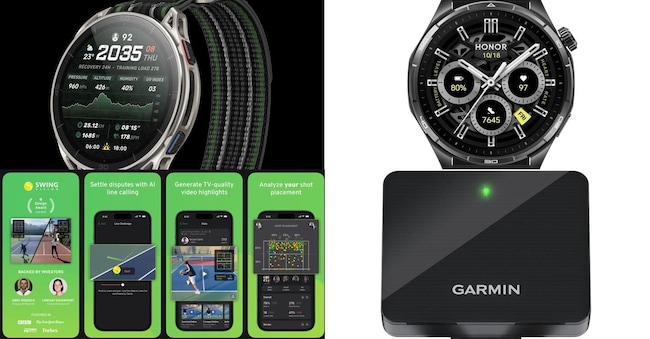
In summer, the landscape of sport changes. The days grow longer, the sports pitches remain full until late in the evening, runners swap the treadmill for a run along the seafront, and outdoor swimming pools take the place of indoor ones. More daylight hours mean more time to train, but also more opportunities to measure your progress. Because nowadays, performance isn’t just about training: it’s recorded, analysed, compared, synced with an app and, often, shared with friends. Whether it’s improving your tennis serve, shaving time off your 10-kilometre run or refining your swing on the green, data has become an integral part of the sporting experience. Here are four sports, six accessories and a single obsession: monitoring every detail, down to the very last millimetre.
We’ll start with football, and it couldn’t be any other way: the World Cup in the United States has only just come to an end. Amidst the tears of a Messi who is (perhaps) bidding farewell to the World Cup trophy and De la Fuente carving out his place in history, the desire to get back on the pitch is more than understandable. The Honor Watch 6 keeps track of every move. It’s a fully-fledged smartwatch, but it has an ace up its sleeve for football fanatics: Football Mode. Thanks to its dual-band GPS, it can create a heatmap of the areas of the pitch covered during a match, record top speed, sprints and distance covered, and even provide insights into tactical movements. This data helps you understand how you move, where you’re wasting energy and which aspects of your game can be improved. In short, it’s like having a little digital coach on your wrist, for anyone with the ambition to become the team’s top scorer.
If, on the other hand, your goal is to train for a half marathon or to beat your personal best over ten kilometres, one of the go-to options remains the Amazfit Cheetah range, which has just been updated with its second generation. The Cheetah 2 Pro is designed for those who live for pace, distance and time targets: it features dual-band GPS, offline maps and algorithms capable of analysing parameters such as lactate threshold, running power and VO₂ max. The built-in artificial intelligence helps create personalised programmes based on your fitness level and recovery, turning every run into a more targeted and less haphazard training session. For those who prefer to leave the tarmac behind and head for the trails, its big brother, the Cheetah 2 Ultra, is designed for trail running, thanks to colour topographic maps and a battery life tailored for long runs.
Even golf is undergoing a minor digital revolution. Launch monitors have transformed the swing into a sequence of data to be analysed: ball speed, direction, launch angle, trajectory and dozens of other parameters that, until a few years ago, were only accessible to professionals. Garmin has a dedicated range. It starts with the Approach R10, a compact radar for swing analysis capable of recording shots and providing useful information to help you identify areas for improvement. At the top of the range is the Approach R50, a portable unit equipped with three high-speed cameras capable of detecting over 15 parameters relating to the ball and club, including spin rate and spin axis. It features a 10-inch colour touchscreen for reviewing impact videos and, most importantly, the ability to transform into a fully-fledged golf simulator, with over 43,000 virtual courses to play in your garden or garage, allowing you to challenge friends and other users.
When it comes to tennis, things get a bit more complicated. Around ten years ago, the Babolat Pure Drive Play was ahead of its time: it was the first ‘smart’ racket with sensors built into the handle, capable of recording the player’s data during a match. An idea that was eventually abandoned. Today, analysis relies mainly on small external sensors such as those from Coollang, which can detect swing speed, shot type and technical parameters of the session, synchronising everything with an app. The real revolution, however, comes from computer vision. The real evolution, however, comes from computer vision: SwingVision uses the iPhone or iPad’s camera to analyse rallies, measure the speed and accuracy of shots, generate personalised statistics and even make line calls. A true digital coach that observes every detail of the game.

