
Five (and more) women writers to understand gender-based violence
The Turin fair opens with the theme 'The world saved by children'. Trauma and abuse are at the centre of the reflection of all the writers in the finals of the European Strega Prize

Five women writers to understand gender violence? "Marie Cardinal with The Words to Say It, a novel about an analysis, Doris Lessing and her account of time passing and becoming old, Edna O'Brien, who describes a reality that is so alive,Elsa Morante, and Simonetta Agnello Hornby, who I particularly like when she talks about Sicily.
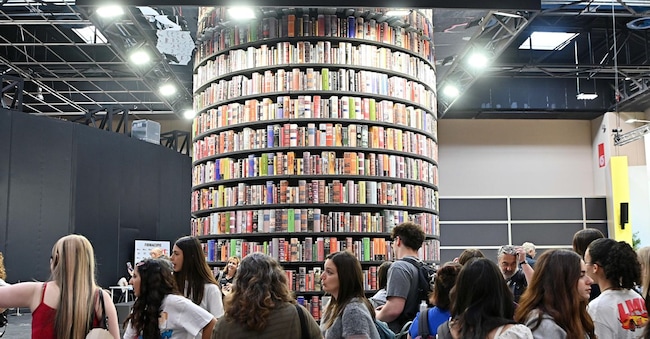
An avid reader, Alessandra Kustermann, the gynaecologist who twenty years ago set up the first public anti-violence centre in Italia to assist victims of Sexual and Domestic Violence (SVSeD), the first headmistress in the history of Milan's Mangiagalli, an intellectual symbol of the city and a national reference point among those who deal with violence against women, is caught a little off guard by the demand and finds it hard to make a selection. We met her at the Turin Book Fair, where she was presenting a novel, Il rubasogni, by Irma Cantoni (Orlotti editore), which tells the story of a mother who suffers violence from her son ('don't call abused women 'fragile people', they are not fragile, it is the damage they have suffered that is very serious!').
Kustermann often recommended books to the women who turned to the centre, and also to the women doctors who worked there, because for her, literature helps (also) to make people understand what violence is: 'the analysis of reality that writers make manages to show what we do not see or what we cannot find the words to say. Women writers, in particular, because they know how to write very well about feelings, while men write about women, but they do not reason as we do and there is a strong risk of homologation'. Reading is also one of the pillars of Kustermann's new initiative, which will make its debut this summer: the projectRebirth of SVS Donna Aiuta Donna, a farmstead on the outskirts of Milan where ten women who have suffered abuse, alone or with their children, will be able to live in a serene environment where they can regain confidence and independence and re-enter the labour market. Among the activities of the farmstead, which will be open to the public, are theatre, circus, music, literature and film workshops.
Violence and trauma are also at the centre of the books by the four female writers in the finals of the European Strega Prize, all present at the Salone (the award ceremony will be next Sunday, 17 May at 6.30 pm at the Circolo dei Lettori e delle Lettrici in Turin): Nathacha Appanah, with La notte nel cuore, translated by Cinzia Poli (Einaudi), winner of the Prix Femina 2025 and Prix Goncourt des Lycéens 2025, which tells the story of two feminicides and an attempted feminicide, that of the author (Sunday 17 May, 11.45 a.m. - Sala Internazionale, with Daria Bignardi); Leila Guerriero with La chiamata. Storia di una donna argentina, translated by Maria Nicola (Sur), winner of the Zenda Prize, which tells the real-life story of Silvia Labayru, a 20-year-old woman who in 1976, during Videla's dictatorship, was kidnapped, tortured, enslaved and forced to give birth to her first daughter in a room of the clandestine detention centre where she was locked up (Saturday 16 May, 12.45 - Sala Internazionale, with Concita De Gregorio); Isabella Hammad, with Entra il fantasma, translated by Maurizia Balmelli (Marsilio), winner of the Encore Award and the Gregor von Rezzori prize, an unpublished portrait of daily life in Palestine (Friday 15 May, 6 pm.15 - Sala Bianca, with Marino Sinibaldi); Yael van der Wouden, with the claustrophobic Estranea, translated by Roberta Scarabelli (Garzanti), winner of the Women's Prize for Fiction, which in a crescendo of suspense describes two women locked in a house tormenting each other against the background - for many chapters unknown to the protagonists and readers - of one of the most terrible tragedies of the 20th century (Saturday 16 May, 4.00 p.m. - Sala Bianca, with Antonella Lattanzi)
More indirectly, the fifth nominee - Tonio Schachinger, with In tempo reale, translated by Francesca Gabelli (Sellerio), winner of the Deutscher Buchpreis (Friday 15 May, 3pm - International Hall, with Helena Janeczek) also talks about violence in his ironic description of the influence of authoritarian structures and how it is possible to deceive them, to establish one's own rules and become great.


