
Five steps into the nightmare of Edgar Allan Poe
The disturbing imagery of the American writer amplified through the art of comics

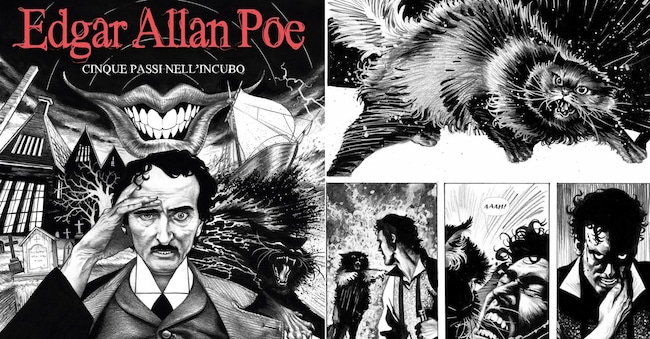
To dialogue with horror classics not by visual simplification, but by stratification of meaning, favouring a close confrontation with fears sedimented from the past: this is the intent of the series conceived by the publisher Lo Scarabeo, which uses the terrifying power of drawing to upset the reader's reference points. "Five Steps into the Nightmare" (Lo Scarabeo, 2025, pp. 112, euro 28) by Edgar Allan Poe, collects five of the American author's best-known tales, entrusting each one to a different illustrator, according to a choice intended to highlight a plurality of registers capable of reinterpreting Poe's imagery. Marco Cannavò's script plays an essential mediating role: it does not imprint a literal fidelity to the original text, but works by atmospheres and thematic nuclei, letting the images take charge of translating the uncanny. In this sense, the volume acts as a critical device that interrogates Poe through the language of comics, rather than reducing itself to a didactic illustration of him.
The lineaments of fear
Entrusted to Corrado Roi, 'The Fall of the House of Usher' constitutes a sort of declaration of intent for the entire anthology. The strongly chiaroscuro stroke, dominated by deep blacks and silhouettes almost consumed by shadow, immediately conveys the entropic dimension of the story, in which the house stands out like a living organism in slow decay. The most successful element lies in the correspondence that Roi ensures between architectural dissolution and psychic disintegration: if the images do not accompany the lapidary words, but absorb them without redemption, the human figures seem to lose consistency, to the point of blending in with their surroundings. In 'A Descent into the Maelström', illustrated by Francesco Biagini, the focus is not so much the description of the catastrophe as the subjective perception of the vortex. The Maelström proves to be a mental catastrophe before being a natural one, and the graphic sign accompanies it through a dynamic composition, sometimes in singletons, that conveys instability and bewilderment.
Diving into terror
The sea retains a symbolic function that is consistent with Poe's tendency to go beyond the semantic limits of Romanticism: it is an obstacle that does not depend on the individual, although it reflects his willpower and, at the same time, the narrator's consciousness. In this way, the comic effectively conveys one of its central insights, namely the idea that horror does not lie in the event itself, but in its internalisation. "From my childhood I was not like others; I did not see as others saw; I could not derive my passions from a common source. From the same source I did not draw my sorrow; I could not rouse my heart to joy with the same harmony; and all that I loved, I loved alone.
Closing the anthology selection is "The Black Cat", in which Giulia Francesca Massaglia's stroke appears more defined, close to an expressive realism that allows a marked characterisation of the characters. A perennial and disturbing presence, the cat becomes a true visual centre, while the progressive slide of the anonymous - and therefore universal - protagonist into violence and self-destruction is accentuated by a mise-en-scene that alternates daily recurrences with sudden dramatic accelerations. Here the comic manifests its ability to make the banality of evil distinguishable, without resorting to an excessive aesthetisation of terror.
"Cinque passi nell'incubo", script by Marco Cannavò, drawings by Francesco Biagini, Francesca Ciregia, Giulia Francesca Massaglia, Michele Penco, Corrado Roi, Lo Scarabeo, 2025, pp. 112, euro 28.

