Cannes Film Festival

'Fjord', integration difficulties and moral dilemmas according to Cristian Mungiu

In competition at the Cannes Film Festival the new film by the Romanian director, winner of the Palme d'Or in 2007

by Andrea Chimento

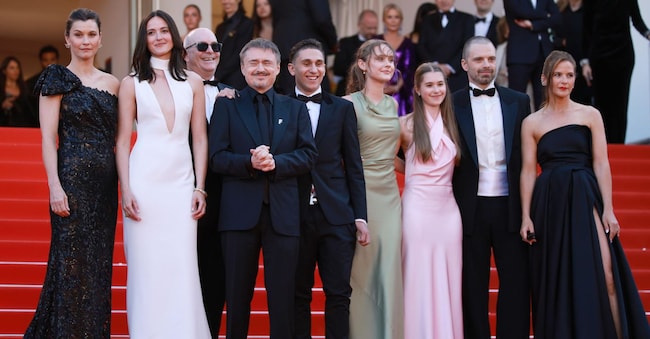
Da sinistra a destra: Lisa Loven Kongsli, Renate Reinsve, Markus Tonseth, Cristian Mungiu, Jonathan Ciprian Breazu, Henrikke Lund Olsen, Vanessa Ceban, Sebastian Stan e Lisa Carlehed partecipano alla prima del film "Fjord" durante la 79ª edizione del Festival di Cannes, a Cannes, in Francia, il 18 maggio 2026. Il festival si svolge dal 12 al 23 maggio 2026.   (EPA/Clemens Bilan)

3' min read

Translated by AI
Versione italiana

3' min read

Translated by AI
Versione italiana

At Cannes, the day has come for one of the Festival's absolute favourites: Cristian Mungiu, the Romanian director who won the Palme d'Or in 2007 with '4 Months, 3 Weeks, 2 Days', is returning to the Croisette again in competition after also participating with 'Beyond the Hills' in 2012, 'A Father, a Daughter' in 2016 and 'Wild Animals' in 2022.

All powerful and very important films, the quality of which can only have made the screening of his new work, 'Fjord', highly anticipated.

Loading...

This time Mungiu goes beyond the borders of his country and sets the film in Norway to tell the story of a family that has recently moved to a small village overlooking a fjord. The father is Romanian, the mother is Norwegian and they have five children, including a boy and a girl who are going through the complicated period of adolescence.

After a domestic quarrel and a number of statements by the latter to the child protection authorities, the parents are accused of violence and psychological coercion against their children, who, from one day to the next, are taken away from them one after the other.

With his classic rigorous and profoundly realistic style, Mungiu offers a new, engaging moral reflection where the audience will have to judge which side they are on and what the best future should be for the younger characters.

The Romanian director focuses on the cultural as well as ethical and religious differences between the countries represented, offering a profound and interesting perspective on sensitive issues, including the difficulty of integrating in a foreign country and the prejudices that can arise on either side.

The ending does not live up to the rest of the film, but it is still a film that confirms the narrative strength of a director who, even on location, definitely knows his stuff. In the cast Renate Reinsve and Sebastian Stan.

Paper Tiger

Delicate moral reflections were also offered in the Cannes competition by 'Paper Tiger' by James Gray, an American director who rehashes many of the themes typical of his cinema.

Set in New York in 1986, the film tells of two brothers, completely different from each other, who join forces to bring home what could be the biggest deal of their lives. In the middle, however, is the Russian mafia and a mistake made by one of the two, albeit in good faith, could cost the lives of his family and break the bond that unites the two brothers.

Picking up on elements of his debut 'Little Odessa' and the remarkable 'Masters of the Night', Gray brings to life a kind of Greek tragedy set in the years of Ronald Reagan's second term in office, and in which one can strongly perceive how he is once again recounting the decline of certain American ideals and dreams.

James Gray thinks a lot about the gaze (the two brothers and the wife of one of them collapse in moments in which they cannot see clearly what is in front of them) and gives several masterful sequences in which he plays with the light and shadows of photography in an extremely incisive manner. Here and there there are a few imperfections, but they are little compared to a powerful, well-written ensemble design enhanced by the performances of Adam Driver, Miles Teller and Scarlett Johansson.

Hope

A mention also for 'Hope', a science fiction film directed by South Korean Na Hong-jin, which turned out to be a kind of alien object (in every sense of the word) of the Cannes competition.

In this long film (about 160 minutes), which is about an extraterrestrial landing and a real war that is established with the inhabitants of a village near the mountains, there is no shortage of action and fun, especially in the first hour, which is very fast-paced and expertly shot.

It is a pity, however, that in the long run the feature film is redundant and that some special effects leave a lot to be desired, as does a conclusion that remains too open to possible sequels. The mix of genres - in addition to science fiction there are westerns and zany comedy - is curious, but the result is not entirely excellent.

Copyright reserved ©
Loading...

Brand connect

Loading...

Newsletter

Notizie e approfondimenti sugli avvenimenti politici, economici e finanziari.

Iscriviti