Flying and sailing lessons, between Etna and the Mediterranean
Aboard a Bermudian ketch among the waves and at an altitude of 3,300 metres in a helicopter, with the aid of barometric curves, nautical charts and altimeters: an adventure to take full advantage of the pleasures of leisure.
6' min read
6' min read
At seven o'clock in the morning, climbing into the van in the direction of the heliport, I take in scents of jasmine, orange blossom and pomelias, as well as the ubiquitous bougainvillea. Sicily has exploded in colours and scents, the not-yet-sweltering air smells of that mix of brackish and maritime pines, and walls of flowers cover walls and gates. I watch them go by fast as I leave the Belmond Villa Sant'Andrea hotel, nestled in the quiet along a blue Taormina bay, to catch the helicopter. The day's programme is packed and revolves entirely around Mount Etna, the giant towering over the island's east coast, the most active in Europe, some 3,330 metres above sea level with a perimeter of over 160 kilometres. The sky is clear, without a cloud, the wind is acceptable: perfect conditions for taking off.
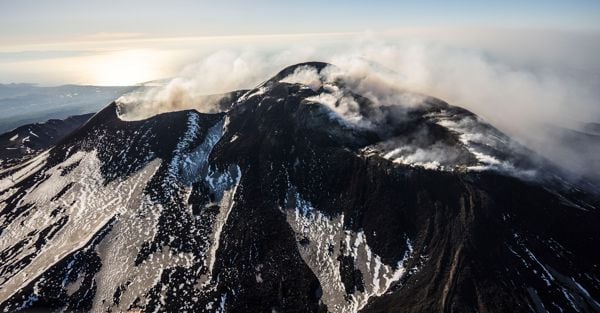
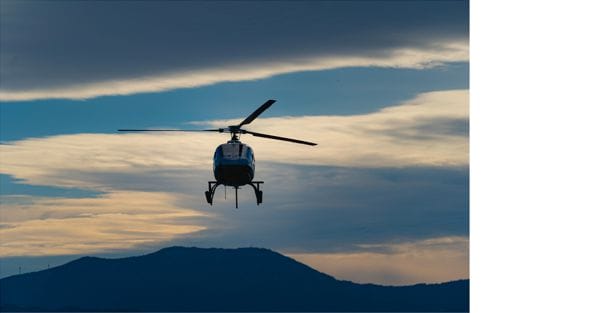
The helicopter tour is one of the activities organised for Panerai's Mediterranean Experience, four days to discover the Italian way of life and the territory at 360 degrees, including adventure, sport, action, but also food and culture: an immersion in this slice of the island designed to share the values of beauty and well made, the formula for quality Italian products. The heliport is located near Giardini Naxos, we quickly enter the vehicles and ascend vertically, a quick turn with a view of the coast and then we head straight for the four craters. It is not even 8 o'clock in the morning and the pilot, as we approach them, begins to describe from the intercom the landscape below: the lava, over more than 500,000 years, has covered an area of about 1,250 square kilometres and the signs of one of the most recent flows from above look like huge, dense outcrops, like long fingers that seem to have just cooled.
The landscape changes quickly and can be seen at a glance, the vegetation becomes more rarefied with altitude, the gorse gives way to brushwood, and the higher we climb the more lunar it becomes, dense black and deserted, punctuated only by a few flecks of snow that does not give way in the late May temperatures. In less than 20 minutes we are at the craters, the helicopter makes rapid circles over the summits, allowing us to look - literally - inside the mouths, gigantic jaws that are only apparently harmless: from one rises a white plume, a sign of incessant and nervous simmering. The excitement is high, a few metres below our feet heaps of pure sulphur break up the opaque blackness, in the background the total blue of the sea, our eyes frantically trying to look at the deepest point of the cavities, to see some tangible sign of volcanic activity. A few more laps and off to the slopes, in the direction of Cantina Cottanera, wine producers based in the area. The stop in the vineyard is only an intermediate step before returning to the volcano, this time from the ground, but it is also an opportunity to take a rest in front of a homemade almond granita made using the ancient method of the "neviere". I take the opportunity to speak with Alessandro Ficarelli, Panerai's C.M.O., who reminds me how the brand has a centuries-old history linked to action, which is part of its DNA: "It was born in Florence as a military watch for the wards of the Royal Italian Navy.
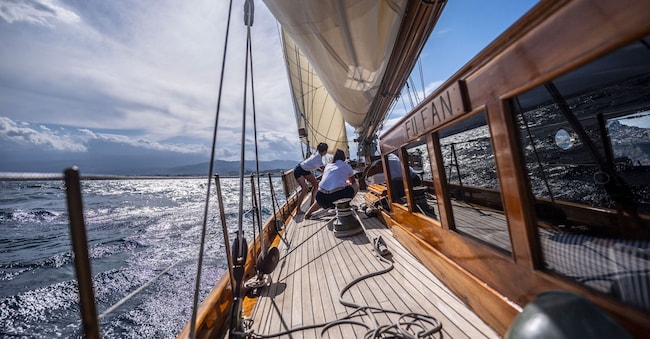
In 2019 we came up with the idea to start having our customer-collectors test some models by replicating the harshest conditions for which they were conceived, and so every year we organise bespoke al cune experiences. These are military-, adventure- and Italian-themed stays linked to special limited edition watches. By purchasing them, one gains access to the Experience. "From training in La Spezia with the Comsubin, the Comando Raggruppamento Subacquei e Incursori, or with the Navy Seals in the United States, to trekking with explorer Mike Horn in Bhutan, the goal is a deep dive into the brand's values to be experienced first hand, to be lived," he explains. The occasion for which we are in Sicily is linked to the new Radiomir 8 Days Eilean Experience Edition, 30 pieces sold out that allowed their purchasers - arriving from Texas, California and the Philippines, Hong Kong, Singapore, Dubai, but also from Italy - to come to Catania for four days of full immersion. "This watch is related to Eilean, a 22-metre Bermudian ketch built in 1936 by the legendary Fife shipyard in Fairlie, Scotland. A boat that Panerai bought and refurbished in the Del Carlo shipyard in Viareggio. Some elements of the bronze watch come directly from the restoration of Eilean. What we want to create with the Experiences is a concept of an exclusive club, a few buyers who can get to know each other and us in privacy and in a leisure context, where we also present them with previews of new products and where we collect wishes and suggestions. Over the years, there have been people who have become so attached that they have even attended four meetings, many buying the Experience watch blindfolded without even seeing it first. The process of loyalty and involvement is the primary objective.
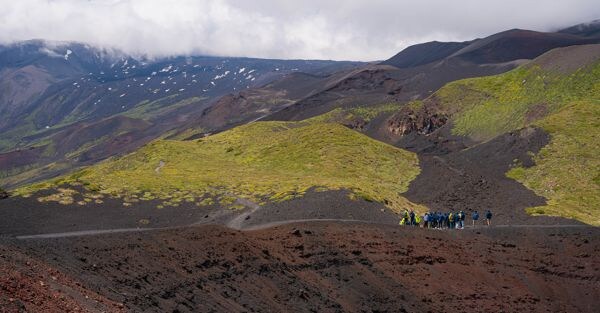
The break lasts barely an hour, and the volcano beckons us back, this time with an approach that is only apparently slower, but with a strong impact: now the ascent is overland, first in jeeps, then in special 4x4 vans that climb up the rocks along precise tracks, steep hairpin bends flanking vertical cliffs. The volcanological guide makes us stop along the way to show us the most recent small craters formed by the powerful eruption of 2002, now completely dormant, but the final objective is an altitude of 2,800 metres, on a plateau just below the Etnean Observatory, from which there is a full view of the north-east and south-east craters. Everything changes quickly, it is the nature of the volcano: an apparent quiet can be interrupted by unexpected activity that is difficult to predict even with the most advanced observation instruments. Here they say they love Etna as one loves all that is unpredictable, and I believe this to be true: only four days after my trek, the south-east crater collapsed and the material plunged down the slope, coming into contact with the residual snow and generating a thermal shock, high velocity gases, a column of ash hundreds of metres high and a general stampede (no one was hurt). It is the thrill of the proximity of a living creature, which over the millennia has marked the inhabitants of this land, who have adapted on the slopes, built houses, organised crops, planted vines - in particular, Nerello Mascalese and Carricante vines, which I get to taste during the wine tasting at Cottanera, when we return to base for lunch.