
Flying taxis and cargo drones, logistics prepare to fly
The Politecnico di Milano dossier presented by Federtrasporto and Freight Leaders Council photographs 656 active advanced mobility projects: 74% for goods and 26% for people

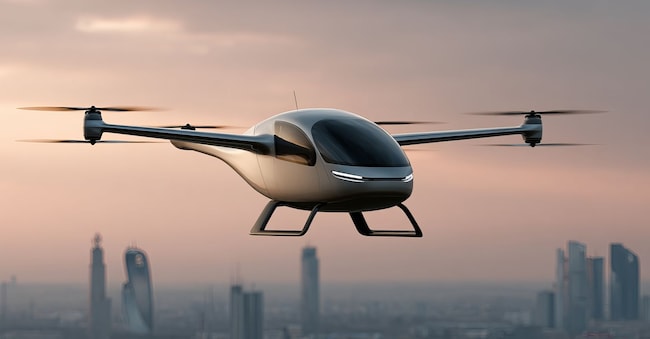
Logistics is looking up and attempting the vertical challenge, where futuristic drives go hand in hand with highly innovative technology. Alongside trucks, ships, trains and planes, a new transport infrastructure is appearing: an immaterial highway that opens up a new frontier that is anything but science fiction. Cargo drones and flying taxis are still largely in the field of experimentation, but projects are multiplying and the logistics sector is beginning to prepare to integrate them into the traditional transport network with a ground-sky-space alliance. According to a study by the Drones and Advanced Air Mobility Observatory of the Politecnico di Milano entitled "Towards the third dimension of mobility: aircraft, drones, space", curated by Alberto Curnis and presented in Rome during a closed-door meeting organised by Federtrasporto and Freight Leaders Council, 656 advanced air mobility projects are active worldwide between 2019 and 2025. Of these, 74% concern freight transport while 26% are dedicated to passengers.
Let's get on with it
The cargo segment is the most advanced. Of the 485 projects dedicated to cargo, 54% are in the testing phase, 34% have been announced and only 9% are already operational, a sign of a technology that is slowly moving from testing to reality. The main field of application remains that of general cargo, which accounts for 56% of the initiatives, while 44% concerns healthcare equipment. It is precisely healthcare that is one of the sectors where drones are finding their first concrete applications. In medical transport, unmanned aircraft are mainly used for medical devices (37%), drugs (32%) and biological samples or blood (23%). In most cases these are last-mile operations, covering 72% of missions, with the aim of reducing delivery times and reaching difficult or isolated areas quickly. In general cargo, consumer goods (75%) and parcels (15%) account for the largest share.
Passengers still behind
Less mature, however, is the passenger front. Of the 171 projects dedicated to passenger transport, 65% are still at the announcement stage, while 35% are at the testing stage. The initiatives are mainly concentrated in cities: 58% of the projects concern urban contexts, the remaining 42% suburban areas. The idea, operators explain, is to integrate these new vehicles into the existing transport system. "Drones are an integration of transport modes. We must utilise the infrastructures and nodes we already have, networking them to develop concrete cases of operation and identify solid business models,' observes Federtrasporto president Paolo Colombo.
The Global Scenario
Meanwhile, international competition accelerates. In Europe, the sector is proceeding more cautiously, also held back by the financial difficulties of some companies. In other areas of the world, however, investments are racing ahead. China, the United States, and Middle Eastern countries are pushing the development of advanced air mobility services and aim to put the first commercial flying taxis into service by 2026. "In this scenario, Italia is among the first countries in the world to have published a National Strategic Plan and to have launched the so-called regulatory sandboxes," explains Massimo Marciani, president of the Freight Leaders Council, "i.e., protected areas in which it is possible to test new technologies in safe conditions. There are three pioneer regions with their own airports: Lazio (Fiumicino), Lombardy (Malpensa) and Veneto (Allegri). "Here," Marciani continues, "tests are underway on the coexistence of drones, recharging infrastructures, and traditional air traffic, as well as experiments on cargo deliveries within airports to reduce environmental impact and the use of drones fuelled by green hydrogen for medical logistics and emergency services.


