
Food Districts Drive Tourism and the Ecological Transition in Piedmont
There are 9 realities set up from 2022 to 2024 by Alberto Cirio's government, with the aim of enhancing the territories, favouring their economic development

3' min read
3' min read
(Il Sole 24 Ore Radiocor) - 'Food does not only nourish tourism, which every year attracts thousands of visitors to Piedmont and Italy who are enthusiastic about our excellence, not just food and wine. It is also a sign of respect for our history and our land, assets that we must safeguard. For this reason, the Food Districts are an important opportunity for discussion'. These are the words with which the President of the Region Alberto Cirio opened"Territori che nutrono", the three-day debate organised from 21 to 23 March by the Piedmont Region, the Department of Agriculture and Food, in collaboration with the National Council of Food Districts. The event aims to address issues such as tourism promotion policies, market organisation, food waste and the sustainability of supply chains with its protagonists, the Food Districts.
Attention to tradition and innovation
They are realities - 9 in all in Piedmont and 200 throughout Italy - created with the objective of favouring the protection of rural areas, their landscape and their specificities. All this is combined with their economic development and support for local agricultural and agri-food production systems. Their membership base is made up of public bodies, institutions, enterprises and third sector entities, whose cooperation is capable of producing tangible and intangible external economies (such as the promotion of the area's products and tourist offer, preservation of the rural landscape, innovation, etc.).
The longest-lived District was born on 1 April 2022, while the newest was recognised in March 2024. Their activities are diverse and show attention to the latest energy innovations, such as cers and renewables, and digital, but also to tradition. Food and wine are one of the driving forces of the Piedmontese economy, especially in an area with a strong vocation for tourism (+9% of entries in 2023). Suffice it to say that the Region's PDO PGIs in 2022 were worth 1.7 billion euro (Ismea Qualivita data), with 13,000 operators involved in the sector.
From organic to tourism promotion
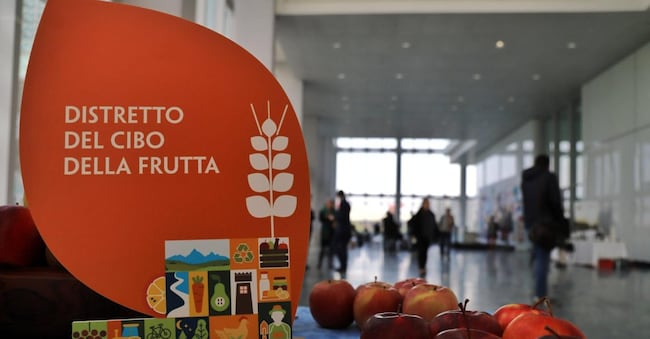
The Chierese-Carmagnolese District, for example, focuses on the implementation of production certification (organic, integrated, traceability, origin) and has a strong focus on the links between tourism, soft mobility and culture in the area. That of the Langhe e Monferrato has a focus on food and wine and experiential visits, while research and development of new production techniques and easier marketing is that of the Distretto del Roero. The Cebano-Monregalese, on the border with Liguria, on the other hand, has an organic orientation, while the Frutta District has, as its name suggests, a fruit-growing vocation and supports its companies in communicating to consumers the quality and wholesomeness of its products and the environmentally and socially responsible choices adopted by local operators.
From adapting to the climate crisis to virtual shop windows
.The plans of the Distretto del Cibo Pinerolese Terre da Tasté, on the other hand, range from the training of operators in the agrifood and tourism sectors on environmental sustainability and adaptation to climate change, to the definition of guidelines for the sustainable management of water resources for the area's agricultural sectors. That of the Mombarone, Serra Morenica and Naviglio d'Ivrea has among its objectives that of creating a system for communication and a virtual showcase of local products, such as wine, and of the area's tourist and historical-cultural excellence. The Alta Langa e del Cebano, on the other hand, aims to develop public-private synergies to improve the logistics and marketing network for its products, but also to promote more responsible consumption. Lastly, the Distretto del Cibo Appennino e Colline di Langa e Monferrato - the last one to be recognised - focuses on the ecological transition of companies, orienting them towards organic production, on qualifying the relationship of companies with the market to organise short sales circuits and finally on consolidating a model of slow hospitality, built on the combination of landscape and typical products.


