
Food education: the alliance of Italian agribusiness is born at the University of Gastronomic Sciences in Pollenzo
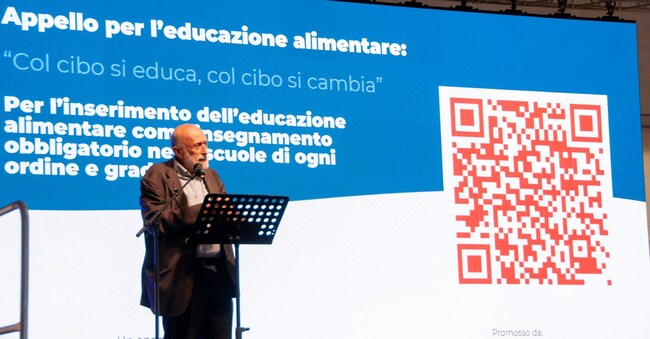
The appeal of the world's first university dedicated to gastronomy: 'Compulsory teaching of food education in all schools'. Celebrating 20 years of activity with 800 representatives of the most important Italian food companies

5' min read
5' min read
"The challenge of the coming years will be to overcome divisions, to work on sharing and cooperation. If we do not go beyond the logic of competitiveness, if we do not see the food sector as a common good, we will not be able to cope with this long period of transition. The necessary paradigm shift in our behaviour is the order of the day: either we take this path in harmony with nature and with each other, or the situation will become irreparable,' said Carlo Petrini, founder of Slow Food and president of the University of Gastronomic Sciences, at the opening of Pollenzo's 20th anniversary celebrations, in front of an audience of 800 people representing more than 300 realities of the Italian food industry, the main institutions in the area and 12 rectors of universities in Piedmont and the rest of the Peninsula.
The mission for the coming years
"To the students present here I say that the mission for the coming years is to have an open eye to the world, to other gastronomic cultures: we have made multidisciplinarity the value of this university, now we must take another step and overcome Eurocentrism. The ability of the gastronome is to understand the complexity of the world starting from food and this is the greatest joy that a university can give'.
The primacy
.Founded in 2004 and promoted by the Slow Food association with the collaboration of the Piedmont and Emilia-Romagna regions, the University of Pollenzo was the first, and still the only, university in the world entirely dedicated to the study of food from the point of view of gastronomic sciences. And it is precisely in Pollenzo that gastronomic sciences have obtained academic dignity: in 2017, in fact, the Miur defined two new degree classes in Gastronomic Sciences based on the Unisg model. In 20 years, over 3800 gastronomes have graduated, 45% of them from 101 countries around the world. Carlo Petrini appealed to the most important realities of Italian agrifood production to spread the cultural and political potential that the food sector has, supporting the appeal Col cibo si educa, col cibo si cambia, with which Unisg and Slow Food Italia urge the government to include food education among the subjects of study in schools of all levels.
The approach
."The logic that must guide the food system can only be 'organic' in the etymological sense, i.e. centred on life. No development worthy of the name, in fact, today can be separated from an approach that makes it first and foremost sustainable, durable, harmonious. In antithesis to food as a 'commodity': produced to be sold, rather than to nourish the body and spirit; produced for the financial markets and subject to speculation; food that is wasted, at a global level, for a third of total production: here food education teaches us the culture of what is necessary to fight waste,' stressed Barbara Nappini, president of Slow Food Italy, promoter of the appeal together with Unisg, the Laudato si' Communities, the University of Turin, the University of Eastern Piedmont and the Polytechnic University of Turin.
Eating disorders
."And what can we say about the recent Italian data according to which two million people under the age of 16 suffer from eating disorders: it is urgent to rebuild a correct relationship with food and the land that produces it. With this in mind, I believe that food education in schools must be a collective project, a place to experiment with new forms of learning. A future that holds together technical data and traditional knowledge, global vision and appreciation of territorial diversity, lucid analysis and affective intelligence, scientific research and beauty'.
Brand connect


Newsletter Scuola+
La newsletter premium dedicata al mondo della scuola con approfondimenti normativi, analisi e guide operative
Abbonati