Excellent sectors

Food, Fashion and Furniture: young people of Italian excellence prepare for the future

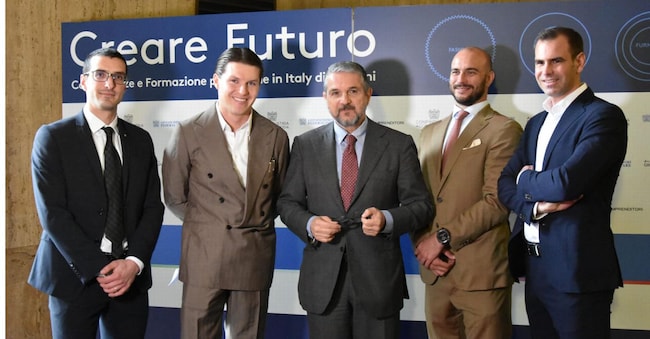
Second edition of the 'Creare Futuro' Forum promoted at Mimit by the presidents of the Young Entrepreneurs' Groups of Confindustria Accessori Moda, Federalimentare and FederlegnoArredo

by R.I.T.
4' min read

Translated by AI
Versione italiana

4' min read

Translated by AI
Versione italiana

They are the incontrovertible symbol and testimonial of Made in Italy in the world: food, clothing and furniture (the three 'A's) or, to put it in English to support the international relevance, Food, Fashion & Furniture, the so-called three 'F's, which together contribute to generating around 20% of the national GDP.

Excellent, innovative, competitive, the companies in these three sectors are nevertheless still too often associated with traditional production methods and organisational structures that are incapable of satisfying young people's ambitions for professional growth. On the contrary, they are highly dynamic and internationalised sectors, where investments in technology, digitalisation and human capital are constant.

Loading...

It was precisely in order to bring these aspects to the fore and reflect on the evolution of these supply chains that the 'Creare Futuro' Forum, promoted by the chairmen of the Young Entrepreneurs' Groups of Confindustria Accessori Moda, Federalimentare and FederlegnoArredo, was launched last year. The second edition, dedicated to the theme 'Skills and Training for the Made in Italy of Tomorrow', was held on 30 March at the headquarters of the Ministry of Enterprise and Made in Italy and featured a speech by Vice-Minister Valentino Valentini. This year's appointment aimed to reiterate the importance of the role of the 3 'Fs', strengthening the dialogue between companies, institutions and the world of training and addressing crucial issues such as innovation, digital transition, production quality and international competitiveness.

The weight of the three industrial supply chains

The industrial sectors concerned represent not only a flagship of the made in Italy, but also a pillar of the Italian economy, both in terms of value generated and employment impact. The wood-furniture supply chain has an annual turnover of more than 51 billion Euro, while the fashion accessories supply chain is around 29 billion. The food sector, on the other hand, reaches the 204 billion euro mark. In terms of employment, almost 300,000 people work in the wood-furniture sector, over 135,000 in the fashion accessories sector and 470,000 in the food sector.

On the export front, 2025 was a record year for the food sector, which exceeded EUR 59 billion in exported goods, an increase of 4.2% compared to 2024. On the other hand, the fashion accessories sector achieved EUR 24.2 billion in exports, while the wood-furniture sector generated EUR 19.4 billion in revenue abroad.

The challenge of the new generations

At the centre of the 'Creare Futuro' Forum is the importance of investing in the new generations and the delicate issue of the difficulty of finding, attracting and retaining professional profiles that are suitable and necessary for development. According to projections by Unioncamere - Ministry of Labour and Social Policies, Excelsior Information System, in the five-year period 2025-2029 Italian companies will need to hire between 3.3 and 3.7 million workers. On an annual basis, this translates into a demand for around 247-268 thousand Its Academy graduates or diploma holders, 185-216 thousand technical-professional upper secondary school or high school graduates, and around 125-126 thousand people with training or vocational training qualifications.

Training also proves to be a central element in the recruiting policies of companies, which nowadays predominantly demand technical figures, and the 3 'F' sectors do not escape this dynamic.

As shown by the analyses shared by Umana, a partner in the initiative, an effective synergy between the world of work and the world of training, such as the dual system, is one of the most effective responses to this shortcoming: the Its institutions, for example, express a placement that reaches 90 per cent one year after graduation, although they are still unable to fully fill the market gap.

The voice of young entrepreneurs

"The new generations, who have grown up in a context that is increasingly oriented towards immediacy, find it difficult today to fully grasp the value, care and work that characterise Made in Italy," said Carlo Briccola, president of the Gruppo Giovani Confindustria Accessori Moda (Young Confindustria Fashion Accessories Group), in his speech. This is why it is necessary to evolve the language with which the sector is told, making it more effective and closer to young people. This is not just a cultural issue: many young people do not know the production processes and, above all, do not perceive the richness and complexity of what happens every day inside companies. For this reason, today more than ever, it is essential to strengthen the dialogue between companies and the new generations. Made in Italy does not need to reinvent itself, but to tell its story better and speak to young people in particular'.

For Guglielmo Gennaro Auricchio, president of Federalimentare's Young Entrepreneurs, 'In the current economic context, talking about business increasingly means talking about a supply chain and system, not individual isolated realities. Competitiveness is not built alone, but through structured models, capable of integrating skills, resources and strategic vision along the entire value chain. For young entrepreneurs, this implies a change of mentality: overcoming the individualism that has historically characterised our country and contributing to the construction of a true Sistema Italia. The challenge for the new entrepreneurial generation is clear: making a system is not an option, but a responsibility'.

"Made in Italy is not just an economic asset, but a cultural and productive heritage that makes a decisive contribution to the country's growth," added Filippo Santambrogio, president of the FederlegnoArredo Young Entrepreneurs Group. To continue to be a globally recognised excellence, however, we must decisively invest in the new generations, building concrete paths that bring young people closer to the business world. Regardless of how the economic scenario evolves, we will need thousands of young people trained and ready to enter our companies to bring vision, energy and new languages. It is not just a matter of ensuring continuity, but of accompanying a necessary transformation. Creare Futuro was created precisely with this objective in mind'.

Deputy Minister Valentino Valentini Italy recalled that Made in Italy 'is not a celebration, but a mission. These young people prove it every day: they did not wait for someone to open the way for them, they opened factories, changed the language, made a system between different supply chains. Example is the most powerful engine of entrepreneurship, and they are proof of that. Our task as institutions is not to hinder this energy, but to multiply it, with faster training, accessible digital tools and the awareness that small, within a cohesive ecosystem, becomes big'.

Copyright reserved ©
Loading...

Brand connect

Loading...

Newsletter

Notizie e approfondimenti sugli avvenimenti politici, economici e finanziari.

Iscriviti