
Football shirts? Carbon dating every life
Through Giacinto’s collection, Gianfelice Facchetti explores the concept of belonging – The 7,000 kits in the Manchester vault: from vintage and retro to one belonging to Maradona

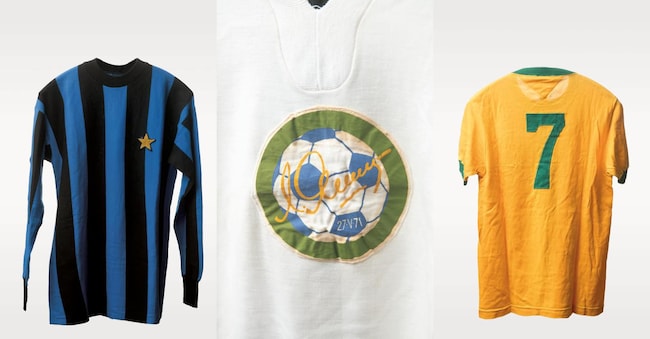
How powerfully a football shirt resonates. Adrenaline and the abyss, sweat and sighs: every shirt is a tapestry of countless lives and stories. And this is clearly evident in Gianfelice Facchetti’s new book Solo per la maglia. My father and his shirts: a tale of football, memory and life. In a family trunk, Giovanna, the wife of the captain of the ‘Grande Inter’ and the national team, has preserved – labelling them one by one – shirts, tracksuits and pennants that her husband brought home over a career spanning almost twenty years – 94 matches for the Azzurri, 634 for the Nerazzurri – at a time when footballers had few shirts to swap; for this reason, writes Facchetti, ‘you never forget your first shirt. We found it in a specific place that memory had tucked away in one of its nooks. The back of a locker in the changing room, the corner of a bed, the bedside table – one day, someone put it there for us, and it caught our eye straight away before settling in our hearts. To stay there for good’.
Thus, the shirts become a part of both personal and collective memory, from Italia to England, from Mexico to Germany. They embody both history and geography. From his Serie A debut (1961), when he scored against Ghiggia – the man behind the ‘Maracanazo’ – to his first appearance for the Azzurri, in 1963, in Istanbul, on the battered pitch of the Mithat Paşa Stadium – the only stadium in the world from which one could admire two continents, Europe and Asia, separated by the Bosphorus. That trunk tells of Soviet and Portuguese talents, long-standing friendships with Pelé or Lev Yashin, the greatest goalkeeper of all time. Or even the story of a changing Europe, with Yugoslavia set to cease to exist. Or the story of Europe told through the white shirts of Overath’s Germany and Octávio’s Portugal, the yellow shirts of Romania and England, and the yellow and black shirt of AEK Athens. The red shirt of Wales and the maroon shirt of Mexico in ’70. The fabrics speak of other eras. Perhaps tinged with melancholy, yet alive because ‘in football, the shirt is the alpha and the omega, the kick-off and the final whistle rolled into one; it is what remains whilst everything else races by and changes at a certain speed’.
The brothers Doug and Gary Bierton know this all too well; at the time, they were university students living in halls of residence in Manchester with more football shirts than books. Football fanatics since Italia ’90, they became captivated by Manchester United’s run in the 1991 Cup Winners’ Cup, by Carlos Valderrama’s hair and by Mark Hughes, who would fire the ball into the net whilst wearing a smart white shirt with no sponsor’s logo. Dozens of English and Italian matches sparked an innate craving for shirts, and their fateful meeting with Matthew Dale led to the founding of Classic Football Shirts, an online and high-street retailer specialising in the sale of original, vintage, retro and modern football shirts. It was 2006, and that story continues to this day: a vault in Manchester housing over 7,000 shirts from all over the world, and a colourful, historic book recently published by Limina featuring the world’s most beautiful and original shirts. The business has grown to become a global benchmark for collectors and enthusiasts, with over 200 employees. But it is the story that matters: the first rare items arrived in 2012. Whilst travelling in Ukraine for Euro 2012, the three friends – having lost their suitcases – found themselves in Kharkiv, a place brimming with vintage shirts: Anderlecht, Lazio, Juventus, Newcastle United from the 1990s, all available for a couple of pounds. Over the next two weeks, more warehouses in the most desolate backwaters and more treasures. Many were resold, others swapped to expand the collection. There’s the Sporting Lisbon shirt worn by Ronaldo in the friendly match where he caught United’s eye; a Napoli shirt which, at a cellular level, might still reveal traces of Diego Maradona’s sweat; the United ‘snowflake’ shirt; and the jersey of the Caribou of Colorado, a modest club from the North American Soccer League of the 1970s that wore a fringed shirt.
In their eyes, the vault – like the book – is much more than just a huge, crammed-full cupboard. It is an art gallery, a showcase of creativity and a museum. Every shirt is a portal to a time and a place: each one is irresistibly evocative of its era. A football shirt is not just an item of clothing. It is a badge of identity and a sign of belonging. It is an act of self-definition, a sharing of knowledge, a symbol of authenticity. But above all, it is a form of memory, characterised by three stripes or a ‘moustache’ and, increasingly, by its ability to wick sweat away from the skin. Because what makes a shirt exceptional is not the intentions of the person who designed it, but the actions and achievements of those who wore it.
In the early 1970s, the first sponsors appeared (Eintracht Braunschweig chose Jägermeister); in the mid-1990s, shirts featuring players’ names; and in the late 1990s, football – having emerged from the tragedies at Bradford, Heysel and Hillsborough – became a business, not least through TV rights. And today, more than the shirts of the Blancos or the Reds, it’s the shirts of the star players that matter. Footballers are stars and full-fledged businesses in their own right, with designers whetting collectors’ appetites through nods to the past and retro choices, because they know full well that every shirt is a carbon dating of our lives. That’s why we love them – because they make us feel forever young.


