The interview.

'For Pompeii we have 100 million for three years now more help from private individuals'

by Vera Viola

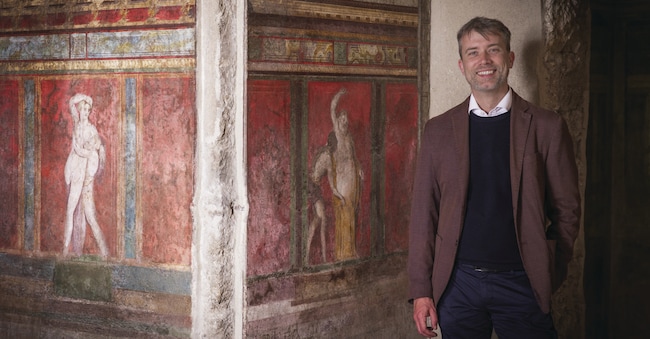
L’archeologo. Gabriel Zuchtriegel dal 2021 responsabile del Parco Archeologico di Pompei

4' min read

4' min read

Twenty-eight restoration and maintenance sites are open, ten of which are also stratigraphic excavations. The Archaeological Park of Pompeii is buzzing with activity, with archaeologists and restorers in action, who are also managing to cope with ever increasing visitor flows. Fifteen thousand a day, sometimes twenty thousand, "even more," points out the Park's director, Gabriel Zuchtriegel, in Pompeii since 2021 and promoter of a new season for the most important archaeological site, "and not only on the first Sunday of the month, but also on any day of the week.

So, director, Pompeii was reborn with the European Major Project of over 106 million. And today, are we in a new phase?
That's right. First there was the rescue: we were coming from the era of continuous collapses, of houses that were cordoned off, of alarm echoed around the world. Today, having secured the heritage, we have moved on to maintenance and eventually expansion. The first is the priority: we have 13 thousand rooms to monitor, to protect, intervening before new critical situations arise. We have also made important discoveries, including the children's drawings in the Casa del Cenacolo, or the frescoes in the Casa dei Pittori al lavoro. Just to mention the most recent ones.

Loading...

The major project had brought a substantial sum to the site, do you now have sufficient resources to support new interventions?

At the moment, yes, because we have as much as 100 million available for the three-year period, which partly comes from the NRP, partly from other European and national programmes, as well as from the Ministry of Culture. Funds that include the ticket revenues that remain at the site for 70%. The problem is for the aftermath, because we need to know today to plan what will happen after 2026. We need to think about the day after tomorrow. For example, with donations from private individuals. In recent years we have received 1 million, but I believe that much more is possible.

We talk about resources, human and professional resources have also grown. Maybe not enough?
We are missing 181 people. Today we have 217 employees of the Ministry of Culture working in the sites of this area. The staff plan provides for a requirement of 398 employees. Now the ministry has published a notice, we are confident that it will want to allocate part of the recruitment to Pompeii. If we then consider the service companies - such as the ticket office, security and others - the number of people employed today reaches 400.

13 thousand rooms in which every stone has great value, and what's more they have withstood 2 thousand years of history: how do we monitor the heritage?
We have a very important 800 million project for 4 years: we have built digital platforms that monitor the entire ancient city. We then have an intervention plan that we consider flexible, so that when a criticality emerges we can review the priorities. A great work.

Let's get back to the attendance: will it be able to grow again, or p do you think that sooner or later a closed number will have to be set?
We also record more than 20,000 daily attendances, but not always: so it is a sustainable turnout. We can also do more, however, to accommodate increasing numbers of tourists.

What, for example.
Open other spaces, such as the Pnrr-funded walk along the walls. Or focus on other sites: from Oplonti to Boscoreale, to Castellammare di Stabia. We can even double the number of entrances.

But the other sites do not take off, even though they insist on degraded areas to which the development of art tourism could give an economic and social turnaround.

We have worked a lot on these areas. In Boscoreale, the Antiquarium that had been closed for many years was reopened, in Torre Annunziata, after an agreement with Minister Crosetto, we obtained the availability of two Defence buildings that will house the finds of the Villa of Oplonti. In Castellammare, the museum of the Reggia del Quisisana is open. We have set up a shuttle service connecting one site to the other.

The effects are not visible. Just as there are no effects on the extra moenia of Pompeii. You yourself have said several times that you would like tourists to stay in Pompeii for more than just one day, which means that this trend has not changed.
Here a further effort is needed. Receptivity must be increased, new roads must be built, services must be offered. It is the whole context that must grow with strong action by the municipal and regional administrations. It can be done, we need a strong commitment and more synergy. In the meantime, we are also putting new projects in the field. For example, we will set up an Academy.

An unprecedented project, tell us about it.
Italy has always been an excellence in the science of restoration. Hence the idea of creating an Academy in Castellammare di Stabia in which to train experts in restoration and archaeology. And in which to go beyond the mere concept of protection to develop the potential of these places to the full. We are talking about this with numerous universities, both Italian and foreign. But there is also something else, for example within the Directorate of the Archaeological Park of Pompeii we have decided to do a course on leadership in public administration. at first I did not believe much in it, then I had to change my mind and I see with great interest this course, which I think is a novelty in the world of Italian public administration.

Copyright reserved ©
Loading...

Brand connect

Loading...

Newsletter

Notizie e approfondimenti sugli avvenimenti politici, economici e finanziari.

Iscriviti