
For Shein, sustainability is an open challenge: greenhouse gas emissions increased by more than 80% in one year
The results in the third sustainability report just published by the fast fashion giant, which admits: 'We still have a lot of work to do'

3' min read
3' min read
In order to witness the realisation of the most heralded and eagerly awaited hypo in the global fashion industry in recent years, it seems that we need to start looking towards the country where it all began and where it all feeds: it is in fact on the Hong Kong Stock Exchange that, according to the rumour reported by the Financial Times last June, Shein, the fast fashion giant, born in Nanjing in 2012 and from 2022 based in Singapore, which has conquered millions of consumers in 150 countries around the world thanks to its peculiar formula: very low costs, infinite catalogue, hyper-speed of service, from production (mostly based in China, in the Guangzhou area) to delivery.
Clouds of uncertainty have been gathering over the past year in the 'western' markets previously considered, New York and London: in the United States, in the context of trade and political tensions with Beijing, Shein has recently come under the lens because its technology applied to American manufacturing and trading partners could pose a threat to national security. In Europe, the deadline set by the European Commission, which on 26 April had included Shein in the list of 'very large online platforms' (VLOP), as such obliged to comply with the Digital Act's stringent rules, is expiring in these very days, and there is discussion about raising the dazi for products such as Shein's. And this while regulations are multiplying - such as those on eco-design, circularity and traceability - with which institutions are trying to force the fashion industry to reduce its still too serious impact on the planet.
While remaining convinced of its formula - truly democratic fashion, produced on demand according to data collected on preferred styles and trends, thus avoiding overproduction - Shein also knows how crucial it is to invest in sustainability, and has been publishing a report dedicated to these issues for the past three years. In the most recent one, published a few days ago, along with the due descriptions of meritorious initiatives, ambitious programmes and undoubted progress, one figure stands out: "Our absolute emissions have grown from 9.17 million tonnes of CO2 gas equivalent in 2022 to 16.68 million in 2023. We recognise that we still have much work to do on our impact and are committed to making progress,' reads a paragraph on page 31.
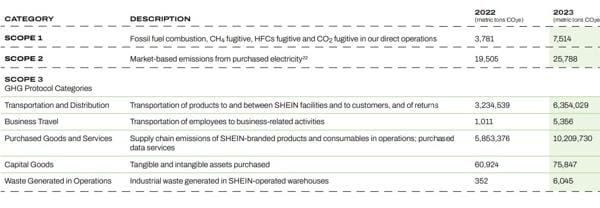
The figure expresses a growth of almost 82%, but it is not the only one that is worrying: between 2022 and 2023, the report states, greenhouse gas emissions linked to direct operations rose from 3,781 tonnes to 7,514; indirect emissions, linked to the purchase of electricity, from 19,505 to 25,788 (Shein states that 72% of the energy consumed comes from renewable sources, compared to 68% in 2022); those produced by the transportation of products, from production to sale to return, from 3.2 million to 6.3; the emissions of the supply chain of Shein-branded products from 5.8 to 10.2 million; the industrial waste produced only in the facilities directly managed by Shein from 352 to 6,045. The network of partner manufacturers mentioned in the report is 5,800, a figure that however only includes those who deal with Shein-branded finished products, i.e. the final stages of the supply chain, and who have entered into contracts directly with the group.
In terms of the fibres used in its products, almost 76% are polyester, of which 6% recycled (although among the objectives of its evoluShein sustainability strategy, launched in 2022, is to reach 31% by 2030); cotton accounts for almost 10%, followed by viscose (8%), of which 5% from certified sources.


