
For the tractors of the Via Emilia, revitalisation depends on skills
Mechanics. The first Master's degree in Off-Highway Vehicle Engineering dedicated to the engineering of vehicles that operate off-road is launched. Objective: to attract young talents from all over the world to the region

3' min read
3' min read
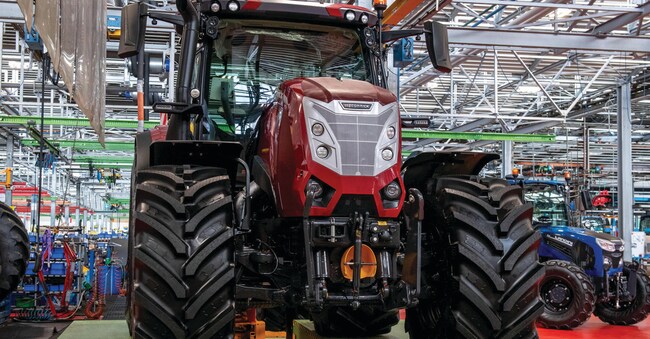
The first Master's degree course in Off-Highway Vehicle Engineering dedicated to the engineering of vehicles that operate off-road, such as tractors, will start in Modena in a few days. This is the first international university course in engineering entirely focused on agricultural machinery, promoted by Muner, the Motorvehicle university of Emilia-Romagna, set up in 2017 by the teamwork between the four universities of Via Emilia and the Motor valley brands to attract young talents from all over the world to the region, turn them into top-level technicians and include them in the auto racing sector. Now, thanks to the synergy with Cnh Industrial and after the success of the summer school at which the project was presented, Muner is starting work on new engineering profiles for sustainable agriculture, capable of combining technological and agronomic knowledge (20 places and 24 months of study within the Master's Degree in Advanced Automotive Engineering), applied to agricultural tractors, combine harvesters and earth-moving machinery.
This is an initial, coherent response focused on training to bring the Modena and Reggio Emilia tractor district back to the centre of the global scene, gripped by a twenty-year crisis that has not undermined its international projection (exports continue to grow and support the Italian trade surplus) but has seen domestic demand for tractors contract in tandem with the production fabric: tractor sales fell from 60 thousand machines in the 1990s to 30 thousand in the great crisis of 2009 and plummeted to less than 18 thousand registrations in 2023, a number that will fall further in the first six months of 2024 (8.363 tractors registered, -17%, FederUnacoma data). Just as the production district has halved: "Today we have 31 member companies in the province of Reggio Emilia and 18 in Modena for a turnover of about 1.9 billion euro linked to the agricultural sector," explain the analysts of the Confindustria Federation, "out of 350 member companies at national level that invoice about 15 billion annually. They are mostly component companies, few Italian brands remain (the leader Landini-Argo Tractors and niche companies such as MB Tractors and Scaip), even fewer are in Italian hands, after Goldoni passed to the Belgian group Keestrack and Gianni Ferrari to the Japanese Kubota.
And yet, the role of the Emilian pole remains crucial, as confirmed by the investments in the territory (around one hundred million euros per year) of an international big name like Cnh that in Modena, where it has been present since 1928, has a team of 2,000 employees, 700 of whom are high-profile engineers, between the huge factory of components for agricultural machinery (then assembled in 40 other production sites around the world) and the R&S centre that has become the reference point at European level for electrification, where the first dynamic simulator for agricultural machinery was created. "The agricultural mechanics sector is still a driving force for Italy, and within a radius of 150 km from Bologna operate the most important national and international brands that still make our country the second player in agricultural mechanisation in Europe, after Germany. And our Laboratory for the homologation of agricultural machinery is the most efficient and productive OECD test station in the world in terms of the number of certifications issued,' explains Michele Mattetti, associate professor in Agricultural Mechanics at the Alma Mater, a branch of engineering that has merged into the Department of Agri-Food Science and Technology of the University of Bologna, where some thirty specialised engineers work. "We are unique in Italy," continues Mattetti, who is involved in several experimental projects with companies in the district, Cnh in primis, "both because of our geographical proximity to the manufacturers, which has allowed us to develop cutting-edge skills and the most innovative agricultural machinery here, and because no other university in Italy has a university agricultural farm of over 500 hectares within cycling distance where we can carry out experiments on very different crops and technologies.


