Automotive

Ford tries again with electric: 5 billion for a new Model T moment

Dearborn-based company invests heavily in Kentucky and Michigan to produce cheaper electric vehicles, but competition with Chinese prices remains a titanic challenge

by Finance Review

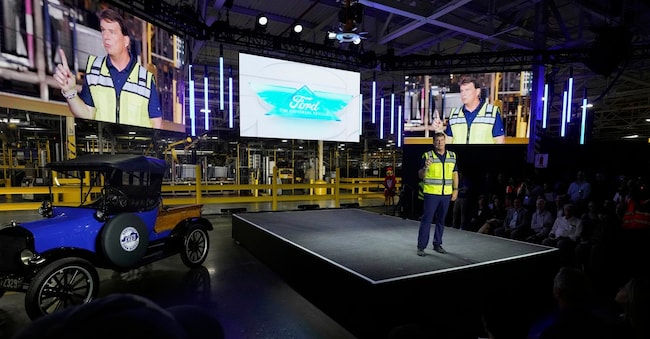
Jim Farley, ceo di Ford, parla nello stabilimento  di Louisville, Kentucky, per illustrare il piano di rilancio nel settore delle auto elettriche. (AP Photo/Darron Cummings). (AP Photo/Darron Cummings)

3' min read

3' min read

Ford is pushing hard on the accelerator to stay on course in the electric transition. The Blue Oval has unveiled a $5 billion plan that includes nearly $2 billion to convert the plant in Louisville, Kentucky, to electric vehicle production. The announcement by CEO Jim Farley marks a strategic shift for the historic American brand, which aims to make electric finally profitable after years of bloody losses.

The first model to emerge from the revamped lines will be a four-door mid-size electric pickup, with a starting price set at around $30,000 and a debut scheduled for 2027. A move that Farley called yesterday 'the Model T moment' of the electric era, comparing the scale of the transformation to the revolutionary one introduced by founder Henry Ford over a century ago.

Loading...

The conversion of the Kentuckian plant, which produced internal combustion vehicles for 70 years, is the heart of a broader strategy. Ford will introduce a universal platform that will reduce components by 20 per cent, reduce fasteners by 25 per cent and speed up assembly time by 15 per cent. The traditional assembly line will evolve into an 'assembly tree' with three parallel lines that will be joined successively.

The total investment of 5 billion between Kentucky and Michigan - where the battery factory will be built - is expected to create or retain almost 4,000 direct jobs. In Louisville alone, 2,200 permanent jobs will be secured, an important signal for an industry undergoing rapid change.

Ford's strategy emerges at a delicate moment for the American electric car. The Trump administration is dismantling federal incentives (Tesla knows something about this), eliminating the $7,500 tax credit for Ev purchases. Despite this, the CEO of the Blue Oval reiterated that from the electric transition 'there is no going back'.

The challenge, in fact, is titanic. Ford's Model E division recorded losses of 5.08 billion in 2024, with revenues down 35% to 3.9 billion. From 2023 to 2024, electric and software operations burned almost 10 billion in total. Sales of the three current electric models - Mustang Mach-E, E-Transit and F-150 Lightning - dropped by 12% in the first half of the year, while hybrids - and it is not only happening in America - are flying (+27%).

The real test remains the Chinese competition. Manufacturers such as BYD have optimised their supply chain and production to sell electrics between $10k and $25k, against a US average of $47k. Ford will use lithium-iron-phosphate batteries produced in Michigan with technology from Chinese giant CATL to cut costs.

"We are not in a race to build more electric cars," Farley explained, "but we are in a race to have a sustainable, profitable electric business that customers like. The Californian 'skunkworks' team, led by former Tesla Alan Clarke and composed of talent from Tesla and Rivian, works in secret on the new affordable models.

The game is played on price. Startups such as Slate (backed by Jeff Bezos) are aiming for $25,000 electric pickups, Tesla has promised a cheaper model that has yet to be seen, while Rivian and Lucid are preparing low-cost versions (above $40,000, anyway). Ford has already scaled back some targets, cancelling the three-row SUV and postponing the new F-150 Lightning and E-Transit until 2028.

Ford's approach contrasts with that of General Motors, which electrifies its entire range, from the mastodon Hummer to the compact Equinox. While GM has invested time in a dedicated electric platform, Ford has converted existing models to get to market sooner, but paying the price of volatile demand.

"The American pure EV market is as follows: small vehicles for commuting and cities," Farley recently stated. A vision that could prove successful if Ford can deliver on its promise of profitability within a year of launch. However, the challenge to the Chinese model remains formidable: closing a price gap of more than $20,000 will require an unprecedented change of pace.

Copyright reserved ©
Loading...

Brand connect

Loading...

Newsletter

Notizie e approfondimenti sugli avvenimenti politici, economici e finanziari.

Iscriviti