
From forests to asthma treatment: Italian excellence at the James Dyson Award 2025

4' min read
4' min read
It is called Foremyc and is a system that combines sensors and digital twins with the aim of "giving voice" to forests and strengthening the climate resilience of Alpine ecosystems: the peculiarity of this unusual project? The fact that it was chosen as Italy's winner of the James Dyson Award 2025, the international design and engineering competition for students promoted by the Foundation named after the British inventor and entrepreneur. The challenge, in which young people from all over the world competed to find solutions capable of tackling a real-world problem, involved more than 100 Italian initiatives (assessed by a jury comprising Eric Serra, Dyson's Lead Design Engineer, Massimo Temporelli, a physicist who has been involved in the dissemination of scientific and technological culture for 25 years, and Riccardo Cambò, an IED lecturer and co-founder of the Caffè Design community), and awarded prizes to Foremyc and two others, both dedicated to the theme of health and safety: Nivor, an anti-avalanche airbag, and Halia, a sustainable therapeutic system for the treatment of asthma. All three projects, as stated in a press release issued by Dyson, will now enter the international phase of the competition, which will end on 5 November, with the possibility of winning the final prize of €36,000.
Foremyc, sensors and digital twins to protect forest heritage
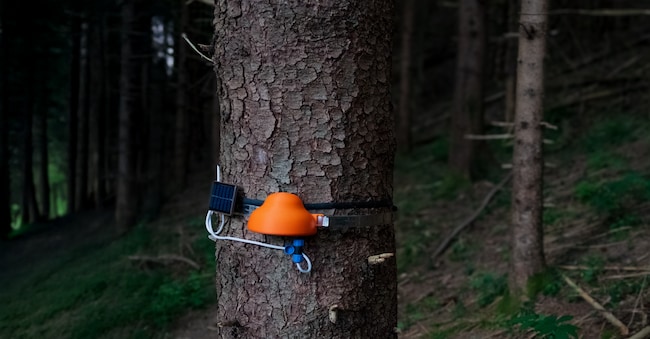
Monitoring soil, microclimate and tree health, using the data collected to feed a digital twin whose task is to support predictive management: this is the nature of Foremyc, a solution that maximises the work of collecting an ecosystem of sensors to support truly data-driven decisions for forest protection. The project springs from the heads of Iari Vanoschi, Bartolomeo Chinali, Federico Luigi Gabrieli and Francesco Cantoni (Product Design graduates at IED) and takes shape as a tangible response to catastrophic events such as storm Vaia in autumn 2018. The system has already been tested in collaboration with the Forestry Consortium of Valle Averara (in the Bergamo area) and integrates sensors that work in synergy with each other by collecting data at the base and trunk of trees and detecting the presence of beetles. All the information recorded is transferred to the cloud via a dedicated Wan network and visible on a dashboard that will be used by technicians (and in the future by consortia, companies and citizens) to follow the evolutionary progress of the forest, tree by tree. The ultimate goal, say the project leaders, is to make the hardware more stable and suitable for prolonged outdoor use and to build a digital twin of the forest itself, and thus a continuously updated model that reflects its status day by day and allows for the early detection of potential risks of decay.
Nivor, the assistant for surviving avalanche burials
The solution consists of a bag inside which is contained
an anti-avalanche airbag designed to be compatible with most mountaineering backpacks on the market: Nivor is a project by Isabella Campana, currently a student at the IUAV University of Venice, and was developed during her three-year degree in Industrial Product Design at the University of Bologna. The innovative feature of this solution is the ability to breathe the air contained in the airbag once it has inflated, exploiting the presence of two non-return valves, one required to inflate the airbag and the other connected to the breathing tube, which only flows when the person starts to inhale and prevents the exhaled CO2 from re-entering the system itself, guaranteeing clean air for breathing. In emergency situations, Nivor goes into action by rapidly inflating the airbag with compressed air in a matter of seconds and providing a capacity of 170 litres of air, the equivalent of just under 30 minutes of additional breathing in the event of an avalanche burial, a significant amount of time to delay the onset of asphyxiation and significantly increase the likelihood of survival compared to traditional systems.
Halia, taking medication gets smart
.Its three elements are a moulded pulp inhaler, a reusable mouthpiece and an app to support the correct intake of medication and reduce plastic waste: Halia is a creation by Lorenzo Franci, Alessio Fontanelli, Ginevra Angrisani and Greta Cesaris (Advanced Design students at the University of Bologna) and is a guided and sustainable solution for asthma treatment. The project stems from the analysis of two critical issues concerning the application of therapy (only 15% of asthma patients follow the correct procedure) and the waste of disposable plastic material. (Inhalers produce around 150,000 kg of these each year). The solution starts with rethinking the inhaler as an integrated system that combines material selection with intuitive interaction. Hence the decision to use a reusable mouthpiece (sanitised in boiling water for 30 minutes) and to resort to packaging made of sustainable materials (moulded pulp) that includes embossed and Braille instructions and a tamper-evident security system with pull tab). Completing the kit is the Halia Sync app, which connects to the system via NFC technology and guides the user through the inhalation process with personalised instructions, reminders and visual feedback.

