
Former Ilva: lawyers say restoring the plants after the shutdown would cost 830 million
A further request has been made to the Milan Court of Appeal to suspend the injunction of 27 July, as the Joint Divisions of the Court of Cassation are due to rule on the matter on 20 October

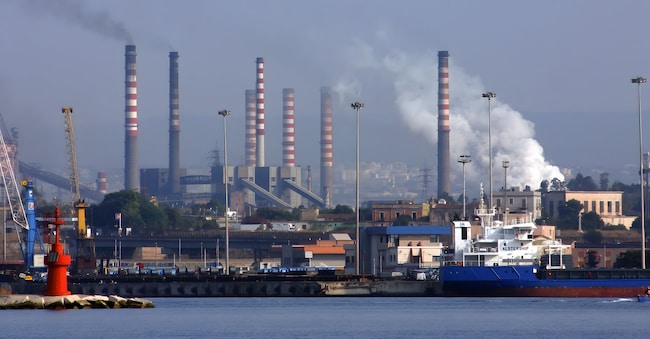
It would cost 830 million to restore the hot-end facilities at the former Ilva site in Taranto following their shutdown. This is stated by the lawyers representing Ilva under special administration, the company that owns the plants, citing the expert report by Rina Consulting in the application with which they are returning to the Milan Court of Appeal to once again request the suspension of the decree issued on 27 July – the one ordering the shutdown of the hot area within 90 days, expiring on 26 October. And this time, the application for suspension – which was already rejected on 11 September by the Milan judges – has been resubmitted on the grounds that the Court of Cassation has scheduled, for 20 October (i.e. in one month’s time), for the hearing of the Joint Civil Chambers to consider the extraordinary appeals through which Ilva and Acciaierie d’Italia – the latter being the plant operator – are seeking to have the decree issued at the end of July ‘quashed’ (appeals lodged last month by the two companies).
“It’s a mockery to shut down the plants and then be proved right by the Court of Cassation”
“It would be a real travesty if, following the public hearing before the Supreme Court (or in the days immediately afterwards), with the plan to shut down the hot-end facilities essentially complete, it were to emerge that the appeals to the Court of Cassation lodged by Ilva and AdI are well-founded,” write the company’s lawyers. “At that point, in fact, it would no longer be possible to restart the plants; instead, extremely costly and time-consuming restoration work would be required, with the consequent liabilities that might arise from such a situation.” According to the lawyers, “the Court of Cassation’s order setting the hearing date allows for a review, from a completely different perspective, of the precautionary measures sought by Ilva and AdI in their original appeals and the balancing test to be carried out in relation to the application for a stay of proceedings. Indeed, given that we need only wait a few weeks to find out whether the decree adopted by the Court of Appeal will stand up to the challenges raised by Ilva and AdI, the serious and irreparable harm that the suspension of operations in the hot area would cause to the plants undoubtedly justifies the suspension of the enforceability and/or enforcement of the decree”.
“The people of Taranto will have to wait a few weeks”
In fact, the lawyers go on to say, the other party – namely the citizens of Taranto who have joined the proceedings against Ilva – is being asked to make “a sacrifice that is certainly far more bearable than the one originally requested, precisely because it involves waiting for just a few weeks. In other words – the lawyers point out – in the new situation that has arisen as a result of the order setting the date for the public hearing before the Court of Cassation, the harm that Ilva would suffer from the enforcement of the order is incomparably greater than that which the citizens of Taranto would suffer from having to wait a few more weeks before learning the (by then final) outcome of their injunction proceedings’.
Restoration and decarbonisation costs are documented
Citing the figure of 830 million required to restart the plants, Ilva’s lawyers challenge the assertion contained in the Court of Appeal’s ruling of 11 September – which upholds the shutdown ordered on 27 July – in which the Milan judges state that “Ilva and AdI had in no way documented the costs required to restore the hot-end plant facilities following their shutdown”. Furthermore, according to the lawyers, “the assertion – which also appears in the Public Prosecutor’s opinion – that Ilva and AdI failed to consider the possibility of ‘upgrading’ the plants as an alternative (and less costly) solution to their shutdown is untenable. First and foremost, Ilva and AdI produced a report by Rina Consulting to demonstrate that it would never have been possible, within the short 90-day deadline set by the Court for the shutdown of the facilities, to remove the asbestos (note: embedded) present in the plants and to secure a revision of the 2025 AIA setting stricter limits (which, moreover, would lack any basis in the sector’s Best Available Techniques) for channelled emissions of PM 2.5 and PM 10. Furthermore, since the asbestos is located in the cowpers (the four heat recovery units that blow hot air at over 1,000 degrees into each blast furnace), but only in the cavity between the outer metal shell and the inner refractory lining, its removal is only possible by shutting down the cowpers (and therefore the blast furnace) and rebuilding them from scratch. This means that if the Court of Appeal’s order is to be complied with, there is no alternative course of action other than shutting down the hot-end plant’s facilities”. Furthermore, Ilva’s lawyers emphasise in their submission to the Court of Appeal, “the assertion that the plans for the decarbonisation of the Taranto plant” indicated by the companies refer to “generic and undocumented” arguments as there is a decarbonisation plan for the plant which AdI “submitted in August 2026 in compliance with a specific requirement”.
‘The Hague 2025’.”

