
Former Ilva: no agreement between trade unions and the company; redundancy payments confirmed for 8,622 workers
A lengthy meeting at the Ministry of Labour. The only point that was made clear is that, from 12 December, INPS will pay the CIGS allowance to furloughed staff on time

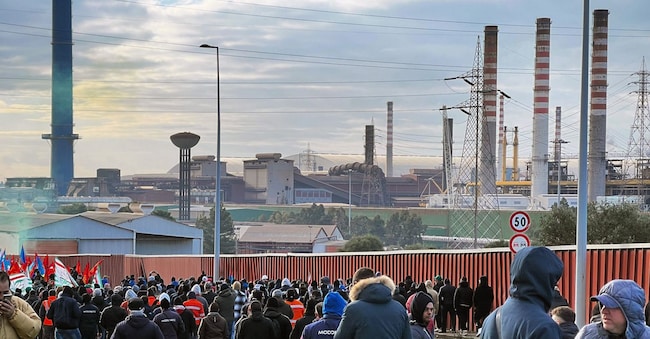
At the Ministry of Labour, the metalworkers’ unions and Acciaierie d’Italia failed to reach an agreement on the extraordinary redundancy scheme requested by the company for 8,622 employees following the shutdown of the hot-rolling mills at the Taranto steelworks. The only point clarified, after several hours of discussion, is that although INPS will pay the redundancy allowance directly to the workers – rather than Acciaierie advancing the funds as has been the case until now (an advance which will not be made as the company no longer has the resources) – the payment date will still be the same as the salary payment date. For AdI employees, this is the 12th of each month. And so, on 12 November, salaries will be paid out as normal by the company, as the accounts refer to October – a month in which work was still taking place at the former Ilva site, as the shutdown had not yet reached its peak. Consequently, the use of the redundancy fund has been lower than is expected from now on, with the factory almost completely at a standstill. From 12 December, however – and for subsequent payment dates – the INPS will take over, paying the redundancy fund directly to staff suspended from work by Acciaierie. Employees will therefore receive the INPS redundancy benefit payment, whilst on the same date they will receive a payslip from the company detailing any hours worked and the supplementary payment from the redundancy fund. The latter is funded by the State until June, is paid by Acciaierie, and provides financial support amounting to 70 per cent of their salary. The new scheme will come into effect following a decree from the Ministry of Labour and will run until next February, unless extended.
The trade unions’ positions
“Many hours of discussion” at the Ministry of Labour, but “they were useful in securing specific commitments from both INPS and the company to manage this painful and, in terms of numbers, dramatic redundancy scheme as effectively as possible,” says Guglielmo Gambardella of UILM, confirming that no agreement was reached between the trade unions and the company. “I don’t think there has ever been a dispute involving such a large number of affected workers in the context of industrial disputes arising from a crisis,” notes Gambardella. ‘The company has made a significant commitment regarding communications and the obligations it must fulfil with the INPS to ensure that payments are made on time for the upcoming deadlines. We cannot afford even a single day’s delay in the payment of the benefit.’
According to Valerio D’Alò of Fim Cisl, ‘beyond the commitments made, the future remains important. We have heard about the tender. We are pleased that there is an Italian group, Arvedi, whose stability and professionalism we are familiar with. We are also seeing other investments in the region, but we need to hold a meeting at Palazzo Chigi so that these issues can be clarified. We have called for this meeting, which is an important starting point. The social provisions regarding arduous work, as promised to us, are still missing, and the early retirement incentives are also missing; but all this is not the solution, because ‘the way out of the redundancy scheme is through work’; and in the Taranto area, ‘we need to relaunch the production of environmentally friendly steel rather than chasing after siren calls that lead only to desertification’.
“We said that the conditions were not in place to agree on a redundancy fund for 8,622 people,” emphasises Loris Scarpa of Fiom Cgil. Furthermore, he continues, “we have not received a response to any of our other demands, whether social or relating to health, safety and the environment. There is still a long way to go in these discussions. We hope that the next meeting at Palazzo Chigi will take place as soon as possible so that we can begin to shed some light on the situation.”
Finally, according to Franco Rizzo of the USB, ‘things did not turn out as we had expected. We would have liked to open a discussion on the proposals we put forward to mitigate the redundancies: early retirement incentives, recognition of arduous work and asbestos-related work, community service schemes and early retirement schemes. It would also have been necessary to examine in detail the amendments which, in our view, need to be made to the decree currently being converted into law concerning the extraordinary measures relating to the contract. None of this happened.”

