
Former Ilva site: supply chain comes to a standstill – risk of around a thousand redundancies
Collective measures are on the way following the suspension of the ‘hot zone’. Some companies have resorted to the standard redundancy scheme, and all fixed-term contracts have been suspended.

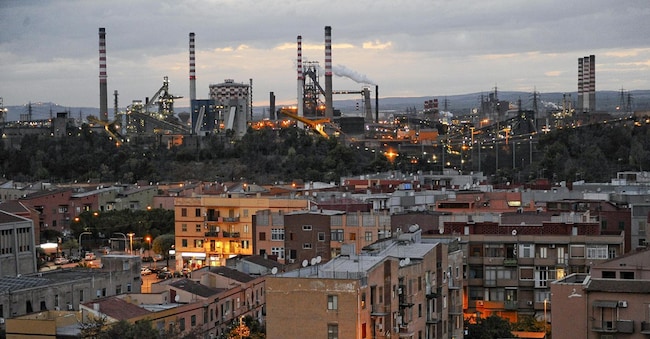
Between the start of collective redundancies and the use of the wage subsidy scheme, the supply chain formerly linked to Ilva is already feeling the first repercussions of the shutdown of the steelworks’ hot section, which, following the ruling by the Milan Court of Appeal, must take place by the end of October (90 days from 27 July). The Aigi business association has announced that ‘the redundancies will be made official in a few days’ time. To date, they affect around a thousand employees spread across three or four companies. These are companies which, seeing no possibility of the hot area restarting, believe it makes no sense to use the redundancy scheme and are initiating collective redundancy procedures. However, 30 per cent of the problem is already unfolding through the non-renewal of fixed-term employment contracts’.
As for the short-time working scheme, Peyrani SpA, a maintenance company, informed the trade unions yesterday that 55 employees would be placed on short-time working (under the standard procedure). Another company, Itelyum-Castiglia, has stated that, with the halt to production, logistics operations and the unloading of raw materials at the port – where 70 staff are employed, 16 of whom are on fixed-term contracts – will also cease. ‘This results in structural redundancies, which the company intends to address with the necessary urgency to avoid financial repercussions,’ writes Itelyum-Castiglia. Prior to these, another firm, Semat Engineering, had requested the renewal of the redundancy fund for over 200 employees following the suspension of work due to the shutdown of the coking plant batteries – a suspension that has been in place for several months now.
Sources close to Acciaierie d’Italia state that, whilst no specific date has yet been set for the shutdown of the hot end, everything that needs to be put in place ‘has already been studied, analysed and planned’. It is not something that can be done overnight, they point out, not least because a formal plan must be submitted to the Ministry of the Environment, local authorities and the regulatory bodies. And, they reiterate, a date has not yet been set.
Three meetings are expected shortly: one between the company and the trade unions to explain how and when the shutdown will take place; one organised by the Government on the future of the former Ilva site, taking into account the bids from the Italian steelmakers represented by Federacciai, the Indian firm Jindal, the American firm Flacks Group and the Czech group CE Industries; finally, another meeting convened by the Government with the Taranto Round Table regarding the area’s industrial regeneration. Meanwhile, Vincenzo Cesareo, head of the metalworking group Comes, president of the Taranto Chamber of Commerce and former head of Confindustria Taranto, has stepped forward. In a letter to the Government, Cesareo writes that ‘the moral and economic imperative must be to save the hot-rolling mill area, transforming it technologically – a task that can no longer be postponed – so that it ceases to be an environmental scourge and becomes, on the contrary, the backbone that powers the cold-rolling area, ensuring sustainable, high-quality Italian steel as well as decent employment. In this scenario,” he writes, “the exclusion or absence of local businesses from decision-making processes of such significance is unacceptable. Local businesses, which have coexisted with the plant for over sixty years and which, like the company I represent, have continued to invest substantial amounts of their own resources to promote innovation and the ecological transition of this region, have the right to be part of the process and the duty to contribute to solving the problems’. The Comes board of directors has approved one million euros ‘to participate in a consortium of businesses aimed at the acquisition and revitalisation of the former Ilva’ and hopes that other local partners will also come forward.
Finally, on the legal front, the legal action seeking to halt the shutdown has been finalised. Following Ilva’s lead, Acciaierie d’Italia has also lodged an extraordinary appeal with the Court of Cassation, and both companies have also submitted an application for a stay of proceedings to the Court of Appeal. AdI states in its appeal: ‘The Court of Appeal, by ordering the immediate suspension of operations in the hot section, has entirely substituted its own injunctions for those ordered by the District Court’ and thus ‘AdI has been deprived of the opportunity to make use of the remedial measure indicated by the Court to avoid the suspension of steel production activities’.

