
Former Ilva: 4,200 workers in related industries to receive temporary redundancy benefits. The blast furnaces remain on standby
CIGS support potentially for 9,200 direct AdI employees

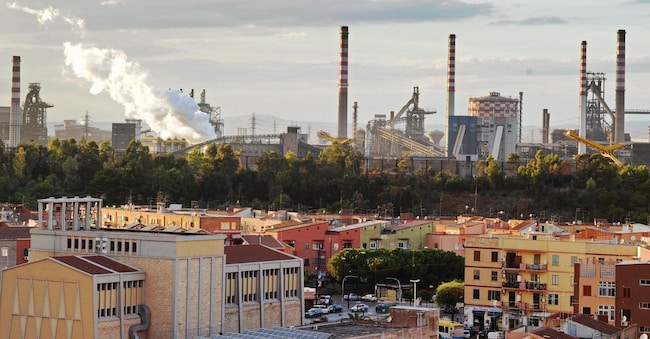
Social safety nets and the reindustrialisation of the Taranto area. At the most critical juncture in the management of the former Ilva crisis, the government is attempting to play these cards to ease social tensions, just as the pre-election phase of the parliamentary term approaches. Meanwhile, in an attempt to keep the blast furnaces operational until their future conversion to electric furnaces, the decree-law approved by the Council of Ministers also includes a provision to keep the hot-end facilities heated until the publication of the grounds for the Court of Cassation’s ruling, which will in any case not be before 15 December. Specifically, the measure will apply to coke batteries 7, 8, 9 and 12 and the Cowper stoves of blast furnaces 1, 2 and 4, which are currently being kept warm.
The measures drawn up by the Ministry of Labour have a total cost that has risen to around 138 million. They provide for the refinancing of the supplementary payments under the extraordinary redundancy fund for direct employees of Acciaierie d’Italia (AdI) for the period 1 October 2026 to 30 June 2027. The technical report indicates that the scheme could potentially be extended to virtually the entire group: ‘9,200 workers on zero-hour redundancy benefits for the entire period’. At the same time, workers will be included in the active labour market policy system through registration on the Siisl platform. The right to the allowance is forfeited if a worker refuses, without justified reason, to undertake a training or reskilling course, or if they refuse a new job offer with pay not less than 20 per cent of that paid by AdI. Workers may also be employed in public service activities.
Provision is also made for exceptional short-time working for 4,200 workers in related industries, again for the period from 1 October 2026 to 30 June 2027. Eligibility will be granted to companies that generated more than 50 per cent of their total turnover from business with AdI in the two-year period preceding 1 September 2026.
The other part of the emergency package concerns the possibility of reintegration. A total exemption from social security contributions will apply to employers who, from 1 November 2026 to 31 December 2027, take on employees from AdI and Ilva in As on permanent contracts, up to a maximum of 8,000 euros per year for each employee (there will be an additionality clause and a requirement to retain the employee for at least four years). The measures drawn up by the Ministry of Enterprise and ‘Made in Italy’ (MIMIT) also include the disbursement of the final instalment of the loan authorised by the European Commission – amounting to 40.5 million. MIMIT will coordinate expressions of interest relating to investments exceeding 10 million in the former Ilva industrial areas and adjacent state-owned land, with an Investment Plan accompanied by the appointment of a special commissioner. Projects included in this Plan will be given priority access to development contracts. The Taranto Technology Park will receive 1 million euros annually for research activities. Finally, the ‘Brindisi-Taranto’ industrial district will be established to accelerate the development of net-zero emission technologies.
The strike continues
Meanwhile, in Taranto, the strike that began on Monday continues indefinitely. The national branches of Fim, Fiom and Uilm have decided to add a further 48 hours of strike action, yesterday and today, at all other sites of the former Ilva, which had otherwise remained at the initial 24 hours. The extension of the protest is justified by the ‘lack of response from the Government’. The unions consider the new decree-law to be insufficient, as it focuses primarily on the continuation of the redundancy scheme which – as Uilm leader Davide Sperti comments – ‘is no longer a temporary measure but has become an objective’. In Taranto, the protest continued through the night, with workers and trade union representatives taking turns in shifts under tents set up in the streets to keep the main roads to Bari and Reggio Calabria blocked, along with the Eni refinery, causing problems for fuel tankers leaving the site and consequently affecting the operations of Aeroporti di Puglia.


