
Former Ilva workers from Cornigliano occupy Genoa airport
The unrest amongst steelworks employees continues

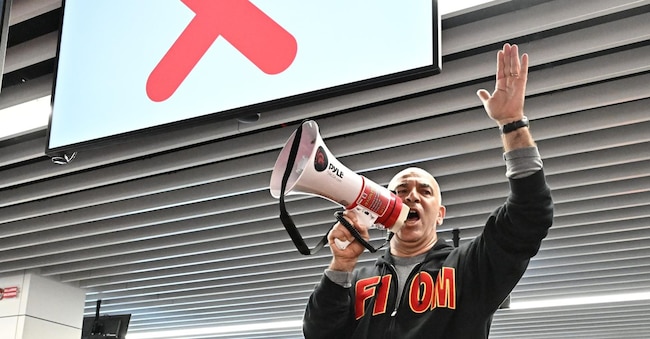
“We officially declare that the airport is occupied.” This was announced by the former Ilva workers from Cornigliano as soon as they entered the boarding area of Genoa’s ‘Colombo’ airport. The workers’ latest protest is in response to the request for redundancy payments made by the former Ilva administrators.
The all-out mobilisation aims to secure immediate responses from the Ministry following Friday’s certified email, in which the commissioners ordered an increase in wage support scheme due to the lack of coil supplies. ‘We’ll stay here,’ shouted Armando Palombo (Fiom) amidst the applause and chants of the workers, ‘until this government gives us an answer. Until the government, which appointed the commissioners, gets those commissioners in Rome to get off their arses and give us a clear, very clear answer’. The workers left a clear passageway so that the passengers present could board. Then they sat down on the ground, banging their helmets on the floor.
Late this morning, a delegation of Ilva workers was summoned to the prefecture by the Prefect of Genoa, Cinzia Torraco. The workers made it clear that the airport will remain occupied until the delegates return. ‘The communication that arrived on Friday night,’ said Stefano Bonazzi, general secretary of the Genoa branch of Fiom, ‘completely contradicts the agreements reached on Wednesday at the Prefecture. It is an insult to the workers, the city, the local institutions and the Archdiocese. We are here at the airport and we are continuing our struggle: we demand that the commissioners withdraw, amend or clarify that letter, because the shutdown of the Genoa plant is absolutely unacceptable.”
Nicola Appice, Fim-Cisl RSU delegate, echoed this sentiment: ‘We feel we are being taken for a ride by the commissioners, whose decision risks bringing the Genoa plant to a standstill even before the work already underway at the factory has been completed. We know what it means to shut down plants and we understand the difficulties facing Taranto in the run-up to the Supreme Court ruling, but indiscriminately halting both the hot and cold sections will condemn everyone to redundancy pay. In Genoa and at the plants in the north, we do not want social safety nets; we want to carry on working: we need immediate, transitional guarantees to ensure production does not come to a halt.”

