
Formula 1: Antonelli crowned world champion following in Ascari’s footsteps – he is the youngest ever
Third place in Mexico City was enough for the Mercedes driver: the first Italian to win since 1953. Ferrari split the field and Verstappen took the win

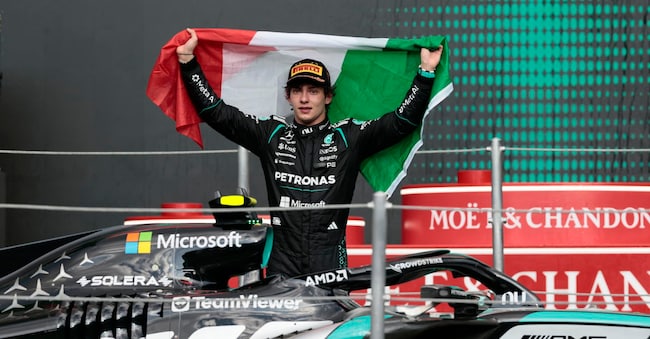
Andrea Kimi Antonelli’s (first) world title comes at the age of twenty, in his second season with Mercedes, with four Grand Prix races still to go. In Mexico City, a third-place finish was enough for the Italian: Max Verstappen took the win, ahead of Lewis Hamilton’s Ferrari. It could have been a one-two for Maranello, and a debate – far from trivial – remains open regarding the drivers’ conduct and the decisions made by the pit wall. It has been a full 73 years since the last Italian title, namely the second and final one won by Alberto Ascari in 1953.
Days of tributes and statements will follow. Among the first to speak: Stefano Domenicali, president of Formula 1, emphasises that ‘greatness is not measured solely by records, but by the generations it manages to inspire’, and notes how Antonelli has already captured the imagination of millions of fans. Valentino Rossi is more down-to-earth, accustomed to living with a level of popularity that has led millions of people to follow motorcycling: for him, Kimi “will become a global superstar; this aspect will need to be managed, but if he stays as he is, it won’t be a major problem”. Genuine, friendly and approachable – at least until he lowers his visor.
The maths suggested it was highly likely that the record-breaking world championship victory would be secured by 1 November, barring some terribly unlucky results, but the race itself was by no means straightforward – as is traditional for this complex circuit with spectators so close to the track. The high-altitude race in Mexico City – one of the most demanding of the year in terms of stress and technical decisions regarding engines and aerodynamics due to the thin air – became complicated right from the start. On the first lap, George Russell, who had started from the front row, made contact with Isack Hadjar, sending the Frenchman’s Red Bull into a spin: a ten-second penalty and a compromised race for the driver who was second in the world championship, just one point ahead of Hamilton.
Ferrari: the overtaking manoeuvre that should have been avoided
On that very first lap Charles Leclerc attacked Hamilton – who had secured his first pole position with Ferrari on Saturday – and took the lead by completing the overtaking manoeuvre outside the track limits. A five-second penalty. “He should give the position back,” Hamilton said over the radio; the pit wall left it to the stewards to decide rather than immediately restoring the order between the two. Leclerc had the right to attempt the overtaking manoeuvre, but not to retain the advantage gained unlawfully, and a team cannot manage its drivers as if they were racing for two rival teams. The figures make the decision even less comprehensible: before Mexico, Hamilton was one point behind Russell in the battle for second place, and Ferrari were trailing Mercedes by 133 points with 215 still up for grabs in the constructors’ championship. An unlikely comeback, though not impossible: enough to avoid risking a pole position start and a one-two finish with a manoeuvre bound to incur a penalty.
Meanwhile, Leclerc had built up a lead of over five seconds over Verstappen, making the most of the slipstream, but everything changed at the first pit stop, around lap 28. The pair pitted one after the other: the Ferrari driver had to serve his penalty, and the Dutchman took advantage of this to emerge ahead of him, switching to soft tyres whilst Leclerc remained on mediums. Hamilton pitted a lap later, whilst Antonelli extended his first stint until the 44th lap, temporarily finding himself in the lead. It was a strategy that might have paid off had there been an early safety car period, but instead it came immediately after his pit stop.


