Engines

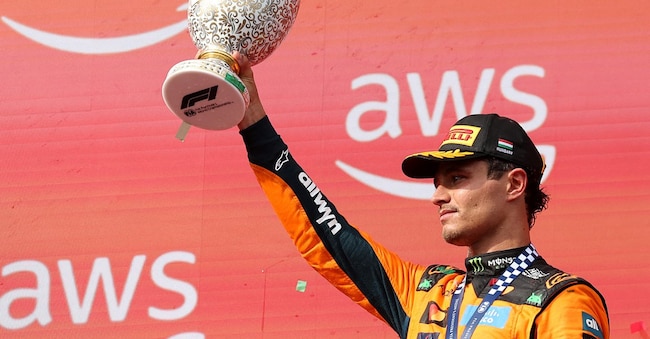
Formula 1: Norris wins in Hungary, McLaren are back in the title race

The British driver’s first win of the season following the Miami Sprint. Piastri retired, with Verstappen and Antonelli completing the podium; Hamilton was penalised and finished behind Leclerc.

5' min read

Translated by AI
Versione italiana

5' min read

Translated by AI
Versione italiana

Norris claimed his first win of the season following his victory in the Miami Sprint – the only race so far in 2026 to have eluded the Mercedes-Ferrari duo. Behind him were Verstappen and Antonelli. It could have been a McLaren one-two, but Piastri’s retirement due to a gearbox failure on lap 56 gave the struggling rivals another chance. The Ferraris were below par: they looked set for a podium finish but instead crossed the line with Hamilton in fourth and Leclerc in fifth; however, a five-second penalty for speeding in the pit lane, imposed in the closing stages, saw the seven-time world champion drop behind the Monegasque driver.

A Hungarian podium that was unprecedented given how the first ten races of 2026 had unfolded: the top three, in that order, had not yet been seen with this generation of single-seaters. Mercedes’ run of success has come to an end, at least for the time being – including from an Italian perspective – whilst the impressive form shown by the red cars in recent races and in the Hungarian qualifying sessions has been put into perspective.

Loading...

Heat, tyre wear, new developments and technical analysis were once again the key factors in this unusual Formula 1 classic. Unlike Spa, this race does not pose a particular challenge for the new hybrid power units because, as Alonso summarised at the start of the weekend, it features “just one relatively short straight and plenty of braking and acceleration phases: conditions that offer more leeway to teams struggling with their engines”. Here, the winner tends to be the driver-car combination best able to avoid wearing out the tyres, which are put under severe strain by the acceleration out of slow corners and the high track temperatures.

The race was in fact won by Norris, despite Hamilton being considered one of the favourites and having held the fastest lap for a long time, right up until the 40th lap. The British Ferrari driver was let down by a combination of factors: his grid penalty, his inability to overtake Verstappen in the early stages, and an aggressive strategy that had resulted in an undercut, which paid off for only a few moments before the advantage was wiped out. A real shame on a circuit which, for Hamilton, is the second most successful of his career and where he holds the records for wins, podium finishes and pole positions. This special connection is confirmed by the naming of Turn 4 – the most difficult and technical corner – the only corner officially named after a driver, whilst all the others remain numbered. Bad luck and penalties aside, Verstappen’s performance – finishing second against many predictions – deserves a mention, as does Antonelli’s, who was also honoured by the crowd as Driver of the Day.

A textbook-perfect start

The two McLarens got off to a good start, whilst Verstappen moved up the field, partly thanks to Leclerc’s poor start, which saw him drop from second to fifth place. Antonelli didn’t get off to a good start either, but the real disaster was Russell’s: the activation of the anti-stall system sent him plummeting down to twentieth position, an unexpected setback following the replacement of several power unit components the previous day, when he had been forced to leave his Mercedes stranded on the track.

Leclerc is also overtaken by Hamilton without being able to respond. Piastri soon gets the better of Norris, and the reigning champion struggles to keep up with the young Australian; both, however, manage to build a lead over their pursuers in the early stages. Verstappen remains very difficult to overtake, even without matching the pace of the McLarens, and slows down the Ferraris, who are faster but forced to wait several laps before passing him. After the pit stops began and following a bit of commotion caused by a brake problem for Bottas, Verstappen once again flexes his muscles in the battle with Hamilton.

A third of the way through the race, the McLarens were back in the lead, apart from the brief spell when Antonelli was in front before his pit stop. It was, however, a fleeting moment: Mercedes appeared to be the fourth-strongest team, behind the two McLarens, Verstappen and the Ferraris, with Hamilton once again ahead of Leclerc. Hadjar, too, ceases to be merely an outsider and makes his presence felt amongst the frontrunners, finally justifying the race seat he has earned in a car which, in the first half of the decade, had generally been the strongest.

After the 40th lap, when Hamilton’s lap time was smashed by McLaren, Norris confirmed what he had predicted the previous day: he felt faster than his team-mate and pulled away from both Antonelli – who had regained the lead halfway through the race – and Piastri. The Australian’s retirement deprived McLaren of a potential one-two finish and handed Verstappen and Antonelli a podium finish which, given their race performance and the form they had shown, had seemed unlikely to be within their reach.

A pole position that was anything but routine

Norris’s pole was his first of the 2026 season and brought to an end a run of ten consecutive qualifying sessions won by Mercedes. Hamilton had really been in control of the session: 1’17”219 on his first attempt in Q3, compared to Norris’s final time of 1’17”207. This was another reason why Ferrari looked set to achieve much more.

Despite the penalty, betting sites considered Hamilton’s victory more likely than Antonelli’s: for the World Championship leader, this circuit was not only new to him but had also proved challenging during the two days of practice. Hamilton, on the other hand, had already won here eight times and, with another victory, would have equalled his own record of nine wins at the same circuit. Up until Budapest, Ferrari had missed out on the podium in 2026 only in Canada, Miami and Austria.

Loading...

A rebirth that wasn’t improvised

After months of struggling with aerodynamic performance, McLaren brought a high-downforce package to Budapest, centred on a completely revised underbody. It was precisely this new underbody that improved the MCL40’s performance in medium-to-slow corners, narrowing the gap to Ferrari and Mercedes. This improvement was further aided by revised aerodynamic surfaces and a configuration better suited to the demands of the Hungaroring: less pure speed, greater precision in changing direction and better tyre conservation.

A race that stands the test of time

Forty years after its Formula 1 debut, three years before the fall of the Berlin Wall, Hungary remains a fixture on the calendar, despite never having produced a Hungarian champion. Even at its very first edition, with around 200,000 spectators, it was one of the major Western events organised in a country that was still communist; today, the crowd exceeds 300,000. The contract, renewed in 2023, guarantees the Hungaroring’s future at least until 2032 – a sign of a stability that is now rare on the world calendar.

Copyright reserved ©
Loading...

Brand connect

Loading...

Newsletter

Notizie e approfondimenti sugli avvenimenti politici, economici e finanziari.

Iscriviti