The Jeddah Grand Prix

Formula 1 returns to Saudi Arabia amid criticism of sportswashing and Vision 2030

Hosting the Formula 1 championship represents a step for the country towards conquering the global sports market, but there is no shortage of criticism, especially that of using sport to mask deeper problems

by Massimo Ruberti and Glenda Mecaj

7' min read

7' min read

The Bahrain Grand Prix, despite the double McLaren podium, was a breath of fresh air for the Formula 1 championship. With the hot temperatures of Friday and Saturday's free practice, the Woking stable had literally terrorised the competition with sidereal gaps. Sunday's race certainly confirmed a technical advantage for the Papaya stable, but one that was limited and potentially bridged over the course of the year. Oscar Piastri throughout the weekend was at ease on the Manama circuit and calmly tackled qualifying, the sprint from pole, tyre management and the restart behind the Safety Car. All easy with the best car? Just ask Lando Norris, who had a rollercoaster of a weekend.

Inexplicably qualifying sixth, he had a great first lap, recovering three positions following both an excellent sprint at the start but also an incorrect positioning on the starting grid. Mistake paid for with a five-second penalty. Engaged in his comeback, he irregularly overtook Hamilton (position forcibly returned) and, as a result of this series of carelessness, was unable to make a comeback over Russell, eventually finishing third.

Loading...

Charles Leclerc and Lewis Hamilton, at the foot of the podium, had very different performances. The upgrades on the Ferrari base improved the performance and even at the race wall the strategic decisions were consistent, although not favoured by the entry of the safety car. If the Monegasque appeared to be on the ball already in qualifying with the third time (turned into the front row by a Mercedes penalty) and then with a great rhythm in the race, the British driver who started from the ninth box was the author of a comeback race but with a race rhythm constantly slower than his teammate. The Formula 1 fans, globally, nevertheless awarded Lewis as 'driver of the day', testifying to the great affection for the seven-time world champion.

Mercedes confirmed itself as a more consistent car than in 2024, with Russell on his third podium of the season and Antonelli the author of a great qualifying but an underwhelming race. The Red Bull of Max Verstappen (sixth) suffered more than expected. Last year the Milton Keynes team dominated here with a one-two finish, while this year it struggled, never giving the feeling of being able to compete with its rivals. At least Yuki Tsunoda scored his first points in the new single-seater (ninth). Honourable mention to Haas, which brings the pair Ocon (eighth) and Bearman (tenth) into the points zone.

The drivers' classification shows signs of McLaren domination, with the Papaya pair leading and only 3 points behind. For Ferrari, still dry of podiums for the season, the classification does not inspire optimism, but the Jeddah Grand Prix can be an opportunity for redemption. Charles Leclerc has taken two podiums in the three editions held so far, always finishing on the front row (in 2023 he was then relegated due to an engine change).

IL CAMPIONATO 2025 POST GP BAHREIN

Loading...

Vision 2030: the total reorganisation of the Kingdom

.

Formula One returns to Saudi Arabia for the Jeddah Grand Prix, one of the pieces that make up the Arabian puzzle called Vision 2030. Saudi Arabia, which has always been dependent on the production and export of oil, has embarked on a path that, in addition to seeking a more diversified economy, will bring it closer to Western standards of quality of life. This strategic development plan, approved in 2016, 'aims to improve the quality of life at the individual and family level by creating an enabling environment that supports and promotes new opportunities for citizens, foreign residents and visitors to participate in cultural, recreational, sporting and tourism activities. The initiative aims to raise overall prosperity, generate new employment opportunities, diversify the economy, and strengthen Saudi cities' ranking among the best in the world.

Essentially, it is the total reorganisation of the Kingdom to position it at a higher level in both economic and human terms. There are three key objectives of the vision: improving the quality of life, strengthening the economy and creating an ambitious nation. In order to achieve these, several programmes have been initiated, comprising multiple macro-projects, ranging from financial development to health system development. These include, for example, the Seha Virtual Hospital (to provide health services through telemedicine) or the creation of cities from scratch, such as the NEOM project. In addition, each macro-project contains other programmes for more detailed aspects, divided by region and objectives.

VISION 2030

Loading...

Quality of life programme: Saudi Arabia focuses on sport

One of the main pillars of Vision 2030 is the improvement of quality of life, measured by various international indicators, including The Economist Intelligence Unit's Global Livability Index and the UN World Happiness Report. The two main levers for action are livability and lifestyle: the former refers to infrastructure and basic needs, such as security and education; the latter encompasses all the alternatives through which life can be enjoyed.

With the Quality of Life Programme launched in 2018, Saudi Arabia aims to achieve ten main goals including increasing public participation in sports and athletic activities, achieving regional and global excellence in specific professional sports, and diversifying entertainment opportunities to meet the needs of the population. Clearly, the investment of hosting Formula 1 falls within this range.

In fact, the Ministry of Sport has launched different initiatives to host international sporting events such as the Formula 1 Grand Prix in Jeddah, the Saudi International golf tournament that attracts some of the best golfers in the world, the Dakar Rally and the Italian and Spanish football Super Cup. Not forgetting, of course, the Saudi professional league that attracted Cristiano Ronaldo to the Al Nassr team in 2023, and more recently former AC Milan coach Stefano Pioli.

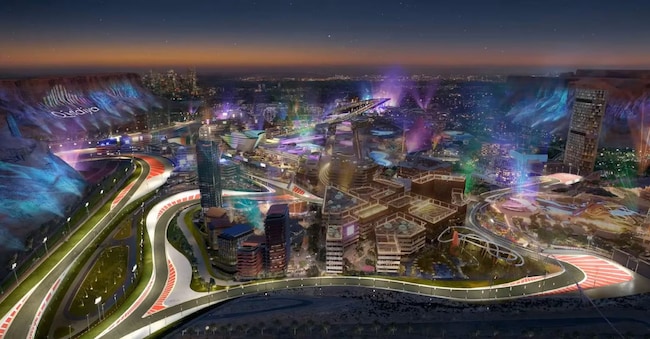
In direct competition with Jeddah, among the various projects is the new Qiddiya circuit in the capital Riyadh, which should host the Formula 1 Grand Prix as early as 2028. It would be the longest track on the calendar, with an innovative layout featuring a curve at a height of 70 metres and a difference in height between the lowest and highest point of the track of no less than 108 metres.

Not only big events but also more sport for citizens

The short-term results of Saudi Arabia's visionary development plan are encouraging.

According to the official report published by the Saudi government in 2023, several targets have even been significantly exceeded. If the penetration of the sports sector to achieve an internationally renowned position goes through major events, much is also being done to foster an increase in sports activity by citizens. In this sense, efforts to improve the quality of life have been important.

In order to increase the participation of students in motor activities, with a special focus on women, 90 new sports centres were created in girls' public schools, in addition to the implementation of the necessary equipment in 590 of the existing ones and the construction of dozens of facilities throughout the country. In addition, training programmes and sports competitions for students were created. Training services with certification and licensing and a national register of sports coaches were launched to encourage work in this field.

In the sports sector, the best figure is recorded for the number of facilities built to host sports events (2739), well above the initial target (1032). Thus, the percentage of people practising sports (37%) is higher than expected (35.9%), and the number of licences for private sports centres is higher, exceeding expectations by 21.6%. In economic terms, the programme's initiatives increased non-government investment by SAR 140 million and contributed SAR 1.5 billion to GDP.

Looking at the Human Development Index calculated by the United Nations taking into account factors such as life expectancy, education rate and gross national income per capita, Saudi Arabia records a value of 0.875 in 2022, placing it 40th. The figure for the average increase in the period between 2010 and 2022 of 0.70 percentage points is positive, showing one of the most marked improvements.

Is this really a case of sportswashing?

Despite the Saudi Kingdom's investments and efforts to rework its international image, there is no shortage of criticism, especially of sportswashing, defined by the International Journal of Advertising as 'the deliberate attempt by an entity to exploit a sports property to counter negative information'.

Indeed, while large investments to host international sports championships are clear steps towards achieving the goals of Vision 2030, they are also criticised as practices of using sport to divert attention from far more important structural issues.

As the following indicators show, Saudi Arabia lags far behind more developed countries such as Australia, the USA and Italy itself.

In fact, protection of the LGBT+ community and recognition of their rights is practically non-existent. The corruption perception rate is unfavourable at 53 close to that of Italy (56) but far behind the UK (78) (higher values on this measure indicate less perceived corruption). Among the goals of Vision 2030 is greater sustainability in the Kingdom, but Saudi Arabia currently has very negative values in terms of environmental performance with 37.90 points. The democracy indicator is clearly very low, given the absolute monarchy nature of the country.

GLI INDICATORI

Loading...

Democracy: 2021 data 

LGBT+ rights data (2025)

Corruption Data 2021 where 0 is maximum corruption and 100 is zero corruption 

Environmental Performance Data 2022 

Is Saudi Arabia using sport to improve its image? As we conclude, the reality is much more complex. The objectives go beyond the façade, but sports marketing is certainly an important tool. One must consider that it is unrealistic to expect a country with such deep-rooted traditions and institutional arrangements to close the gap with advanced democracies in the short term. Saudi Arabia is in a long-term transition process, with a programme as elaborate as Vision 2030 that takes time to show its effects, especially on the most deep-rooted problems, such as the insufficient protection of minority rights.

Moreover, the increased Saudi presence in the global sports market exposes the country to an open dialogue with values of inclusion and transparency. This mechanism can incentivise deeper changes, going beyond the logic of using sport purely for reputational marketing. The results currently achieved by the great Saudi operation are encouraging, but it will only be in the long run that one can say with certainty whether it is just a façade or whether it represents genuine progress in solving deeper problems.

Copyright reserved ©
Loading...

Brand connect

Loading...

Newsletter

Notizie e approfondimenti sugli avvenimenti politici, economici e finanziari.

Iscriviti

Tutto mercato WEB