
Formula 1 runs on cloud and artificial intelligence
From claims management to telemetry, here's how big tech like Oracle and Amazon Web Services enter the race

3' min read
Key points
3' min read
Every F1 Grand Prix, and there are still seven to go before the end of the season (the next one is scheduled for 21 September 2025 in Azerbaijan and the grand finale will be staged in Abu Dhabi on 7 December 2025), is a highly complex system, where every millisecond and every decision can make a difference. You might say it's a cliched phrase, but the work behind the scenes to manage the critical infrastructures that drive the entire 'circus', from the Web Api that enable live television broadcasts to the telemetry accessible in real time during the race, is a real and tangible example of the application of new technologies. And how vital it is to minimise risks is easy to guess: any malfunctions can impact not only the on-track performance of the single-seaters but also the degradation of the services that feed off the data, and consequently the operation of the teams in the pits (and in the laboratory) and the entertainment experience of the fans. F1 must and wants to be a perfect machine, in short, with some big names in the tech industry also playing a part.
Oracle's Llm for Complaints
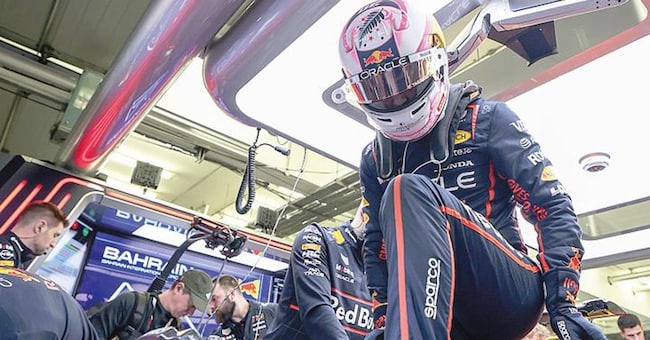
.Oracle, for example, has been supporting the Red Bull Racing team for some time and at the beginning of this season launched a pilot project that brought generative artificial intelligence to the so-called 'pitwalls', the screens set up at the pit walls on the race track. The solution combines a system of 'augmented retrieval generation', i.e. both the technique that enables the generation of content augmented by the further retrieval of information, and a large-scale language model with the ultimate aim of being able to quickly query all previous race measures and produce answers in real time. In the case of penalty complaints, for example, the system significantly improves the ability of track engineers to efficiently consult and/or adapt to regulations during the race weekend.
An innovative 'add on', confirmed by Oracle, that adds to the IT infrastructure that follows the Red Bull team through the various GPs, managing the monitors connected to the car sensors, the dashboard displays and the pit computers, all within the virtualised ecosystem in the proprietary cloud. And also in Oracle's cloud (the Cloud Infrastructure) run the various applications that guide in data-driven mode, with billions of simulations performed before and during the race weekends, both the race strategy and the development and realisation of the new engines in charge of the Red Bull Ford Powertrain engineers.
Agents Ai to solve critical problems
.All the racing teams are now working to harness the capabilities of artificial intelligence and machine learning algorithms to accelerate complex decisions, predict component wear and tear, and optimise performance and efficiency in previously unimaginable ways. Obviously, the team that is dominating the 2025 F1 World Championship, namely McLaren, is no exception. It is using AI to improve aerodynamics and reduce simulation times, and (with the IT support of Dell Technologies) to process millions of scenarios in real time thanks to edge computing systems that process data directly at the trackside, reducing the latency of information transmission. The advantage? Continuous and dynamic testing of car configurations, adapting them to race weather conditions or tyre behaviour. Another American tech giant, Amazon Web Services, is also playing its part in this work of progressively updating the car and its race performance.
Millions of data per second
.In fact, the cloud systems of Jeff Bezos' company are analysing more than 1.1 million data points per second from the hundreds of sensors installed on the single-seaters, and it is AWS that has partnered with the Formula 1 consortium to implement a solution, based on generative AI and supported by the proprietary Bedrock platform, to support engineers and developers in diagnostics and troubleshooting during a race weekend. The project led to the creation of a virtual assistant for Root Cause Analysis, the benefits of which speak for themselves: the tool is able to interrogate datasets and provide specific indications in just 5-10 seconds, cutting triage time from over a day to less than 20 minutes and the overall time for problem resolution by up to 86%. Power of LLM, and the cloud.

