
Formula 1: from past tragedies to life-saving innovations
The last Grand Prix at Spa confirmed the trend of a Formula 1 that prefers safety to adrenaline. Over the last thirty years, there has been a clear path towards making racing safer, reducing the risk of fatal accidents as much as possible. Let us look back at the introduction of the five main elements that protect drivers

7' min read
7' min read
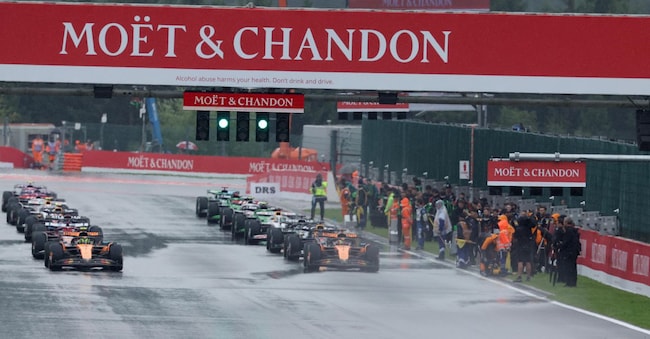
The Belgium Grand Prix showed once again how the priority of the Fia and the entire Formula 1 is the safety of the drivers and people working in the Circus. Although the whole of motorsport was born out of the adrenaline rush to push the limits, the evolution of the sporting world as a system of emotions and positive values has seen the need to avoid tragedies on live TV prevail. Thus, the rain that fell in abundance on the Spa-Francorchamps circuit could have been the spark for a crazy and fun, but also dangerous race: on a circuit that saw Anthoine Hubert lose his life in 2019, driving an F2, the preparatory championship to F1, Race Direction preferred to postpone the start and wait for the storm to pass.
After a wait of an hour and a half, the start took place on a track that was more damp than wet, and not from a standstill: so they all paraded around the first corner (La Source) and took Eau Rouge and Radillon without too much trouble, apart from Lando Norris, overtaken by Oscar Piastri with a perfect manoeuvre. The race thus developed in a very linear manner, with the few noteworthy overtaking moves made by Lewis Hamilton, author of a fine comeback when the track was still slippery. However, his Ferrari, configured for a wet race, then saw the pace fall behind Alex Albon once the track dried out. The performance of Charles Leclerc, on the podium and author of a great head-to-head with Verstappen, should be highlighted.
Ferrari was the author of a very convincing test in terms of strategy and performance. It thus consolidates its second position in the Constructors' Championship, pulling away from Mercedes and Red Bull. Heading into the Hungaroring, which, in the words of Fred Vasseur, is more congenial to the SF-25, one can hope for another good result for the Cavallino. However, to quote Leclerc, 'Ferrari has to be careful with positivity and not create the wrong expectations'. In short, one GP at a time this season, with thoughts already turned to 2026.
Fatal accidents in Formula 1: a comparison of decades
.The road to safety in Formula One has passed through many tragedies. In fact, many drivers have died while driving a single-seater, whether during championship races or test drives. The first death in a Formula One single-seater, albeit not in a race, occurred in 1952, when British test driver Cameron Earl perished following an accident while testing a single-seater in Warwickshire. The following year, American Chet Miller became the first driver to lose his life during a race weekend, namely during qualifying for the Indianapolis 500, which was part of the world calendar at the time.
In the following years, other names tragically entered the collective motorsport memory. Among them, the most remembered are Gilles Villeneuve at the wheel of a Ferrari during the qualifying of the 1982 Belgian Grand Prix at the Zolder circuit and, of course, Ayrton Senna, the three-time world champion Brazilian driver who died during the San Marino Grand Prix at Imola in 1994 at the wheel of a Williams.


