Motorsport

Formula 1: Verstappen tames the chaos at Sepang. And Antonelli extends his lead

All sorts of things happen, but in the end it’s the Dutch Red Bull driver who comes out on top, ahead of Kimi’s Mercedes and Hamilton’s Ferrari

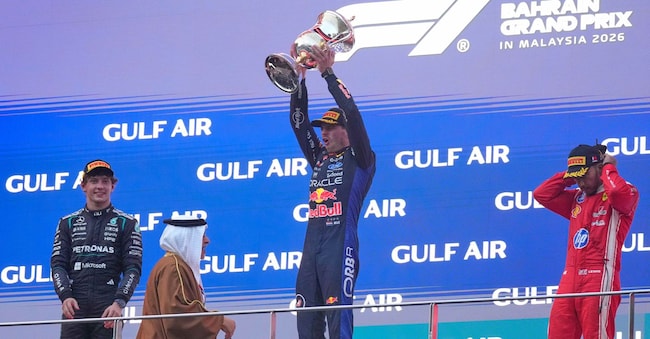
Il pilota olandese della Red Bull Max Verstappen festeggia sul podio affiancato dal pilota italiano della Mercedes Andrea Kimi Antonelli, secondo classificato (a sinistra), e dal pilota britannico della Ferrari Lewis Hamilton, terzo classificato APS

6' min read

Translated by AI
Versione italiana

6' min read

Translated by AI
Versione italiana

Max Verstappen has returned to victory at Sepang nine years after his previous win there, which also marked the final official edition of the Malaysian Grand Prix, where he finished ahead of Hamilton in a Mercedes and Ricciardo in the same Red Bull-Tag Heuer. This is his 72nd career victory, adding to a tally that had stood still since Abu Dhabi 2025 on one of the most challenging days of this season. It was a Sunday that saw Mercedes fail to be the best car and McLaren’s performance plummet.

Joining Verstappen on the podium first and foremost was Antonelli, and – performing better than he did at the Olympics – following Russell’s unexpected retirement due to technical problems, Hamilton pulled off a historic and memorable (double) surge (and Leclerc too) who, on the restart following yet another delay caused by the stationary Mercedes, managed to snatch the podium place from Red Bull’s second driver, the resurgent Hadjar, securing a podium finish that was as unexpected as it was timely for Italian morale. Italian fans, in fact, remain torn between bitterness over Ferrari’s still mediocre season – fortunately salvaged by a decisive turnaround from the seven-time British champion – and the confirmation of the rising star from Bologna, a young twenty-year-old, Antonelli, who is increasingly on course to become the youngest world champion in history. And the first Italian after a long drought spanning seven decades.

Loading...

Leclerc finished fourth, with a position handed to him – just as it was for Hamilton – thanks to Russell’s debacle and, to be fair, one he fought tooth and nail to secure so as not to be outdone by the lion with whom he shares the pit: thanks to a vehemence not seen from him for some time; indeed, the Monegasque driver too was able to dig deep and summon the energy to secure the best possible finish given his circumstances, right behind his team-mate in red. A very important performance for Ferrari’s morale but also for the world championship standings: Leclerc is now back in fourth place, a massive blow for the ‘papayas’, who see the outgoing champion in fifth and Piastri in seventh, with Verstappen today level on points with Norris and trailing only on head-to-head results.

A nightmare start: the monsoons are becoming an ever-greater threat to live TV broadcasts

Following a near-record delay of over an hour and a half due to torrential rain, the away race in Bahrain got off to a very shaky start, with the chaos leading up to the various start attempts deserving special mention: standing water, aquaplaning, Hadjar ending up in the gravel during the formation lap, followed by technical issues for both Max Verstappen and Lewis Hamilton, with the procedure suspended once again and the cars sent back to the pits. There was also confusion over the pit lane order and tyre choices as track conditions changed rapidly; Hamilton initially described the conditions over the radio as ‘extremely slippery’.

The race then completely shook up the grid. Kimi Antonelli had initially managed to take the lead and was running ahead of Verstappen, who had, in the meantime, quickly overtaken Russell. The decisive factor turned out to be tyre choice: at the same time, we saw intermediates, slicks and softs on a track that was drying out fairly quickly. Hamilton stayed on slicks, trying to capitalise on the changing track conditions; Charles Leclerc, on the other hand, lost ground in the early stages. The teams that ultimately paid the highest price were Ferrari and McLaren.

However, Verstappen’s ability, composure and determination to secure at least one victory in 2026 enabled him to quickly restore order to the race and reclaim the lead. From that moment on, the four-time world champion steadily built up his lead, whilst Antonelli and Russell settled in behind him. With no further worries and no credible rivals: Hadjar and Hamilton really couldn’t have done any better, despite the gaps being repeatedly closed by several safety car periods. Leclerc was in sixth place until Russell retired: for Maranello, after narrowly missing out on a front-row lock-out on Saturday and having two cars in the top four positions, the overall assessment is that of an opportunity squandered, particularly in terms of reading the track conditions.

Congratulations to Alonso on his tenth-place finish; he’s finally back in the points, just as he was in the Netherlands. It’s very little for a driver of his calibre, but a great deal from a personal and inspirational point of view: a driver who is already a champion and has renewed his contract for yet another season demonstrates a tenacity, strength, energy and aggression which, beyond the financial considerations that are ever-present and a priority in this sort of deal, remain exemplary and heartening for the public and his colleagues. However much it ‘suits him’, in fact, how many other drivers of the latest generation will be able to remain so hungry, capable and competitive at his age?

Bahrain races in Malaysia, Italia faces up to the taxman

The Bahrain Grand Prix was held in Sepang – some 6,000 km from Sakhir – for the first time in nine years, without changing its name: the Formula 1 Gulf Air Bahrain Grand Prix. The April race had been cancelled on 14 March, after Iranian retaliatory strikes following the outbreak of war on 28 February had reached Bahrain, including Manama. The rescheduled event stems from an agreement between the FIA, F1, Bahrain and Malaysia: according to the Sepang circuit, Bahrain pays the rights fees to F1 and collects the ticket revenue. This weekend, Stefano Domenicali confirmed to Sky Sport that both the Qatar (29 November) and Abu Dhabi (6 December) races will go ahead, based on the information and assurances received. This puts an end to the speculation and the great hope that Imola might serve as a reserve venue for the season finale. The decision was announced in an interview, rather than via an official statement, and remains linked to the situation in the Gulf. However, during Minardi Day two weeks ago – which featured over 600 classic cars, 30 Formula 1 single-seaters and a record turnout of fans for this event – it was clear that the Italian public had high hopes for this option, not least as a way to make up for the sad conclusion and cancellation of this circuit’s history in the top flight, which in 2023 had seen the final scheduled round cancelled due to the notorious flooding, with serious consequences for the entire region.

Bottas: a missed opportunity. But the message for Italia remains

“No driver really wants to race in Italia,” Bottas had clumsily remarked a few days ago, speaking out against a possible return at the end of the season for a potential ‘make-up’ race in Italia, adding that there are no taxes in Abu Dhabi. The following day, he clarified: paying tax is not a problem, provided the rules are clear; what irritates the drivers is a tax authority that has “gone back seven or eight years” regarding income they believed they did not have to declare in Italia. The case file exists. Following a complaint lodged in June 2025 by lawyer Alessandro Mei, the Bologna Financial Police investigated whether teams based abroad – that is, all except Ferrari and Racing Bulls – had paid tax on drivers’ earnings from Italian Grands Prix since 2018. According to *Il Resto del Carlino*, the tax authorities have already received almost €100 million in taxes and penalties for the 2020 and 2021 Imola races; the investigations have now been extended to Monza.

Tax incentives are, of course, a key factor in the competition to host major events. Italia had planned incentives for Milan-Cortina 2026 and a comprehensive package for the 2027 America’s Cup in Naples; the United Kingdom grants exemptions on a case-by-case basis, most recently for the 2026 Commonwealth Games in Glasgow. These are usually measures designed for large-scale ‘giga and mega’ one-off events, not for a Grand Prix that takes place every year. Monza is under contract until 2031: at the next round of negotiations, if this is the prevailing mood amongst the drivers, it will probably be necessary to take these factors into account as well; in a world where athletes are being paid ever-higher salaries, they will carry increasing weight in negotiations. It is also worth noting that tax incentives and credits are likely to be conditional on the ecological transition: in short, to qualify for them, it would be necessary to pass increasingly stringent due diligence checks regarding the elimination of carbon impact, the use of energy from renewable sources and a serious commitment to maximising sustainable mobility.

Loading...

Simoncelli: a comeback rooted in memory

Formula 1’s return to Sepang also featured a moving moment for Italians, away from the din of the single-seaters: Stefano Domenicali, President and Chief Executive of Formula 1 – who was also born in the same Emilia-Romagna region as the unforgettable rider – stopped at the point on the circuit where a plaque commemorates Marco Simoncelli, who died here on 23 October 2011 at the ‘fateful Turn 11’ during the Malaysian MotoGP Grand Prix whilst riding his stunning Honda RC212V for the San Carlo Honda Gresini team.

Copyright reserved ©
Loading...

Brand connect

Loading...

Newsletter

Notizie e approfondimenti sugli avvenimenti politici, economici e finanziari.

Iscriviti

Tutto mercato WEB