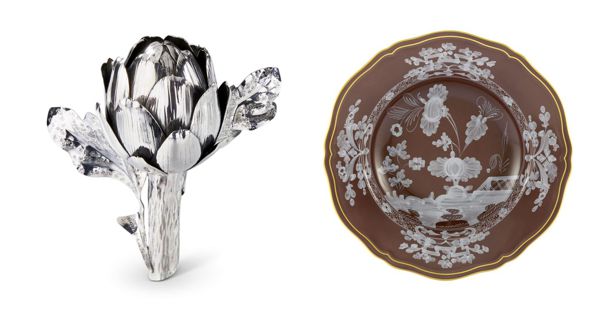
Four tales at the table: setting stories consistent with the home and style of the host
For the festive lunch or dinner, an intimate, family or public mise en scène that unfolds over four themes. Fashionable fabrics and designs, handcrafted one-off pieces, cosmopolitan curiosity cabinets, decorative maximalism.

7' min read
7' min read
Throw away your darkness and you will be rich. Like an evening after the snow,' wrote Olav H. Hauge. The Norwegian poet, translator and horticulturist had condensed the spirit of the holidays into a handful of words and an image. Light and wealth set within the walls of the home, while outside it is cold and dark and the table is the secular altar around which to celebrate.
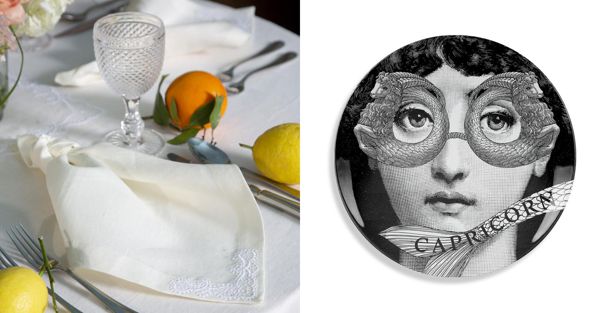
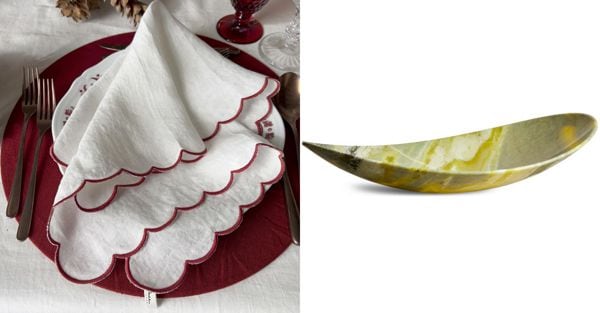
Each in his or her own way, assembling and composing, without hesitation, beautiful and precious things - plates, glasses, tablecloths and bowls - perhaps unique in their refined workmanship or craftsmanship. A personal, familiar, public mise en scène.
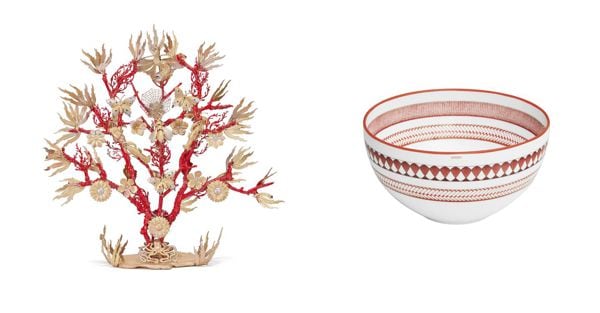
Beware of fashion, always and in any case, even at Christmas: those who seek stylish details for the table choose the unmistakable spirit of the maisons. Hermès, for example, does not miss the return to its roots in the series of precious porcelain Tressages Équestres, born from the study of the company archives, in which the designs of the products that made the Parisian workshop that produced saddles, harnesses and horse harnesses famous in the mid-nineteenth century are kept. In the hands of the French Virginie Jamin, a children's illustrator who has already signed several textile accessories for Hermès, the details of the harnesses and trimmings have been transformed into graphic motifs and refined designs that stand out against the kaolin white of the porcelain (plates from 110 euros).
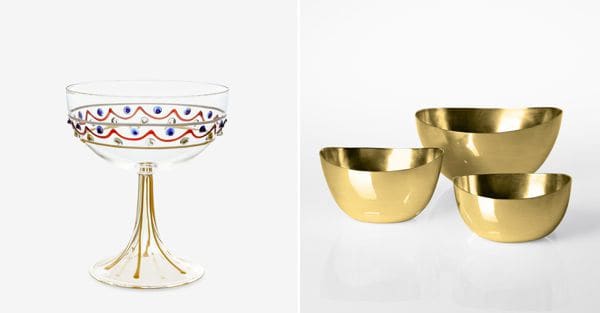
Dolce & Gabbana glasses do not escape the swirl of colours - and how could they? - of the Sicilian Carretto, an icon of the tradition so loved by the designers. In the glasses the colours are delicately interpreted by master glassmakers: they are tumblers, wine goblets and champagne glasses in mouth-blown clear glass in which the drink is embellished with polka dots and lines in coloured glass (champagne goblet, €295). If the centrepiece is to shine, the choice falls on gold, but the distilled and almost impalpable gold of Giorgio Armani: the two Ginger bowls, of different sizes, irregular and pure in their roundness stripped of all decoration, are in gilded brass, handcrafted one by one and treated on the inside with a special process that allows contact with food. They contain grapes to serve at the stroke of New Year's Eve or Mediterranean-scented mandarins to put on the table at the end of dinner, when the chatter gets more intimate and the children fall asleep. Or, even more simply, the Ginger become the luminous centrepiece of the table, in which pine branches, red berries and cinnamon sticks can be arranged like an ikebana (Ginger medium centrepiece, 95 euro). Fantasy and art also meet on the Dior table, in the guise of Pietro Ruffo's fantastic sea creatures. The Roman artist is the author of the imaginative world of Cabinet de la Mer, which inspired Maria Grazia Chiuri for the Cruise Collection 2025. A starfish, a creature from that underwater universe, with the maison's cartouche between the points, is embroidered with pictorial mastery in the centre of the new white cotton placemats (€350 each); circular and with wavy edges, they highlight each place setting or offer themselves as a romantic setting for a dinner for two under the tree.
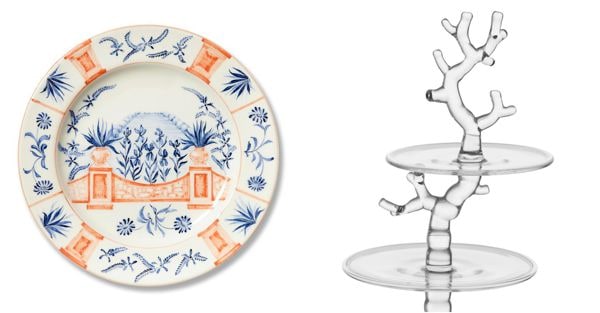
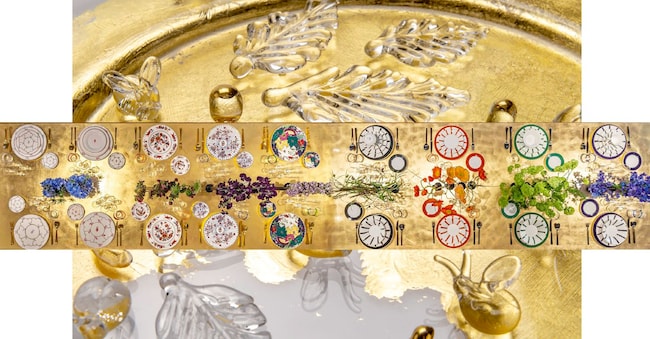
If precious is synonymous with unique, it is necessary to transform the Christmas table into a stage on which to display objects with unusual stories. Such are the creations of the Atelier of Simone Crestani, a young master glassmaker who trespasses into the field of art. His story is singular: fifteen years old, he started by chance as an apprentice in the workshop of master glassmaker Massimo Lunardon in the Vicenza area. The trade won him over, he discovered a vocation; gallery owner Jean Blanchaert noticed his work and invited him to exhibit in Milan. He is considered, today, a star of lamp-blown glass (borosilicate), the material in which the trio of pieces that make up the Coral Collection is made: a vase (730 euro), a multi-tiered riser (840 euro) and a domed riser in which transparent coral branches act as supports for the tops or as a precious handle (915 euro); they lend themselves to serving panettone or pralines in the most regal of ways.