The Europeans in France

French elections: Bardella triumphs, Macron dissolves the Chamber

After the overwhelming victory of the Rassemblement national, Macron decided to dissolve the Assemblée and call new elections

by Riccardo Sorrentino

Aggiornato alle 17:20 del 10 giugno 2024

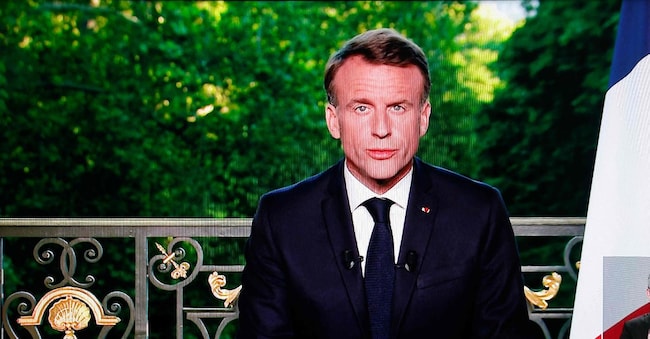
Il Presidente francese Emmanuel Macron nel discorso televisivo alla nazione in cui annuncia lo scioglimento dell’Assemblea Nazionale, la camera bassa del Parlamento francese, e indice nuove elezioni il 30 giugno. (Photo by Ludovic MARIN / AFP)

5' min read

5' min read

The Rassemblement national wins. Macron calls the polls. After the first projections of the election results, which showed the Lepenians at 32% against the 15% of Besoin d'Europe, the president's coalition, Macron dissolved the Assemblée and ordered an early vote for 30 June and 7 July. The idea is not to nominate members of the majority in constituencies where outgoing deputies of the 'republican camp' stand. "We are ready to exercise power," Marine Le Pen immediately said. Many French people, at the invitation of the ecologists and leftists, took to the streets in Paris against the dissolution of the lower house.

Macron: 'France needs a clear majority'

"This decision is serious," the president said. "It is above all an act of trust," he added. "It is worth more than any plea bargain, than all the precarious solutions" The president added that he had "confidence in France, to design the future and not retreat. I have listened to your message and I will not leave it unanswered. At this moment of democratic truth, and despite the fact that I am the only politician with no personal electoral deadline, I know I can count on you. France needs a clear majority, in serenity and concord. Being French means, after all, choosing to write history rather than suffer it'.

Loading...

"Not a good result for Europe"

.

Macron also said that 'the main lesson is clear: this is not a good result for parties that defend Europe'. 'In France,' he explained, 'the representatives of the extreme right reach 40 per cent of the results expressed. It is a situation I cannot resign myself to'. The president's idea, according to the Minister of Europe and Foreign Affairs, Stéphane Séjourné, is not to present candidates in the constituencies where outgoing deputies from the 'republican camp' are standing, in order to create a broad coalition and isolate the radicals.

Macronians stop at 14.5%

.

Provisional but complete figures from the Ministry of the Interior show Marine Le Pen's party, led by Jordan Bardella for these European elections, in first place with 31.5% and 30 seats. It got more than twice as many votes as Besoin d'Europe, led by Valérie Hayer, which stopped at 14.6%, with 13 seats out of the 81 earmarked for France. The differences with the 2019 vote are important: five years ago the Rassemblement national, led by the then 23-year-old Bardella, had obtained 23.3% of the vote and 23 seats, while the Macronians were second with 22.5% and 23 seats.

Bardella: Macron renounces pension de-indexing

Immediately after the first projections, Bardella called for new legislative elections. 'The president of the Republic cannot remain deaf,' Bardella said, 'He must give up the agenda he wants to implement, such as the de-indexing of pensions. Emmanuel Macron is a weakened president. He is limited in his means of action in the European Parliament. The President of the Republic must decide to defer to the institutions. We ask him to organise new legislative elections'.

Marine Le Pen: 'We are ready to exercise power'

.

Marine Le Pen hailed Macron's decision, which puts her back on track after months in which she was eclipsed by the young leader, claiming her party's role in Macron's decision. "The vote of the French is unequivocal: the president, responding to Jordan Bardella's appeal, has just announced a return to the polls." "We are ready to exercise power _ he added - ready to put an end to this mass immigration, to make purchasing power a priority, ready to revive France."

Europee, Marine Le Pen vota al seggio elettorale di Hénin-Beaumont

Glucksmann: "Why obey Bardella?"

.

The socialists of Reveiller l'Europe, with the Raphaël Glucksmann leader, obtained 13.8% of the vote and 13 seats, against the 6.2% and 6 seats won in 2019 by a broader coalition than the current one (which includes only Ps and Place Publique); however, it misses by just under 200,000 votes the undeclared but long pursued goal of coming second. The leader immediately criticised the president's decision to call the polls: 'I don't understand why we obey Bardella,' he said, 'It is very dangerous.

Left: electoral pact for the legislature

It was followed by the socialists La France Insoumise, of the radical left, which gained 9.9% and 9 seats, up from 6.3% and 6 seats in 2019. Jean-Luc Mélenchon's party immediately called for a pact for the left with the greens and communists, to retrace the experience of the cartel in 2022 that came in third place one step behind Rn. Les Républicains, heirs of the neo-Gollist tradition, obtained 7.2% and 6 seats. In 2019, in what had appeared to be a major defeat attributed to the choice of adopting certain themes of the populist right, they had obtained 8.48% and eight seats.

The collapse of the ecologists

.

In 2019, the third party had surprisingly emerged as Europe Ecologie with 13.48% and, potentially, 13 seats. This year, the Greens led by Marie Toussaint stopped at 5.5% and 5 seats, ahead by less than three thousand votes of the Reconquête's radical right ( Eric Zemmour and Marion Maréchal), at 5.5% and 5 seats (it was not present in 2019).

The coalitions

.

Based on the votes, the left - corresponding to Nupes, the electoral pact of 2022 - obtained, taking into account also the communists who did not reach the quorum, 31.5%, and 26 seats, against 28.5% in 2019. The radical right won 37%, and 35 seats, against 23.3% (plus Debout La France's 3.5%). For the first time, pro-European parties, at 41.5%, are in the minority.

Votes in big cities

Some large cities show a completely different landscape compared to the national vote, confirming the clivage between urban centres and the countryside, which is deepening more and more. In Paris, the first party was the Ps, with 22.9%, followed by Besoin d'Europe (17.7%), La France Insoumise (16.7%), Europe Ecologie (10.7%), the Républicains (10.5%) and finally the Rassemblement nationale - which is, however, first in the Ile de France - with 8.5%. In Marseille, Rn is first with 30.1%, followed by La France Insoumise (21.5%), the Ps (11.5%), Besoin d'Europe (10.3%), Reconquete! (6.9%) and the ecologists (5.6%). In Lyon, governed by the Greens, the leading party is the Ps (18.8%), followed by La France Insoumise (17.2%), Besoin d'Europe (15.8%), Rn (13.5%) and Europe Ecologie (11.2%). In Toulouse, the fourth largest city in the country, the Ps is the first party (21.4%), followed by La France Insoumise (19.7%), Rn (13.6%) and Besoin d'Europe (13.1%).

Party consensus: percentages of eligible voters

.

The official French data, unlike the Italian ones, also indicate the percentage of votes obtained with respect to the number of people entitled to vote: an irrelevant datum to assess the weight of each party, it is instead important - especially in the European elections, where voting is by single round and with a proportional system - to assess the actual consensus of the political forces and the role of abstention, which was 48.2%, compared to 49.9% in 2019. Out of one thousand people entitled to vote, 159 voted Rn, 73 the Macronians, 70 the Socialists, 50 La France Insoumise, 37 the Républicains, 28 the Greens and Zemmour's Right.

Copyright reserved ©
Loading...

Brand connect

Loading...

Newsletter

Notizie e approfondimenti sugli avvenimenti politici, economici e finanziari.

Iscriviti