European Defence

France wants to join British-German long-range missile project

Paris has expressed its interest in participating in Berlin and London's long-range precision strike programme. The three countries hope to hold trilateral talks on the subject in early June

4' min read

Translated by AI
Versione italiana

4' min read

Translated by AI
Versione italiana

France intends to join an Anglo-German plan for the production of new long-range missiles. This was exclusively reported by the Financial Times. Paris has expressed its interest in participating in the long-range precision strike programme of Berlin and London, in a move that is part of a broader French-German defence dialogue. The three countries hope to hold trilateral talks on the subject in early June.

The programme, announced by the UK and Germany in 2024 as the spearhead of their defence agreement, aims to produce a family of advanced land-based missiles with a range of over 2,000 km, capable of hitting military targets within Russian territory.

Loading...

The issue took on new urgency after Donald Trump cancelled plans to deploy a battalion equipped with Tomahawk missiles and other long-range weapons at a US base in western Germany. The project, dating back to the Biden era, had been conceived as a temporary solution while waiting for Europe to develop its long-range precision strike capabilities.

A weakness of European armies

European nations possess some conventional missiles with a range of about 300 km or more, but these are almost exclusively launched from aircraft or ships. This means that European fighters, warships or submarines would have to enter disputed waters or airspace to strike targets deep inside Russian territory.

But Moscow's extensive use of land-launched missiles in Ukraine, as well as the deployment of long-range weapons in the Kaliningrad enclave on the Baltic Sea, has prompted European nations to seek to develop similar capabilities in the hope of helping to deter Russian aggression.

Paris's interest also reflects President Emmanuel Macron's growing conviction that the development of advanced conventional weapons would be a valuable complement to France's nuclear deterrent.

Paris again concerned

Although France had initially been involved in talks with Germany and the UK to collaborate on the development of a long-range strike capability, Paris had later backed out due to the ongoing debate over its nuclear doctrine.

In a speech in March 2025, Macron outlined how France could implicitly protect its neighbours with its nuclear deterrent, announcing talks with six countries willing to participate, including Germany. However, he also emphasised the importance of long-range missiles, air defence and surveillance to manage escalation "before the nuclear threshold is crossed".

French officials concluded that joining the Anglo-German programme would help 'reduce the gap' between conventional and nuclear deterrence.

The Anglo-German long-range precision strike proposal, which is part of the six-country project known as Elsa, still remains at the conceptual stage. The two countries have agreed to include in the programme stealth cruise missiles and hypersonic weapons that travel at very high speeds on unpredictable trajectories, making them difficult to track. The initial focus will be on ground-launched systems.

The companies involved

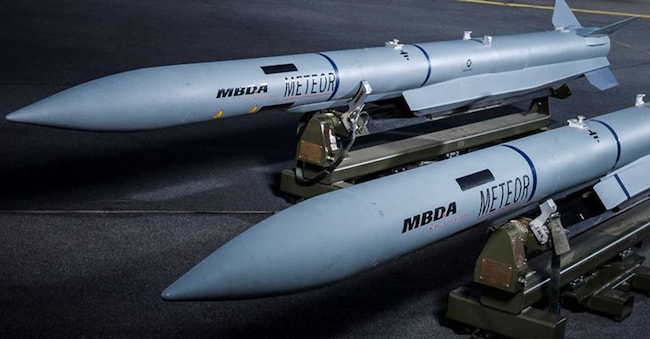
Among the companies involved in the Anglo-German discussions are the pan-European missile manufacturer Mbda and the Anglo-German start-up Hypersonics, which announced in February that it had become the first privately owned European defence company to successfully complete a hypersonic test flight.

Paris proposes that ArianeGroup, jointly owned by the European aerospace group Airbus and France's Safran, could join the programme to provide carrier rockets capable of launching hypersonic weapons into the Earth's atmosphere. Ariane currently produces the M51 ballistic missile for the French nuclear programme.

French officials believe that their involvement in the programme could accelerate the development of the new long-range missiles, which, according to the UK and Germany, are expected to enter service in the early 2030s and will be among the most advanced missile systems ever designed. Macron had hinted that he was interested in joining the Anglo-German programme, explicitly citing the two countries as partners with whom he wishes to collaborate in the development of advanced long-range weapons. "This will offer new options for conventional escalation at a time when adversaries are deploying new technologies and weapons," he said.

A joint Franco-German statement, published after the speech, also pledged to develop capabilities that include precision deep-sea attacks.

German Defence Minister Boris Pistorius gave the first explicit acknowledgement of French interest in the Anglo-German programme earlier this month, stating: 'Now the French want to join us, and do it as soon as possible.

Berlin's OK, London's doubts

Berlin welcomes the accession of Paris with enthusiasm. In London, however, there is some apprehension among some officials about the possibility of France joining a project that has been discussed with Berlin for more than 18 months.

Some fear that the entry of a new partner with its own weapon concepts, as well as its own industrial interests in the defence sector, could debilitate the project. A number of Franco-German defence collaborations have failed due to political and industrial tensions, including the project to build a joint combat aircraft under the Fcas programme, which is on the verge of collapse.

However, the UK and France together successfully developed the Storm Shadow/Scalp missile, which entered service in the 2000s.

Together with Germany, the three countries represent the largest economic and military powers in Europe and have a long history of cooperation on national security issues.

Copyright reserved ©
Loading...

Brand connect

Loading...

Newsletter

Notizie e approfondimenti sugli avvenimenti politici, economici e finanziari.

Iscriviti