
Francesco Guccini, the great singer-songwriter from the Via Emilia to the West, has died
The artist passed away at the age of 86 at his home in Pavana. His songbook is a cornerstone of this country’s culture and collective imagination

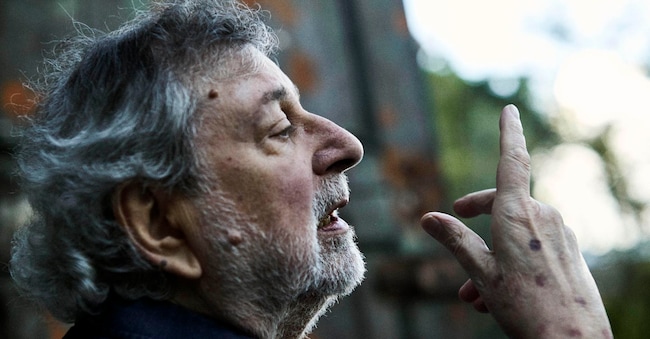
God is dead, Francesco Guccini too, and we’re not feeling too great either. This is a historic moment, the emotion is intense: we could say so many things, but in the end we’ll get by like this, quoting – or rather paraphrasing – Eugène Ionesco. Because with Francesco Guccini we are losing one of the greatest singer-songwriters in the history of Italian music, to be sure; a poet of the little things, a chronicler of the grand dreams of students living away from home and of the sense of inferiority in our province; an ideologue, albeit unwittingly, of the orthodox Italian left (that is, the Tuscan-Emilian variety), a friend to anyone who rang the doorbell at 43 Via Paolo Fabbri to have the lyrics of Canzone quasi d’amore explained to them or to argue about the Bolognina turn; a fairly revolutionary reformist somewhere between the Via Emilia and the West, but above all a master of paraphrase and quotation.
Because the artist – who passed away today at the age of 86 at his home in Pavana, surrounded by the love of his wife Raffaella and daughter Teresa – over half-century-long career, starting out as a voracious reader and listener, was able to build a songbook that has become a fundamental part of the culture and the collective imagination of Italia. He consistently reworked what he read and listened to.
He had a community behind him – a privilege few artists can claim – and it is to his community that his first thoughts go: forget about funerals in the square, raised fists and flags fluttering in the wind, for we are people of the Apennines and, besides, it is no longer the time for such things. ‘In accordance with the artist’s wishes’, ‘the funeral will take place in the coming days and will be a strictly private affair’. The family, ‘in asking that this time of grief be observed in the strictest privacy, would like to thank all those who will join them in their mourning with affection, discretion and respect. To allow those who loved him to remember and bid him farewell, a memorial service will be organised in September’. Guccini’s followers, true to the Maestro’s teachings, will understand. How true it is that one could rewrite his biography word for word, simply by quoting and paraphrasing his lyrics.
The Maestro’s life is a story that epitomises the history of this country. Born in Modena just a few days after Fascist Italia entered the Second World War, Guccini was still in nappies when his father, a postal worker, was called up for military service, and he and his mother were evacuated to Pavana, the town of his paternal grandparents in the Tuscan-Emilian Apennines, to which he would remain attached for the rest of his life. As he grew up, he would come to realise that his father had spared himself nothing, not even a stay in a concentration camp.
He returned to Modena (‘Small town/rotten place’) after the war to study: he qualified as a primary school teacher at the Sigonio Teacher Training College. He tried his hand at teaching, working as a journalist for the *Gazzetta di Modena* and even as an advertising executive during the *Carosello* years, but all the while he played the guitar and wrote songs. He entered the music scene, at the height of the protest movement of the mid-1960s, almost reluctantly, first as a songwriter for Caterina Caselli and the beat bands of the Modena scene Equipe 84 and Nomadi , which led to the success of Auschwitz, Per fare un uomo, Dio è morto, and Noi non ci saremo. At the same time, under the name Francesco, he made his debut with Folk Beat N. 1 (1967) and became, to all intents and purposes, a singer-songwriter (“I too rebelled against the system / that is, dreaming of Dylan and the Provos”).


